Haha. I have cats too. But think how the dogs dealt with it in times past. Such a weird name. I often wonder what the people that made that mental decision were thinking. A more psychopathic time perhaps.
The earliest record of 打狗 is probably in the 1603 Dongfan Ji (東番記 Records of Farangs to the East) written by Chen Do (陳第):
東番夷人不知所自始,居彭湖外洋海島中。起魍港、加老灣,歷大員、堯港、打狗嶼
Here Takao sū (打狗嶼) refers to an island, which later is also known as 打鼓嶼. Originally, there was a huge rock between what Europeans recorded as Saracen’s Head (present day Kî-āu-san 旗後山) and Tankoya (present day Shoushan 壽山), and that rock was known as 打狗嶼.
The hills to either side were also known as 打狗山. 打鼓山 was then shortened to 鼓山 by the Chinese immigrants, and the hill across the bay was renamed Kî-āu-san (旗後山) as Chinese word play (旗鼓相當). The locals also called it Tshâ-san (柴山 firewood mountain). It was renamed Kotobuki-yama (壽山) to suck up to Crown Prince Hirohito who stayed there on his birthday when he visited Taiwan in 1923. On Chiang Kai-shek’s 1968 birthday, the mountain was actually renamed to 萬壽山 to suck up to him. It was only changed back to 壽山 in 1991.
The name then can be seen throughout Dutch records as Tankoya, Tancoia and many other ways of spelling the place. For 打鼓山 they often wrote it as Apen Berg, for reasons still obvious today.
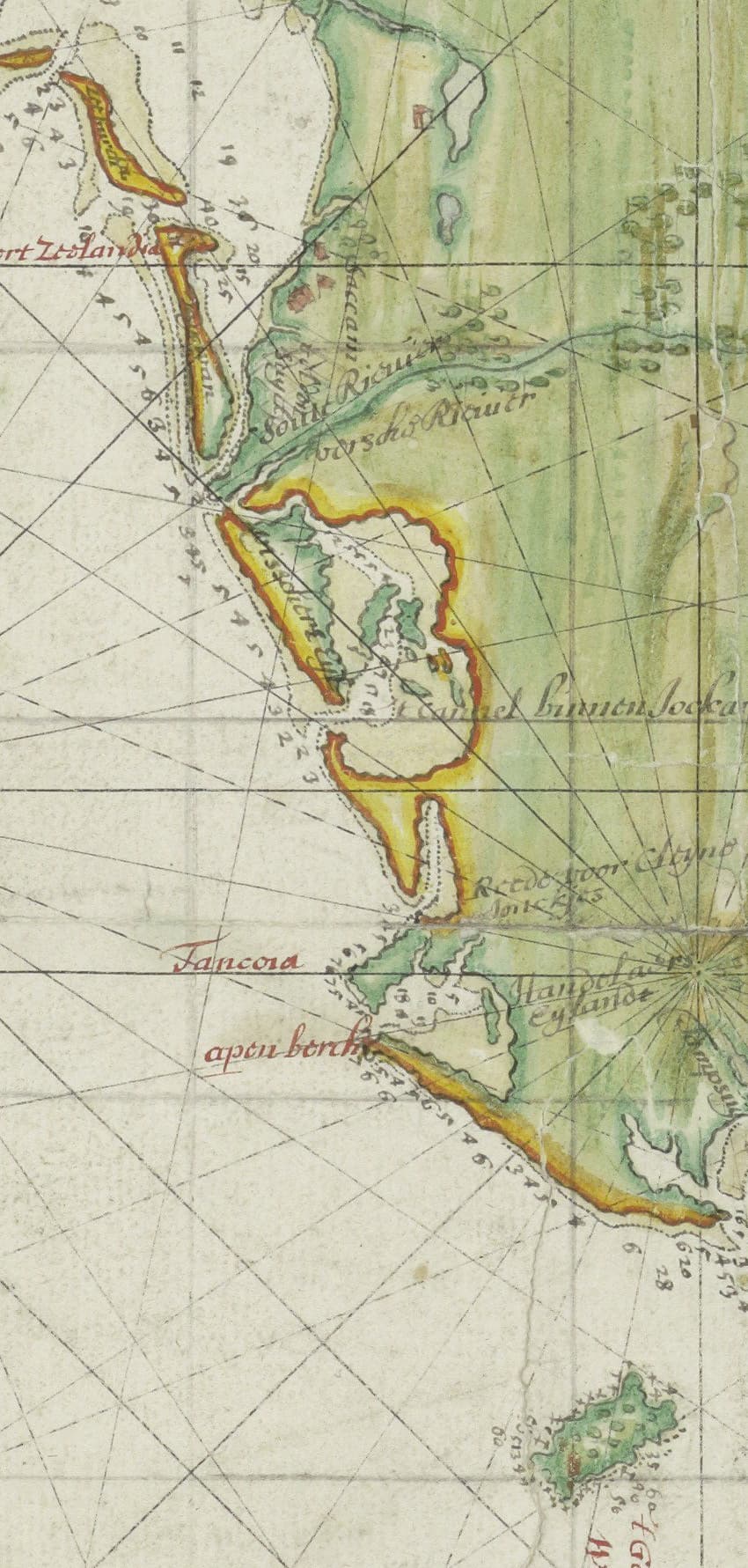
The Dutch recorded it as Tancoia in the 1640 Dutch map of Het Eyland Formosa & Pisca Dores.
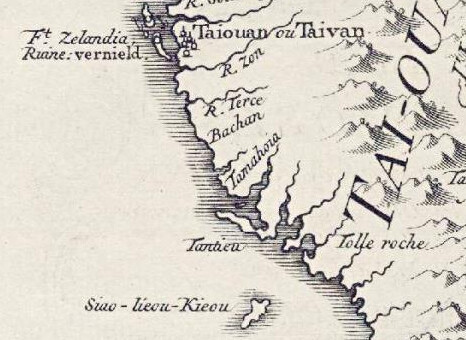
Also as Tankeu in the 1749 Kaart van Formosa. Eiland Formosa, met een Gedeelte der Kust van China.
2 Likes
Back on topic. I recently started trying to do Taigi-only days with my friends who can speak it decently, which has helped my fluency and exposed lots of little gaps and situations where I’m not used to expressing myself. I would definitely recommend something like this if you find yourself plateauing.
From some linguistic reading, I know there are places in Ireland which will advertise things like “discount if you order in Irish”, and coffee shops might have an “Irish corner” where there’s a part of the shop where customers can come in and speak Irish. Is there anything like that in Taiwan? I know about Tai-oan e tiam, I’m curious if there are cafes or bars that lean into Taigi or Hakka.
1 Like
There is no discount, just shops with stickers that say 𠊎講客 on the door or behind the counter. That I think is a Hakka Affairs Council 's government program. Since there isn’t a council for Taigi revival, there have been NGO pushes to have a similar thing going for Taigi, but it is far less prominent. Although, it just lets the customer know the shop keepers are willing to converse in their native language of choice, no discount whatsoever.

2 Likes
Great, thanks. I think I’ve seen that around once or twice but didn’t know exactly what it was.
To be clear, I wasn’t asking specifically about discounts, more about the general idea of cafés or bars having e.g. a “Speak Hakka/Taigi” corner or specific staff who can speak the language(s) on certain days. I guess maybe akin to the dime-a-dozen English “language exchange” activities I see around Taipei, but for Taiwanese languages.
always respect the knowledge, I didn’t know any of that long history of the names, pre japan. But even so, history and all, “hit dog” is a bad name. I mean, objectively. It looks and sounds bad. Deserves being changed. To what, I agree they could do better. BBQ cat? “I dunno”. Hehe, But keeping that name is a terrible idea. Albiet they likely didn’t have morals either in mind at the time. I suppose.
In my opinion, we just can’t name big cities literally “animal abuse”, that’s a truly terrible idea. Call me crazy, but fuck historic norms, we can evolve and be better than our second biggest city being called beating a dog  it’s just a bad idea, moving forward…
I asked the family what the taiwanese word is for hitting dogs (in order tonstay on topic of learning taiwanese). Doesn’t sound better Hehe. To be honest though, written form of taiwnaese has only been recently taught so I don’t know how to type it. And this topic is so gross that I don’t want to ask my kiddo, who learns written form in school now, to correct me. Us old farts actually don’t know how to wrote it down. But I am curious actually. What does “hit dog” in taiwanese look like in written form?
That’s the other issue. In Taigi, hitting dog would be phah-káu (拍狗), and not tánn-káu (打狗). In fact, 打 does not have the meaning of hitting or beating in Taigi, unless it’s referring to borrowings from other Sinitic languages.
In Taigi, 打 has the meaning of do, act, commense, buy things with money, or give ball park estimates. Think 打算. Instead of saying tánn for hitting, the closest thing would be tainn.
So at least in Taigi, 打狗 is mostly a nonsensical phonetic transcription.
1 Like
But the other evidence (Dutch maps) suggests that “打狗” was more accurate phonetically, is that correct? Is there other evidence of “phah-káu” being used?
Yes. The Makatao village located at the entrance of the bay was called Tankao, judging by both the Dutch records and the Tánn-kau (打狗) phonetic translation. 打狗 was an accurate phonetic translation, but even if 打 doesn’t mean hit in Taigi, or Foochow (Mindong language family, spoken by Chen Di 陳第, the author of 東番記 Records of Farangs to the East), they really could have chosen something other than 狗 for kau. The disrespect for the indigenous peoples was in that translation, whether 打 meant hit or not. Then again, 打狗 was the name that was used for 400 years, and the original Tánn-kau was even older.
Interestingly, by the Qing era, the Paiwan people would also refer to the Makatao people as Pairairang, which also sounds like an adaptation for Farang. If that’s the case, the word pairang often reserved these days for Han Taiwanese and often transcribed to 白浪, probably also started as an adaptation for Farang, instead of it being a borrowing from pháinn-lâng (歹人). Or… could it be pháinn-lâng was yet another word derived from Farang?
2 Likes