No, no. That still works. It was intended for them, you could say. It would be a rather delicious irony if they happened to cut themselves on a blade made from US shells sent to fight the commies all these years later.
Well in all honesty I learnt on wide combs. I wonder how many other 'mosans grasp the significance of that? I’m confident of the the fox and your good self.
And by the bye, that beer I owe you is killing my credit rating. I hope we can settle accounts when I’m back in the 'bei - 4 April - 10 April, although a country jaunt is a must.
If they’re just old US shells and I can buy them in Taipei, I’ll do that and ponder another trip into wa galligong land for Ms Huang.
Maybe I’ll thread that query into a proper, erh, thread?
Cool - while your at it, go to a building materials store and get yourself two sharpening stones…medium & fine…you’ll be able to keep those babies razor sharp forever. It’s cost you about 300 NTD.
Sorry to dig up an old thread (by the way isn’t it funny how even HGC’s older threads end up being about sheep shagging?)
Anyway, I was wondering if any of you fine folks have tried Kanetsune knives? I was in HsinChu yesterday and the knife shop I found there had a few for sale. I did a bit of Googling today and they seem pretty decent. I also like the fact that they look a bit Eastern in style.
There’s a temporary stand in the Global Mall Jusco in Zhonghe selling knives from Jinmen. This is the brand with the cartoon-character logo. While that might not project quite the image of toughness, the knives seem good.
On Saturday I bought a knife with a 7-inch Damascus steel blade for NT$2,500. There was only one other Damascus steel piece left (an 8-inch knife, for a little more money); but it’s probably sold by now.
There were lots of nice cleavers and knives left – at a 20 percent discount or so.
Note: Jusco closes for good in three weeks, and the stand will probably be gone before then.
My knives have turned out a tad disappointing. I strongly suspect they were only meant for display, as the knife edges seem to rust very quickly and require constant sharpening.
My knives have turned out a tad disappointing. I strongly suspect they were only meant for display, as the knife edges seem to rust very quickly and require constant sharpening.
And by the way, Irishstu stinks! :raspberry:
HG[/quote]
That would be true for any high carbon steel blade. I can show you a knife that basically is black and rusts if you look at it funny.
My knives have turned out a tad disappointing. I strongly suspect they were only meant for display, as the knife edges seem to rust very quickly and require constant sharpening.
And by the way, Irishstu stinks! :raspberry:
HG[/quote]
That would be true for any high carbon steel blade. I can show you a knife that basically is black and rusts if you look at it funny.[/quote]
What he said, but actually I can’t understand why that can’t hold an edge. Usually that’s the trade-off with knife metal… high carbon = good edge, but goes rusty if you are a BAD OWNER, and lower carbon is more rust-free, but not such a good edge.
Lads - edge holding ability can be based on a number of issues.
Composition of blade is not really all that big of a factor.
How the blade is ‘sharpened’ - the type of grind angles is probably the most important.
There are several different blade angles used for sharpening a blade for different usage purposes. A long tapered grind is excellent for ‘razor-like’ sharpness, but it is easily dulled due to it very small edge area. A greater angle edge with a stronger support is called for when chopping or prolonged cutting of hard material.
Think slicing meat (not chopping bones) vs chopping wood for examples at both ends of the spectrum.
And the compromise grind is just that - a compromise for most general needs.
Next would be what the blade is being used for. What type of cutting and/or chopping is the blade being used for and what material is being cut/chopped?
This is a determining factor in maintenance of an edge.
Re:rust - unless your talking about some of the ceramic blades - rust will happen.
Keep your blade clean and coat it with a light oil, r water-displacing lubricant - and rusting will not be a problem.
Also,leather sheaths are terrible places to store a knife. The oils used in the leather will damage the blade metal.
Synthetic ‘canvas-type’ sheaths are better. Kydex sheaths are best for high humidity areas.
irishstu -
Well, since you understand the term ‘grind angle’ what I wrote in the previous post about covers the basics.
Use the right angle for the intended use.
Small angle for razor-type edge - which will be easily dulled.
Greater angle for stronger edge for harder to cut objects - which will last longer.
Use a bit of water or a light oil on the blade when sharpening it. A bit of spit will usually suffice in a pinch. Clean the blade during and after. Clean the stone to remove metal bits after use.
Coat with a light oil or water displacing lubricant and remember - “Its a tool for cutting - NOT A PRY BAR or Screwdriver”…
I was in Helsinki last week. Check out THESE beautiful knives that I saw there, made by the Marttini family since 1928. And HERE are some similar knives from Sweden. Maybe not macho, gut splitting, freedom defending, psycho commando knives, but they look great for fishing, hunting and carving.
[quote=“TainanCowboy”]irishstu -
Well, since you understand the term ‘grind angle’ what I wrote in the previous post about covers the basics.
Use the right angle for the intended use.
Small angle for razor-type edge - which will be easily dulled.
Greater angle for stronger edge for harder to cut objects - which will last longer.
Use a bit of water or a light oil on the blade when sharpening it. A bit of spit will usually suffice in a pinch. Clean the blade during and after. Clean the stone to remove metal bits after use.
Coat with a light oil or water displacing lubricant and remember - “Its a tool for cutting - NOT A PRY BAR or Screwdriver”…[/quote]
Cool. but what I was really after was what you usually grind it with.
A stone, I see, but if you have any more info on that, I’m curious to know. I have a stone, with two sides, one a bit rougher than the other (for obvious reasons). Is that what you recommend, or do you like those new-fangled diamond coated thingmajobs?
Also, I’ve been taught to sharpen in a clockwise movement for the left side of the blade, and anti-clockwise for the right-hand side. Does that more or less describe your technique?
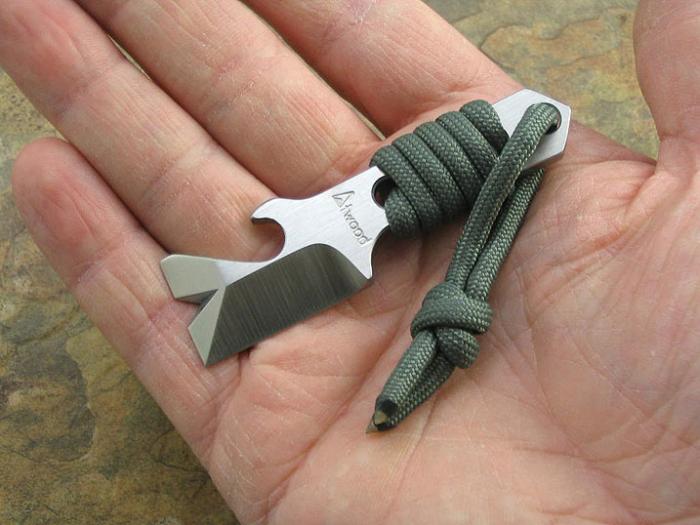
P.S. On the subject of pry bars, I thought you might be interested in this guy’s cool tools: atwoodknives.com/home/index.php


 [/quote]