A small step forward. The plant in question is in Hualien.
Guy
A small step forward. The plant in question is in Hualien.
Guy
The thing is, Zhanghua, where Google’s server farm is located, absolutely has geothermal potential. The place was called Sulphur Creek (磺溪), and had one of the most famous hotsprings back in the Japanese era. Google totally could have developed a geothermal power plant closer to their operation center.
To be fair, the article points out that this their first agreement; it does not say it will be their only agreement, or their last.
Guy
One would assume it’s easier for a foreign company to just make contracts to buy rather than develop energy infrastructure themselves here, no? Far less risk. Energy is already cheap here, so it’s probably a fine sacrifice to pay cheap costs for juice over investing huge and spending time building new without long term securities.
Last week an alliance was formed between major geothermal players, including Bill Gates’ baseload capital.
The government’s goal is 1GW by 2027, which would be equivalent to NP3, and 6GW by 2050, which would be equivalent to the current fossil fuel power output.
Taiwan has been deploying aerial surveillance techniques to probe for hotspots 1 KM underground.
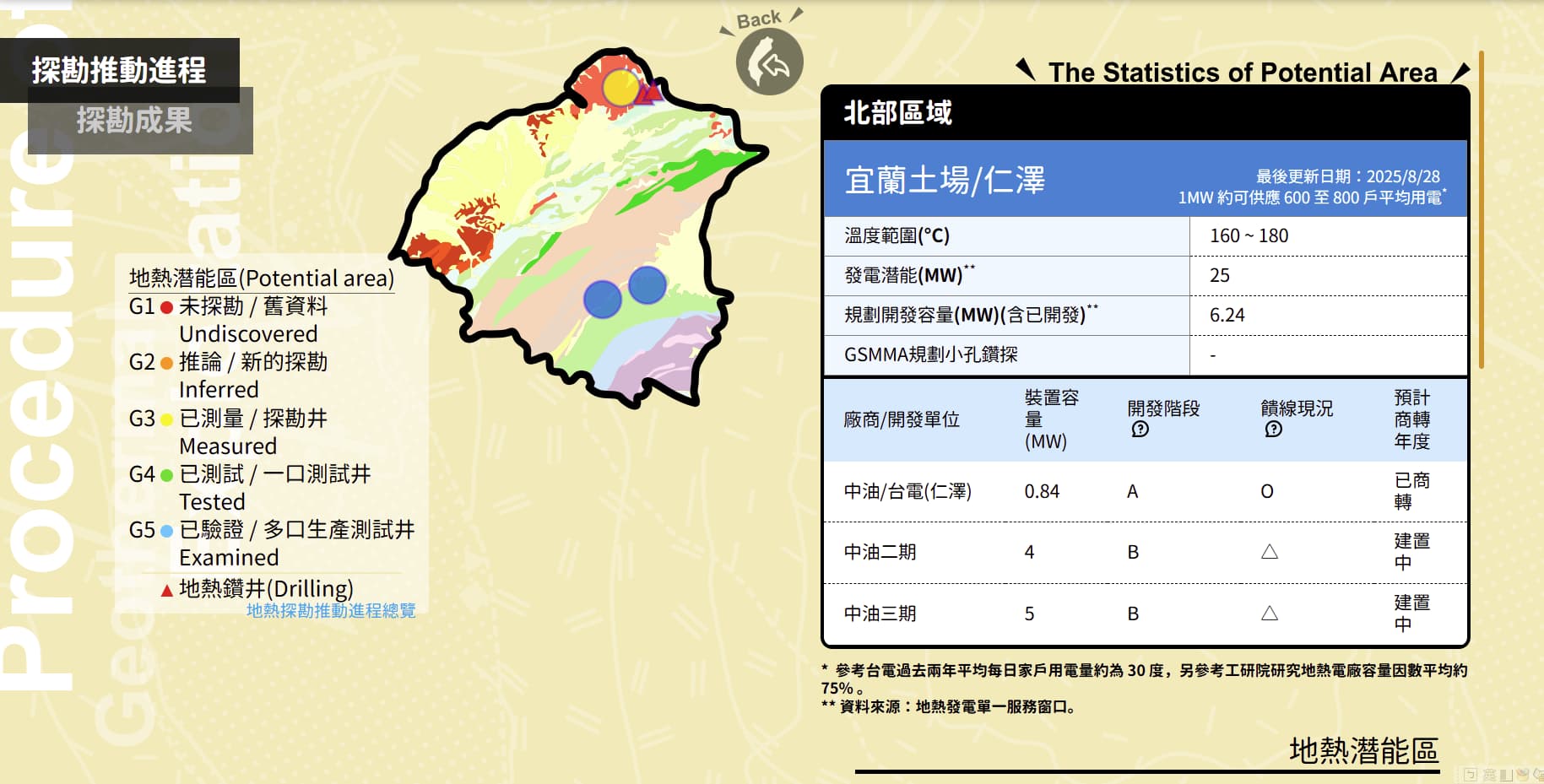
Back in August, a well in Yuanshan, Yilan became the first geothermal well to reach 4,000m in depth. They are planning for an other such well in Dongshan, Yilan.
Google has also signed a 10MW corporate power purchase agreement with Taiwan’s government, and aims to bring that online by 2030.
Apparently the temperature at Yuanshan’s 4,000m borehole was an underwhelming 150°C. For 150°C geothermal to be profitable, it should have been reached at 3,000m instead of 4,000.
I actually can’t find any corresponding report in Mandarin.
Power now being generated in Yilan. More of this, please.
Guy
This actually took more than forty years of work to achieve this. In my opinion , understanding Taiwan’s energy needs and pressing environmental issues vs geothermal’s very slow development pace and low energy output, geothermal energy in Taiwan is largely a waste of time and money .
In terms of the timeline, there are a number of factors to keep in mind. These include:
Early exploration work in Tuchang started in 1984, with the assignment of Industrial Technology Research Institute (ITRI) by the Energy Council of the Ministry of Economic Affairs with the task of building a 0.26 MW demonstration geothermal power plant using binary power plant technology. This facility operated from 1986 to 1994, completing its purpose as a technology verification and data collection project. It was then decommissioned.
My take is that it’s not only geothermal that is / will be slow. The entire energy transition in Taiwan is slow! How to do this while not being subjected to the costs of the gangster / local political shakedown and while not trashing the local environment? That will be at the heart of Taiwan’s slow, painful, yet necessary energy transition.
Guy
A great long-form conversation here about Taiwan’s slow energy transition. This is not a quick read; better to dive in with a nice cup of tea and a quiet evening.
Guy
Yet if we started back in 2005, we’d be half way there by now.
I think it’s a waste of time and a drop in the bucket given Taiwan’s energy needs increase annually. My understanding is it also need substantial and reliable water resources and could be damaged by earthquakes.
Wind, solar and nuclear are more impactful by far.
Output of 5 MW means you need 200 of these to match a 1 GW fossil fuel plant.
The Ministry of Economic Affairs forecasts an average annual electricity demand growth of approximately 1.7% over the next decade (2025–2034), driven heavily by AI development and semiconductor industry expansion, with some forecasts suggesting a 2.5% increase in peak demand
What they should do is encourage homeowners to put solar panels on rooftop. All that solar energy could run ac instead of heating the place up.
Right now 100 watt panels are around 1000nt. Summer in Taiwan tends to be very sunny.
Geothermal generators that pump water down into the hot spot have existed for a long time. So if you are talking about requiring a stable underwater table, that’s not necessary. In other words, it’s not that different from nuclear, which also absolutely needs water.
I am not opposed to wind or solar, and think Taiwan should require rooftop solar, instead of going down the solar farm route, since land is at a premium. If energy storage solutions are cost effective at scale now, I would say wind and solar are cheaper, but since that’s not the case, I don’t see why Taiwan has to choose between geothermal or wind and solar.
As for nuclear, I have expressed why I don’t think Taiwan is suitable for uranium and plutonium based nuclear energy plenty of times. Russians have proven my point in Ukraine by shelling the nuclear plants, forcing Ukraine to give up control to them.
That’s 1 pilot generator at one station. You can have hundreds of generators at a fulling working station. In the Philippines, there are plenty of complexes that can output more than 100MW, such as the Mak–Ban Geothermal Power Plant, which has the capacity for 480MW.
Anyway it’s an interesting technology but I’m afraid that it will just be a figleaf for the government to say we are doing something ‘later’ while still continuing to burn more fossil fuel than ever. The Philippines site seems to be pretty big but I don’t think they have as many earthquakes. Also I wouldn’t discount the water needs of such a plant which may be in conflict with hot spring operators or others.
Wind farm capacity is growing by about 1GW every year
Seismotectonics of the Philippine and Taiwan Subduction Systems and Implications for Seismic Hazards
USGS hypocenters in the Philippines-Taiwan region for all events (a) M ≥ 4.6 and (b) M ≥ 7.0. The majority of events are at depths <70 km and have magnitudes M < 5.0. Seismicity is concentrated at or near the plate boundaries and major fault zones. Hypocenters are colored by depth and scaled by magnitude. More information on events labeled in panel (b) is presented in Table [3].
Don’t really see much of a difference.
Well it only took them 40 years to build that one so we should be ok then. 
The law governing geothermal energy development was actually only passed in 2024.