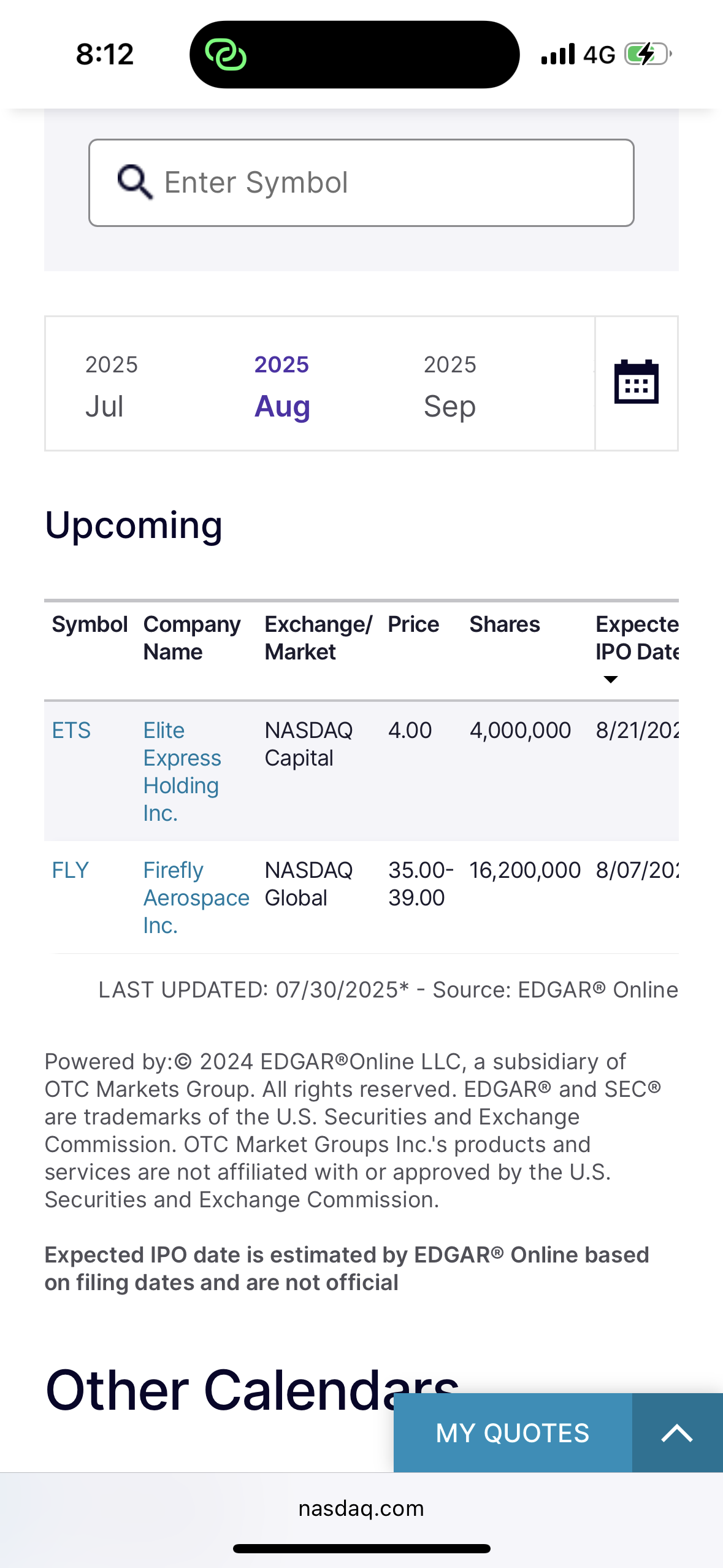
They seem solid enough technically, but I don’t know enough about their financials and business to judge them as an investment. They did go out of business once already though (with some shady business practices), so I’d be taking a gander at the board and their management team before buying. ;D
RKLB is the clear favorite here. I think I was just being a bitch about having missed the big run up. But there should be a solid steady climb for the next ten years .
Below is a list of publicly traded U.S. companies in the commercial space industry that could or should benefit from this Executive Order, based on their business activities aligning with the order’s objectives:
Rocket Lab USA, Inc. (RKLB)
• Why it benefits: Rocket Lab is a leading provider of small satellite launch services, operating frequent launches from U.S. and international facilities. The order’s focus on streamlining launch and reentry licenses under 51 U.S.C. 50905 and reducing NEPA-related obstacles directly supports Rocket Lab’s ability to increase launch cadence. The company’s reusable rocket development and space systems manufacturing also align with the order’s emphasis on innovation and novel space activities.
• Market position: Operates launch sites in the U.S. and New Zealand, with contracts for satellite constellation deployments.
• Source: General industry knowledge and alignment with the order’s provisions.
Astra Space, Inc. (ASTR)
• Why it benefits: Astra focuses on low-cost, small-payload launch services, which could see reduced regulatory hurdles for licensing and environmental reviews. The order’s push to expedite approvals and potentially waive requirements for vehicles with flight termination systems benefits Astra’s scalable launch model.
• Market position: Developing flexible launch systems for small satellites, with operations based in the U.S.
• Source: General industry knowledge and alignment with the order’s regulatory reforms.
Redwire Corporation (RDW)
• Why it benefits: Redwire provides space infrastructure, including satellite components, on-orbit servicing, and space manufacturing. The order’s streamlining of mission authorizations under the Outer Space Treaty and support for novel space activities could accelerate Redwire’s projects, such as in-space manufacturing and satellite servicing.
• Market position: A key player in space infrastructure with U.S.-based operations, benefiting from faster spaceport development and regulatory clarity.
• Source: Recent posts on X highlight investor interest in Redwire’s growth potential ().
Spire Global, Inc. (SPIR)
• Why it benefits: Spire operates a constellation of small satellites for data and analytics, relying on frequent launches. Streamlined launch permits and reduced regulatory barriers would lower costs and improve access to space for Spire’s satellite deployments.
• Market position: Provides space-based data services, with U.S. operations that align with the order’s focus on commercial space competitiveness.
• Source: General industry knowledge and alignment with the order’s goals.
Intuitive Machines, Inc. (LUNR)
• Why it benefits: Intuitive Machines focuses on lunar missions and space exploration services, which could benefit from expedited authorizations for novel space activities under Section 5 of the order. The company’s U.S.-based operations also align with the order’s emphasis on supporting domestic space companies.
• Market position: A leader in commercial lunar lander services, with contracts from NASA and commercial clients.
• Source: General industry knowledge and alignment with the order’s provisions.
Maxar Technologies Inc. (MAXR)
• Why it benefits: Maxar builds satellites and provides geospatial data, relying on launch services and spaceport infrastructure. The order’s reforms to spaceport development and regulatory streamlining could reduce costs and delays for Maxar’s satellite deployments.
• Market position: A major U.S. provider of satellite imagery and space systems, benefiting from increased launch cadence.
• Source: General industry knowledge and alignment with the order’s objectives.
And ChatGPT took a shot.
Thought for 25s
Here’s a quick, research-grounded list of U.S. publicly traded companies in commercial space that are poised to benefit from the Executive Order “Enabling Competition in the Commercial Space Industry” (streamlined FAA licensing, faster environmental/permitting reviews, and a push to increase launch cadence and “novel space activities” by 2030). The White House+1Reuters
Likely beneficiaries (U.S. listed & U.S. companies)
Rocket Lab USA (RKLB) — Launch services & spacecraft; more predictable, faster FAA approvals directly help its U.S. launch cadence and reentry missions. The White House
Virgin Galactic (SPCE) — Human spaceflight; streamlined launch/reentry licensing could shorten turnaround for commercial flights. The White House
Redwire (RDW) — Space infrastructure/components used on many missions; higher industry launch tempo lifts demand for payload integration and in-space manufacturing. The White House
Terran Orbital (LLAP) — Satellites & buses; faster rides to orbit (from more launches) support backlog conversion and constellation builds. The White House
Planet Labs (PL) — Earth-observation operator; benefits from increased launch availability to refresh/expand fleets. The White House
BlackSky (BKSY) — EO constellations; same launch-availability tailwind plus quicker licensing for hosted payloads. The White House
Spire Global (SPIR) — Weather/AIS/ADS-B nanosats; higher launch cadence reduces time-to-orbit for replenishment. The White House
Iridium (IRDM) — Global satcom; indirect beneficiary from cheaper/more frequent launches for future refresh or hosted payload partnerships. The White House
Intuitive Machines (LUNR) — Lunar transport/payload services; faster mission approvals and supportive policy for “novel space activities.” The White House
Sidus Space (SIDU) — Small-sat manufacturing & services; more launches = more small-sat deployments. The White House
Lockheed Martin (LMT) — Major space prime (satellites, lunar landers/partnerships); industry-wide acceleration boosts supplier and mission pipelines. Reuters
Northrop Grumman (NOC) — Launch/space systems (propulsion, payloads); benefits from relaxed bottlenecks and increased commercial cadence. Reuters
Boeing (BA) — Satellites and human-spaceflight systems; gains from a more active commercial manifest and streamlined rules. Reuters
L3Harris (LHX) — Space payloads/communications; higher launch tempo can pull through sensor and comms demand. Reuters
AST SpaceMobile (ASTS) — Direct-to-cell constellation; benefits from more frequent/expedited launches for large satellites. The White House
Notes & context
The EO’s core thrust is streamlining FAA licensing and environmental reviews to “increase commercial space launch cadence and novel space activities by 2030,” which most directly favors launch providers and mission operators; satellite makers/operators benefit indirectly via more, faster, and cheaper rides to orbit.
Took a read through of their financials… hard to imagine anyone investing in FLY over RKLB at this point. Both early companies so both come with a nice chunk of risk, but RKLB just in a better position, more mature technically, with better financials, and a lower P/S than FLY (even at today’s $45 vs ipo day prices, despite their sales being juiced by their one landing in 1Q (rest of 2025 quarterly earnings are going to be ugly I think - they have 2 potential launches on firefly alpha, which isn’t exactly a proven platform yet, and neither have a launch window yet). Doesn’t seem like a whole lot of reason to consider FLY over RKLB at this time other than retail stonk potential due to low float.
I have a few former coworkers that worked there - they’ve been abandoning ship this year due to the company’s (lack of) prospects. A couple former employees left. Have gotten a couple cold calls from my old boss who’s a director there looking for a job. My other old boss who was a VP bailed. We’ll see if they survive…
FLY and Virgin Galactic have lost their shine to me.
I’ll stick with RKLB and LUNA. Anything that gets us to the Moon and sets the stage for mineral extraction on the surface and lunar orbit sats is on my radar.