Or you know, give it to France for reprocessing. It’s right next door.
There’s also a fundamental misunderstanding (I think this is supported by big oil) of nuclear waste and radiation. Everyone says “oh it’s going to be dangerous for thousands of years”. Actually no, the stuff radioactive for thousands of year is actually not that dangerous to be around because these are all long half life stuff that emits little radiation. What’s really bad is the short half life stuff that’s intensely radioactive, but because they have short half life they’ve decayed in a few decades, to the point they’re not quite so dangerous anymore. It’s like an intense fire (say gunpowder), or a slow fire (a candle). They’re both fires but one burns quite hot (and explodes), another basically just barely burns. One burns in seconds, other burns for hours.
The problem is mostly political. It’s against the law to export nuclear waste, and it’s against the law to reprocess them. Most the problem with nuclear waste is basically laws that prohibits doing what really should be done with them, not scientific or technical stuff.
Stuff fresh out of reactors are put in the pool for a reason, water is a GREAT radiation shield. You could take a swim in it (though you’re more likely to die from lead poisoning if you try).
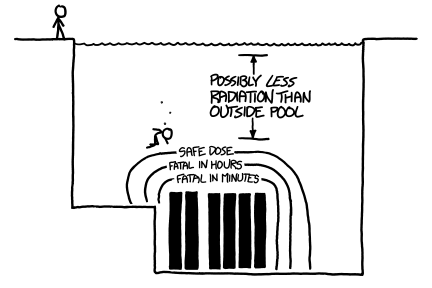
It’s why I thought that dumping it into a deep sea trench would be a good idea. I mean it’s illegal, but the water would stop any radiation, and being so deep means it would be damn near impossible for terrorists to reach it. In geological timescale it would just be subducted back into the mantle, so it’s safe. There’s already several downed nuclear subs with active reactor, and they’re left in place, no attempt made to salvage them.