1.225% is the rate for NTD deposits. I doubt that IBKR pays that much on NTD deposits - if you deposit USD, you’ll also have an additional exchange rate risk.
they r useless tools. even more useless than branch tellers. glorified shopping assistants
So much for the ‘World’s local bank’ advertisement.
They let me open a fixed deposit but not an investment account
I said something similar in a complaint to Standard Chartered about a co-promotion with LINE Bank that excludes foreigners lol.
Their website has a load of marketing gumph about how they’re a global bank that holds diversity, inclusion, fairness, equality, human rights, and lifting banking participation among their “core values”, so I asked them how it’s possible for them to exclude foreigners living in Taiwan without contradicting those. 
I’m glad I complained about this Richart/JKOPay stuff lol. It’s now almost a year later, and JKO is still giving me bonus JKO coins/points each month even though I think the original promotion ended in the summer:


I don’t really understand the amounts — they seem a bit erratic and sometimes more than 3%, considering that I only usually spend maybe NT$1000–2000 a month through JKOPay. I’m not sure why I got 150 coins this month, when I only spent NT$2288 in October. 
I sometimes use it to pay utilities bills too, but I’m guessing they’re not included in the cashback promotion (or shouldn’t be — at the beginning they were calculating this manually to shut me up, so maybe they’re just doing it differently each time).
So Cathay ETF is $3USD on any amount. Do they charge in or outbound wire fees? Maintenance fees? Are gains above 6.7M subject to AMT? US ETF also has 30% withholding tax on divvy right?
So Cathay ETF is $3USD on any amount.
Yes.
Do they charge in or outbound wire fees? Maintenance fees?
Not that I noticed.
Are gains above 6.7M subject to AMT?
It’s only a gain if you sell, and I don’t plan to anytime soon.
US ETF also has 30% withholding tax on divvy right?
Based on the only dividend payout I got so far, yes.
Taiwan has outperformed global averages in multiple financial inclusion categories, according to a report released Monday by the Financial Supervisory Commission (FSC).
Good news - banking in Taiwan is very inclusive! 
FSC gave themselves a report card
according to a report released Monday by the Financial Supervisory Commission (FSC).
Financial inclusion, also known as inclusive finance, is a concept adopted by the United Nations in the 2000s that refers to ensuring that all members of society have equal access to responsible and sustainable financial services.
Though it covers the availability of services for the general population, it also is aimed at making sure more vulnerable members of society, including the elderly, people with disabilities, and lower income households, have equal access to financial services.
Among the FSC’s metrics for disadvantaged groups were statistics for microinsurance and small-amount whole life insurance, both products available to people with low incomes.
Anyone want to take a bet as to whether the FSC calculated financial inclusion solely based on Taiwanese citizens?
Meanwhile, Chunghwa Post saw the news and decided to do its bit to fight back against financial inclusion:
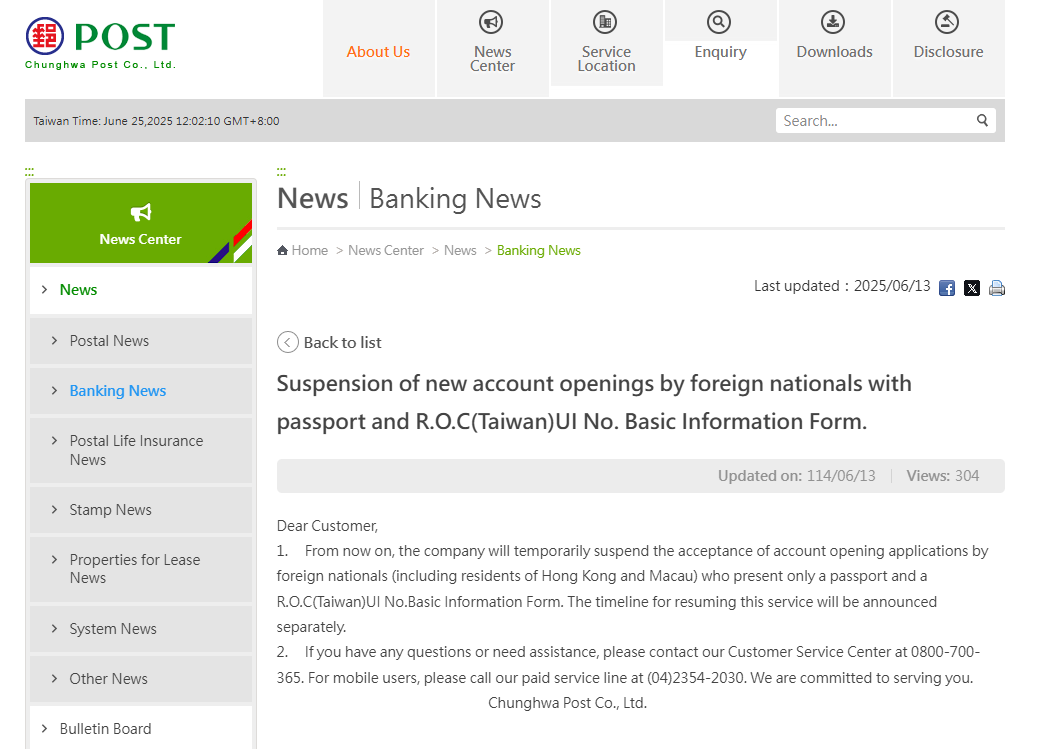
You might be onto something 
According to the article:
Though it covers the availability of services for the general population, it also is aimed at making sure more vulnerable members of society, including the elderly, people with disabilities, and lower income households, have equal access to financial services.
Probably foreigners don’t count as “vulnerable members of society”, so they do not matter for this kind of survey.
And then they mostly look at number of ATMs, number of bank accounts. And for some reason, number of whole-life insurance policies 
The share of adults with a bank account in Taiwan stands at 93.3 percent, and 81.6 percent use digital payments – both notably higher than the global averages of 76.2 percent and 64 percent, respectively
Among the FSC’s metrics for disadvantaged groups were statistics for microinsurance and small-amount whole life insurance, both products available to people with low incomes
This is the sort of thing that we can hope the New Residents Agency can help us look into. NGOs will finally have an agency to talk to about things like this. At least that is what I am hoping.
New government banking survey where you can choose answers like “To be able to open an account online without the need to visit in person.” and “After my account is open, I do not want to visit my branch if possible”