This is factually untrue. Chiang Kai-shek’s occupying forces were assigned to occupy Taiwan after Japan’s surrender. Interestingly they were also assigned to do this in northern Viet Nam, but nobody uses this historical fact to claim that the ROC obtained legal control to rule over Viet Nam.
Taiwan’s legal status in relation to Japan was not formally decided until the 1951 / 1952 Treaty of San Francisco. Neither the ROC nor the PRC were signatories, and neither was named as the recipient of Taiwan. After shooting people and jailing dissidents, ROC forces remained as a violent occupying power on Taiwan until the end of martial law and the sedition statutes were repealed in the early 1990s.
Article 2 (b) Japan renounces all right, title and claim to Formosa and the Pescadores.
Article 4 (b) Japan recognizes the validity of dispositions of property of Japan and Japanese nationals made by or pursuant to directives of the United States Military Government in any of the areas referred to in Articles 2 and 3.
Chiang Kai-shek’s January 12, 1949 letter to Chen Cheng, the Governor of Taiwan appointed by CKS:
Before a Sino-Japan treaty can be signed, the legal status and sovereignty of Taiwan is merely a trust territory to the ROC. How can we openly claim the island as our last stronghold of our anti-communist efforts, and the base for the revival of our race? Such open statement would only be derided as crazy talk from slightly more knowledgeable people both in and outside of China.
On Taiwan’s sovereignty and legal status, the British and the Americans are afraid that I cannot hold on to Taiwan, and will allow the CCP to grab it, letting Taiwan fall into Russia’s sphere of influence, making a hole in the South Pacific island defense chain, therefore they are trying to have me return Taiwan to the US’ governance. The British are peddling the same behind the scenes, and trying to increase Hong Kong’s regional prominence. At the moment, this is the most critical issue. I have to firmly express to the Americans that I’ll die protecting Taiwan if I have to, I’ll protect my territory, fulfill my duty to my citizens, and absolutely will not return Taiwan to the Allies. If they wish to assist me, and defend Taiwan together, then they are more than welcome. With that I think they don’t dare to take Taiwan back forcefully.
All shows Taiwan post WW2 is a territory separated from an enemy state, and trusted to the governance of Allied Powers, specifically the Principal Victor in the Pacific Theater, the United States’ military government. Taiwan’s sovereignty is pending until self-determination as specified in the UN charter. Chiang Kai-shek’s letter and diary entry show he was fully aware of this fact.
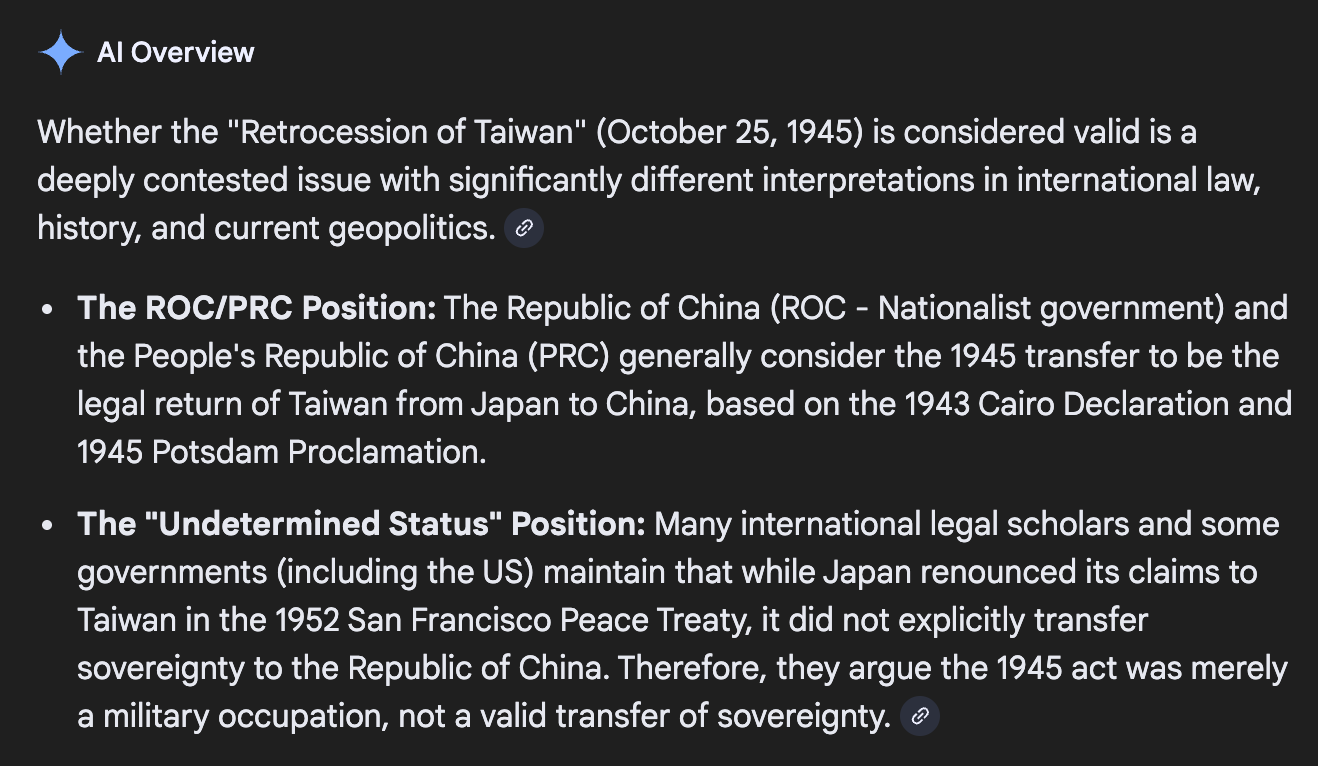
I’m not an expert in international law so can’t go too deep here, but a Google search said the Retrocession of Taiwan is a contested issue depending on who you ask:
Which got me thinking… if you invade a foreign country by force and then force them to sign a treaty under duress (or completely eliminate the other country), does that mean you’re in the clear in terms of international law? Because any country with enough military force can do that, and that’s kind of what happened when Taiwan got handed over to Japan. The victors get to decide the terms.
There are only 2 options on interpreting Treaty of San Francisco, which is a internationally recognized treaty.
Taiwan’s sovereignty is undetermined and pending self-determination, and that the island is trusted to the US Military Government, which delegated the right to administration to the ROC government in exile.
Might is right. Anything is fair game. Who ever occupied a territory gets to keep it until they get dislodged. All international treaty are meaningless, especially treaties made before WW2, which can be called unequal and nullified unilaterally. You don’t even have to nullify them all at once, you get to pick and choose, and only nullify those you don’t like.
It’s an interesting treaty but also subject to contention. For starters, neither ROC nor PRC were part of the treaty negotiations or signing. It is like me signing a treaty with my neighbor saying that I now own someone else’s property. And if i’m the mightiest, I’m in my right to do that. Which is the way things have been in history. The victors of war write history.
The treaty itself did not involve any of China’s territories. Why would the representatives of China need to be there? The Treaty of San Francisco didn’t even mention Manchuria. Taiwan was permanently ceded to Japan, it was and still is not a Chinese territory.
Is it customary in these kind of meetings to not invite those living in a place when you’re deciding their future?
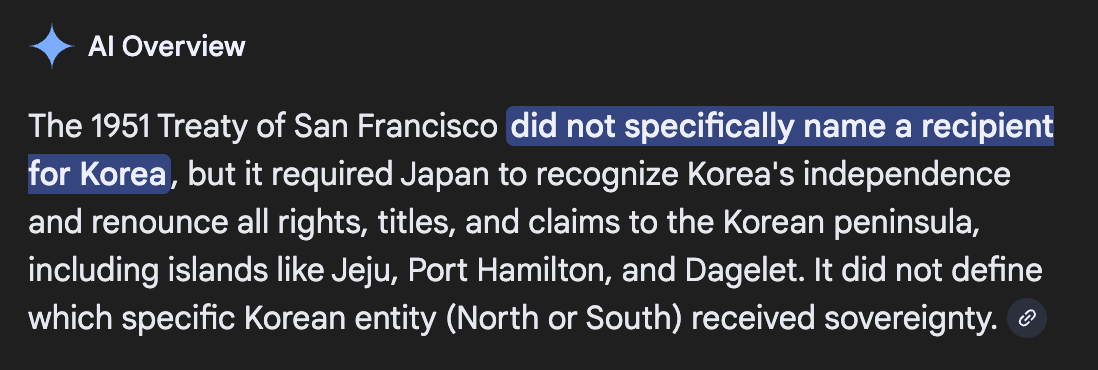
Wikipedia says ROC wasn’t invited because there was a civil war going on with the PRC. Korea wasn’t invited for similar reasons on who could represent Korea.
The treaty language used for Korean territories was similar to that used for Taiwan. Does that mean the Korean Peninsula is not Korean territory? Korea also signed the 1910 Japan–Korea Annexation Treaty which gave total sovereignty to Japan.
Why should they be? Japan was defeated, Japan surrendered its colonies which had nothing to do with either of those nations as they had (and have) no legal claim.
Korea got its independence. Look at what you wrote and now think about Taiwan and why it also should not get its independence after enduring a history of colonialism.
International law seems quite tricky, maybe I need to play some games of Civilization. Who comes up with these rules?
So declaring independence while on foreign land means the land is now yours? Because South Korea declared independence after treaty of 1910 but before the treaty of San Francisco in 1951 so the land was still Japan’s. Or the later treaty of 1951 is like giving out international pardons for people who did illegal stuff (like declaring independence on foreign land) in the past?
In any case, back to the topic of the thread: the Takaichi electoral victory must be causing headaches in Beijing. Their attempts to intimidate and punish Japan seem to have backfired. This is quite familiar as we saw with electoral results in the Lee Teng-hui era and in the Tsai Ing-wen era in Taiwan. Somehow Beijing’s tactics produce the opposite results that they would apparently prefer. Whoops!
South Korea did not exist in the 1910s or anytime before that. The Empire of Korea came into existence in 1897, after Japan forced the Qing government to forfeit its suzerainty over Korea, and the Kingdom of Korea sought Russia support to keep Japan out, and renamed the country to an Empire to be at equal footing with Japan. Unfortunately, as a result of Japan’s victory over Russia in the First Russo-Japanese War, Korea was forced to sign the 1905 Treaty, accepting Japanese suzerainty, and allowing Japan to have the final say in Korea’s internal and external affairs.
In the 1910 Treaty, Korea did not declared independence as you claimed, but actually the treaty forced Emperor Sunjong to abdicate, transferring all rights of the Emperor of Korea to the Emperor of Japan, and the Empire of Korea ceased to exist.
In Article 2 section (a) of the Treaty of San Francisco, Japan recognized the independence of Korea, renounced all right, title and claim to Korea. However, the US and Russia held separate elections to elect a new Korean leader and backed the formation of their regimes, and those became what we colloquially call North and South Korea.
I didn’t claim that. I said the treaty of 1910 Japan–Korea Annexation Treaty passed sovereignty to Japan, and Korea declared independence after this time but before the Treaty of San Francisco.
The exact same language is used for Taiwan. The treaty didn’t specify a recipient for Korea either. Japan merely renounced all claims to Korea.
“The 1951 Treaty of San Francisco (Article 2) states that Japan renounced all right, title, and claim to Taiwan (Formosa) and Penghu (the Pescadores).”
It’s pretty clear that the recipient of sovereignty for Korea is the Korea. The treaty even clearly states "Japan, recognizing the independence of Korea, renounces all right, title and claim to Korea.
You can use AI agents to help you research, but it’s a good practice not to post stuff generated by AI as source or evidence for your argument. You can simply find full text of the treaty, and just quote the actual treaty.
It’s not clear at all. There’s North Korea and South Korea and they weren’t invited to the San Francisco talks because they couldn’t figure out which one represented Korea.
South Korea claims sovereignty over all of Korea even after declaring independence
Both Koreas technically have legitimate claim to sovereignty over all of Korea. The Treaty of San Francisco did not assign sovereignty to any regime, just acknowledging Korea should and would be independent from Japan.
How do South/North Korea have a legitimate claim over the Korean Peninsula? The 1910 Japan–Korea Annexation Treaty gave sovereignty of Korea to Japan and the 1951 San Francisco treaty did not transfer sovereignty back to Korea.