What about neutral tone in front of another neutral tone changing to 4th?
Now then…
Or all the tonal sandhi associated with 一?
I think I am more aware of what’s going on with 一 than 不. It is also interesting that it’s entering tone characters that are doing all these sandhi in Mandarin after Mandarin butchered them.
It is a thing, but in Taiwa we use bú nàme instead of bú zěnme.
I have no idea what tone sandhi is, and I am just doing fine. 
If you should figure it out one day, you’ll probably realize you’re doing it unconsciously.
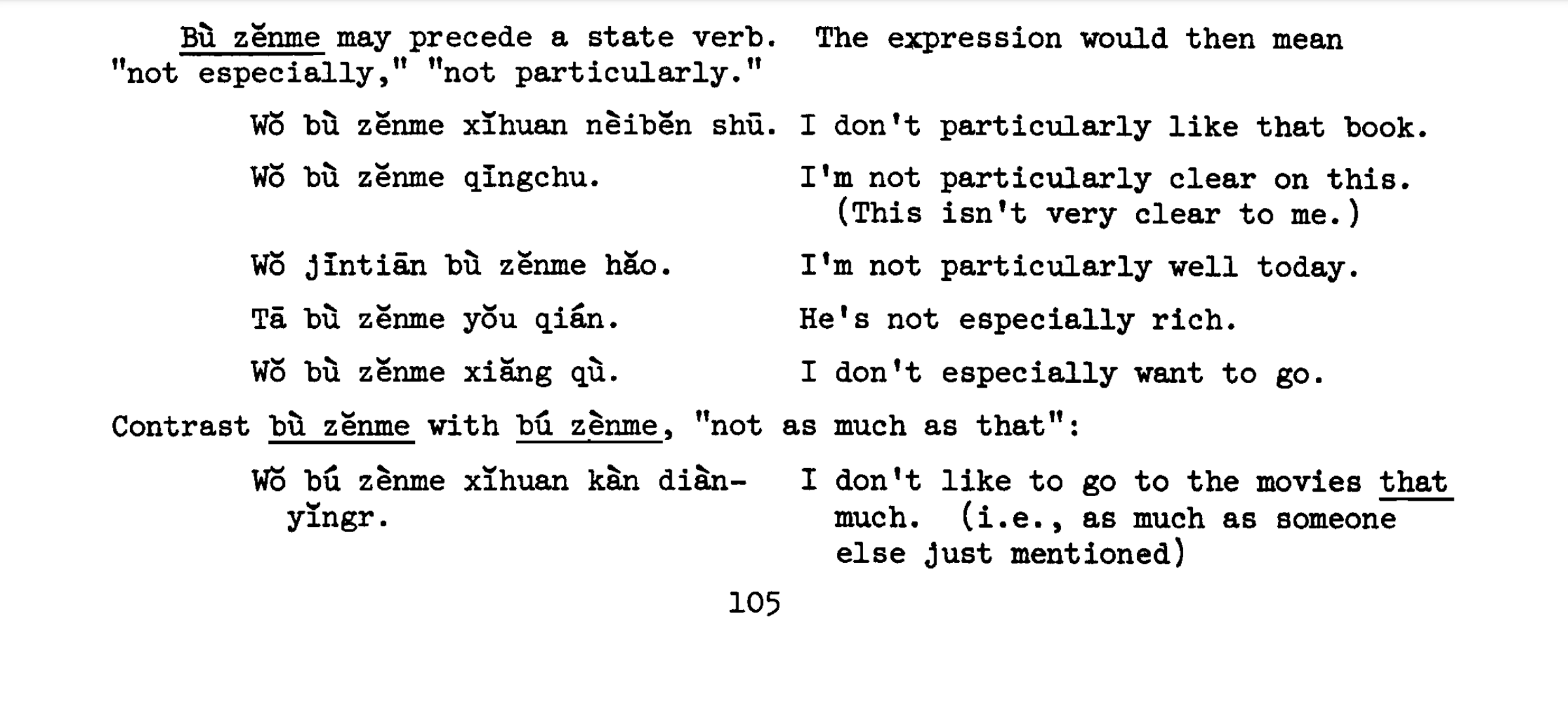
Hang on… in the textbook excerpt I showed, there were 2 examples:
- bu4 zen3me to mean “not so much in a general sense”
- bu2 zen4me to mean “not as much as that previously-specified amount”
In Taiwan, when bu2 na4me is used, which of the two above cases does it cover?
In the dictionaries I checked, it seems that the only correct pronunciation for zenme is zen3me, but zen4me is never listed.
Therefore, it almost seems to me that the above-provided example of “bu2 zen4me” to mean “not as much as that previously-specified amount” may be some kind of dialect or corruption of “bu2 zhe4me”.
Continuing this logic, and given the above information, I might then hypothesize that in Taiwan:
- bu4 zen3me still means “not so much in a general sense”
- bu2 na4me (or maybe also bu2 zhe4me) means “not as much as that previously-specified amount”
Right? Wrong?
The second one. bu2 na4me is used to mean not as much as that previously specified thing.
For example,
我不那麼喜歡吃青菜 I don’t like to eat vegetables as much.
wo3 bu2 na4me xi3huan chi qingcai4.
The 不 character is definitely 2nd tone here.
For the first meaning, “not so much in a general sense”, 不 is still bu4 zen3me in Taiwan, with the 4th tone.
I think it’s less common for people to say 怎麼 as zen4me in Taiwan. I feel like that role is usually replaced with 不這麼 and 不那麼.
I only know about it because I majored in linguistics (or maybe because my useless Chinese professors in college spent 98% of class time using English to explain the details of the Chinese language instead of teaching us the language?)
Cuz
Yes, because what percentage of the Chinese-speaking world did not exactly get an education growing up? Yet they speak their tonal language(s) without ever knowing about this rule.
Back in the days when Windows 95 was just a thing, people just had type bu4 ze4me in Zhuyin regardless if they wanted to type bu4 zen3me or bu2 zen4me.

Isn’t ‘stess shift’ or ‘iambic reversal’ just binary tonal sandhi?
So yeah… English also has tonal sandhi.
Just realized this tonal sandhi in Mandarin: 多多. Not at a drink, no sandhi there, but as a question. Like 很多是多多? The first 多 changes into second tone.
The 3 tonal languages that will ruin your life, and Taigi is the boss.