Don’t forget the fact that someone decided to add on street parking to the roundabout itself.

Don’t forget the fact that someone decided to add on street parking to the roundabout itself.
What is it? The link is to a post from November last year talking about the number of police necessary to control a junction, presumably due to the usual red light breakers and drivers who think the world revolves about them only. Are there any accident statistics published?
What? The thread is about the removal of the roundabout in Gongguan and it didn’t have street parking on it as far as I remember.
Sorry getting confused with the Tainan roundabout above, still half asleep this morning.
The issue here is even today, 7 months post the change, 3 traffic police officers are stationed at the intersection for morning and afternoon rush hours. For most of the past half-year, 6.5x more traffic police man power have regularly been assigned at the intersection than when it was still an, albeit imperfect, roundabout. So it is difficult to have a fair comparison whether the intersection has been made safer.
Why does it need 3 traffic officers? It’s actually far from unusual for junctions to require police and/or the volunteer brigade to keep them running at peak hours!
I think usually just 2 at an intersection would already be pretty rare.
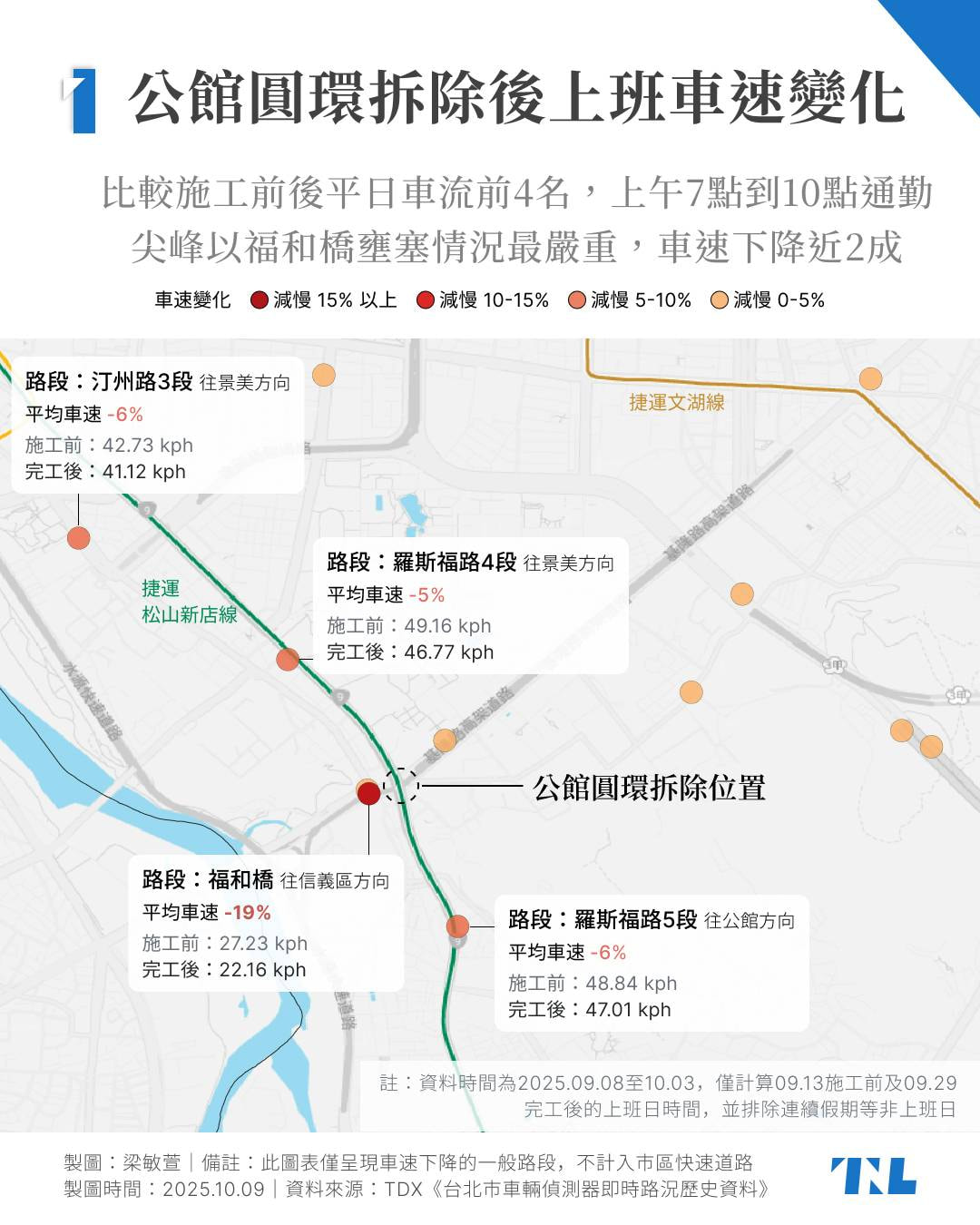
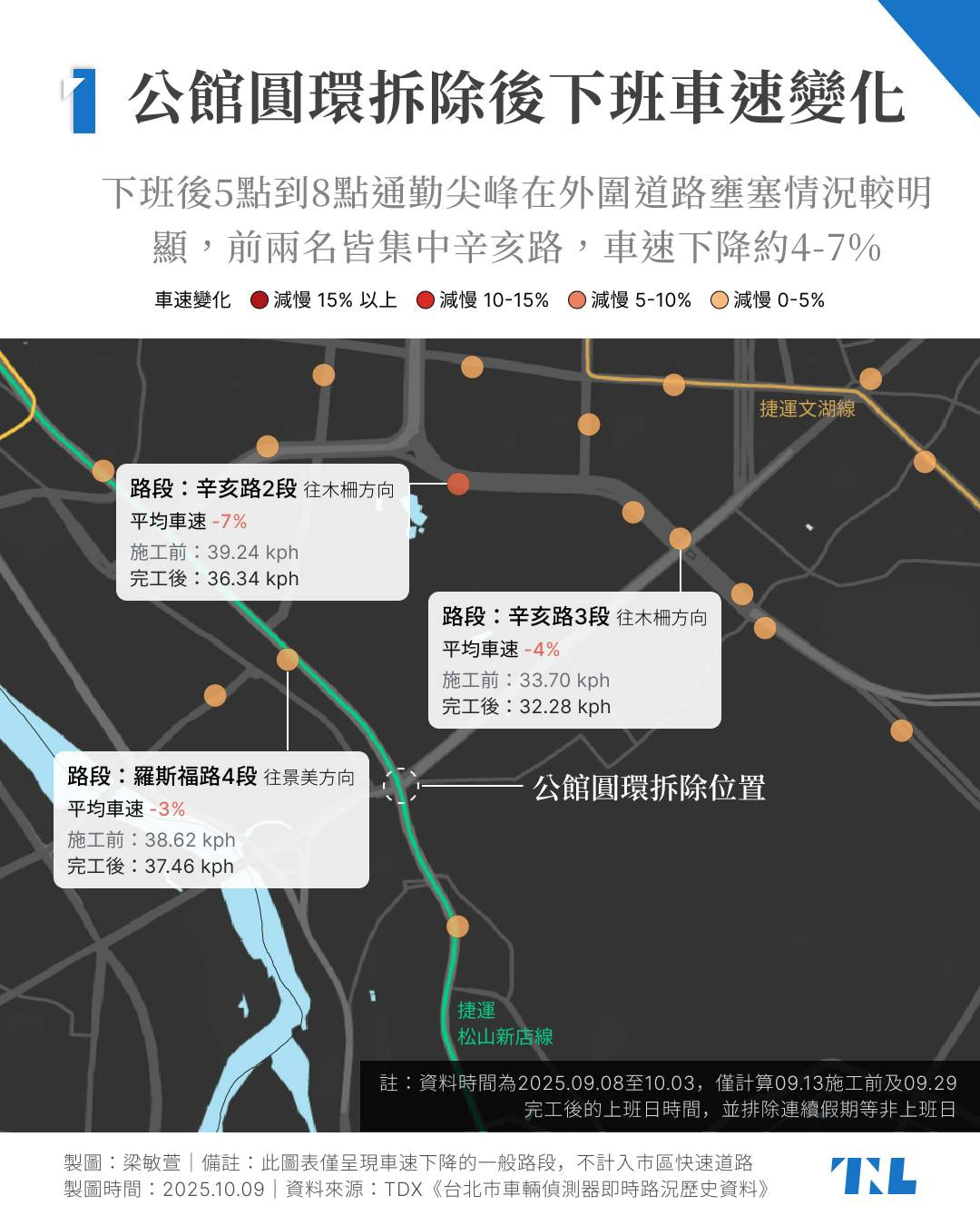
Here are some numbers about the speed of vehicles going through the intersection before and after the change:
during the morning rush hour
during the evening rush hour
So axing the roundabout didn’t solve the issue of congestion. In fact, commute for people coming from New Taipei has gotten significantly worse, which is something that Li Sichuan, the KMT politician who pushed for removing the roundabout under Taipei City mayor Jiang Wanan, admitted himself.
Li is being considered for the KMT’s New Taipei City mayoral candidate, and when first asked how to solve Zhonghe and Yonghe’s congestion issues, his first response was that he would fix the congestion if he is elected mayor. However, he later realized that removing the Gongguan roundabout made New Taipei congestion a lot worse, he backtracked and claimed there is no congestion issues in Zhonghe and Yonghe.
There are four helpers and at least one police officer at the pedestrian crossing at my kids school in the morning and there are still ^%*$ who break the red lights…
The fact that junctions require officials to stand and actively police them on a daily basis is pretty third world!
Wasn’t safety listed as one of the key reasons for removal? The roundabout was an accident black spot. Has it’s removal successfully reduced the number of accidents?
I don’t think you can excuse creating congestion just for the sake of safety. Safety and efficiency are trade-offs of equal importance when planning for vehicle transportation.
What was the stated reason for the removal of the roundabout?
He sounds like a “one more lane, bro” bro.
Yeah it was the #1 spot for accidents in Taipei.
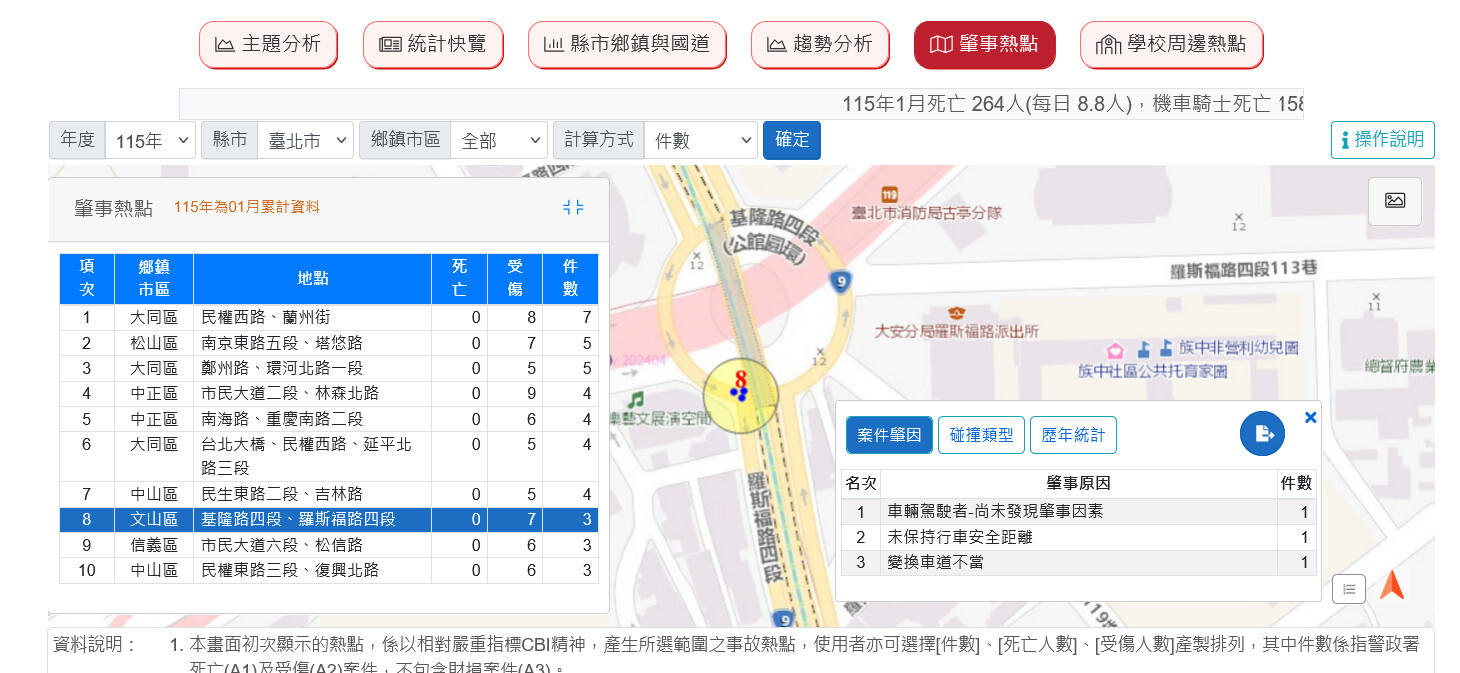
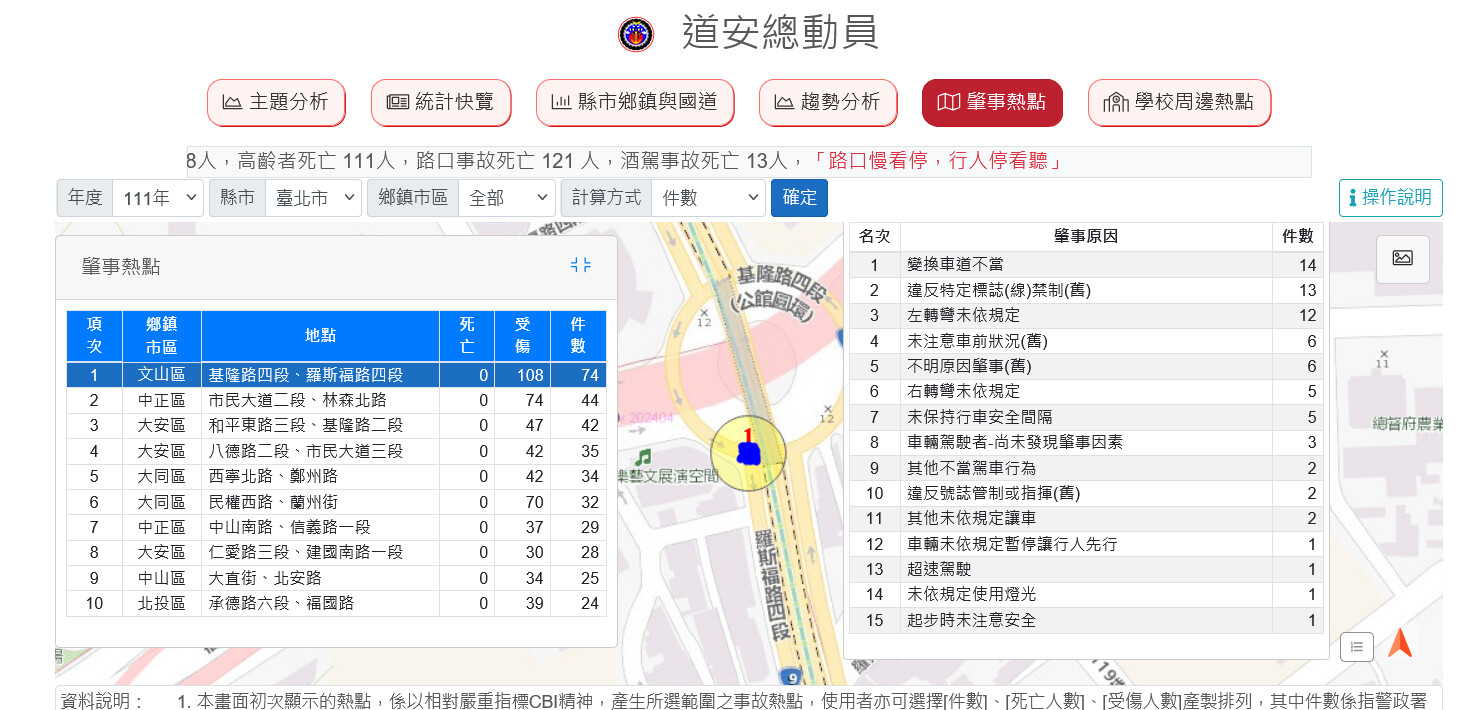
Using the MOTC safety dashboard you can see it’s at the top for Taipei. From 2018 to 2025 it was the number 1 spot in Taipei for traffic accidents. In 2017 (the earliest year shown on the dashboard) it was number 5.
[Link to MOTC safety dashboard]
So far for 2026 it’s sitting at #8 for number of accidents with just 3.
The worst on record was 2022 where there were 74 traffic accidents there.
For the last full year with the Gongguan roundabout, 2024, there were 67 accidents. For 2025 it was 51 accidents. The removal took place in September, so about 3 months with the new intersection.
But so inconvenient now!
Won’t someone think of the traffic!?
Through these changes, they eliminated the speedy underpass for buses that bypassed this intersection entirely.
In this sense, it’s consistent with most of what I’ve seen with the Chiang Wan-an era adjustments: drivers kept hitting and killing people, so let’s deprioritize public transit and radically shrink pedestrian spaces at the crossings.
I continue to be unimpressed.
Guy
WTF. For real?
And here I was thinking we were moving PEOPLE and goods and therefore safety should be higher on the list. Turns out we are moving vehicles, so to hell with people, specially those who aren’t inside those VIV (very important vehicle).
For real. If safety is above all else, then there shouldn’t be vehicle traffic at all. It is inherently more dangerous.
If that’s not the case, then there should be a balance between traffic efficiency and safety. You can argue about where’s the point of balance, but if you argue for change that require a lot of money and subsequent 6x more man-power to maintain supposed safety benefit, while causing significant congestion, you are failing the trade off game.
The roundabout wasn’t perfect because people were educated on how to use it, the police man-power should have been spent on enforcing users of the roundabout to follow the simple rule of no entering if you would cause traffic in the roundabout to slow down. Instead, like everywhere in Taiwan, pointless traffic lights were put in place to make the roundabout less efficient. However, the public transport thru-tunnel was the perfect solution for a high-volume roundabout. Even if the Chiang city-government and Li Si-chuan wanted to remove the roundabout, they should have kept the underpass for buses.
LOL! So 1960’s!
You’re failing to understand the root cause of Taiwans traffic problems!
And how does converting the Gongguan roundabout to a intersection address the root cause of Taiwan’s traffic problems?
Removing something Taiwan’s drivers were not trained to use and didn’t have the road manners necessary saw an immediate reduction in accident numbers.