Usually it’s parents or illness or the boss told you or you will lose your job . It can’t be anything fun that would be ‘wrong’. Gotta play the game with this kind of subjective nonsense.
2 Likes
Do you know if they have any published guidance on this? Like what kind of proof we need to give (if any?)
I did not find any reason to travel so I never did. Best thing for me really. Just get HHR and ID card then traveled. My first passport of course did not have the ID number in it and I used that. Most places I did not need a visa only Philippines. Was not an issue. If others want to travel for a holiday or whatever I’m sure they can find a reason.
Hey @fifieldt
I saw this on your citizenship site.
A key factor in the timing is in the Citizenship Committee in the Ministry of Interior that conducts the final assessment of naturalisation for High-Level Professionals. The committee meets once every two months, typically around the 25th of the month (February, April, June, August, October, December), but can also meet ad-hoc. If your application misses a meeting, you can be waiting a significant amount of time for the next one.
Do you know if the same citizenship committee reviews regular (non high level professional) applications? If so, is the meeting time the same as above?
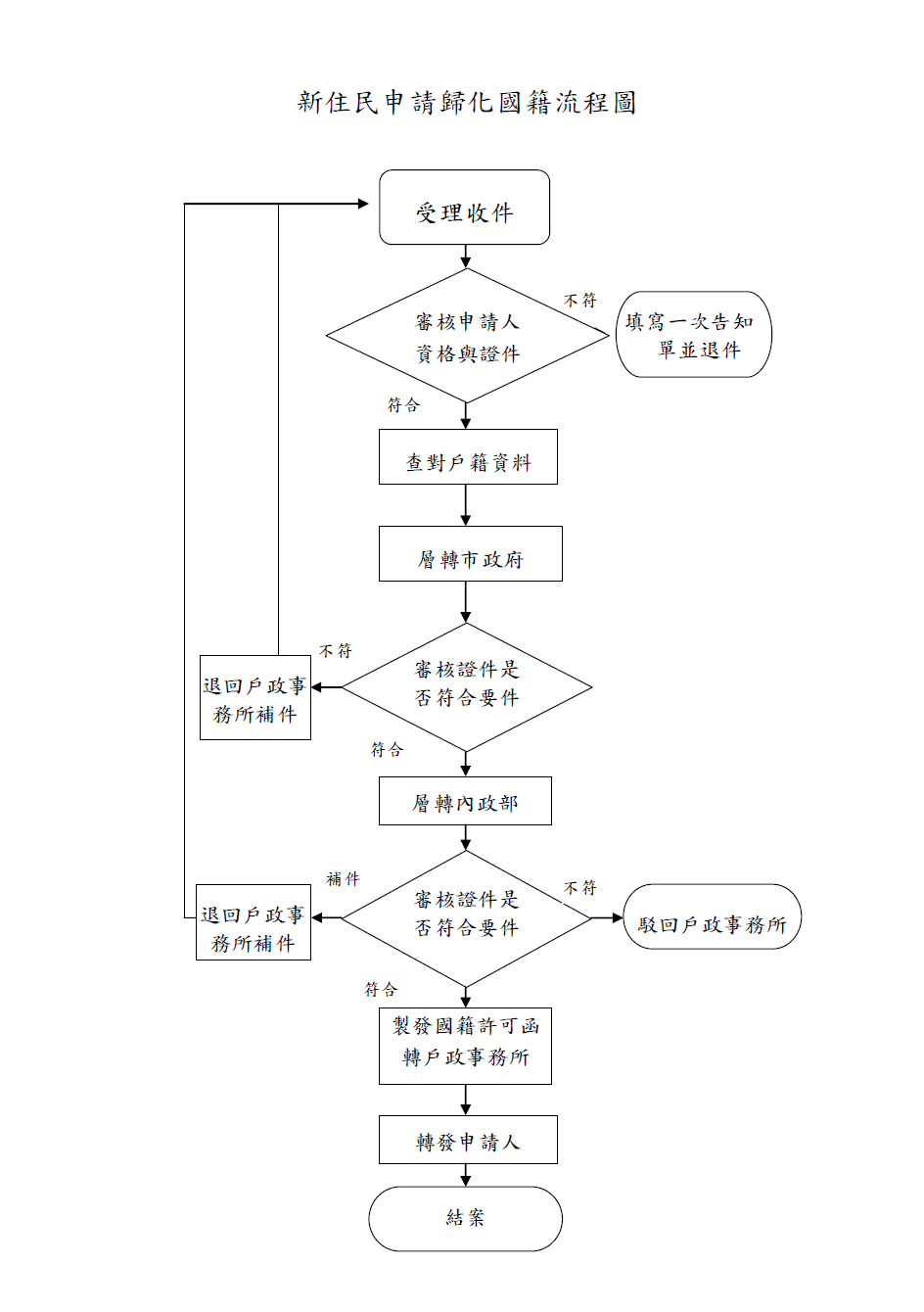
I found this flowchart online but it doesn’t mention a committee.

As I understand it, the committee is only for High-Level Professionals. Regular applications appear to me to be much more standard bureaucratic processes. However, I don’t actually know for sure.
4 Likes
Thank you
The mysteries of tw bureaucracy
That’s because, in the current state language, you are a “special professional,” not (yet?) a “high-level [or “senior”] professional” mentioned by @fifieldt , or a “regular professional” as inquired by @meishijia .
Now everything should be clear, right? 
Guy
4 Likes
I was briefly confused because you forgot to mention senior professionals as defined by the Act for the Recruitment and Employment of Foreign Professionals. What form does intermediate skilled manpower use? Do they have household registration or merely a domicile? What’s the difference?
1 Like
Normal foreign professional as per immigration law.
The most stupid distinction is special foreign professionals for the gold card which are different from the senior/high-level professionals for plum blossom card/naturalisation without renouncing
3 Likes
And there are two kinds of special professionals.
2 Likes
After a talk with the new talent Taiwan office, I got to know that there exist more than 60 types of APRC depending no how you get it. And they still find more of them as they keep digging. Not even NIA knows exactly how many types there are
3 Likes
APRC? I think you meant ARC, no?
Nope, APRC @fifieldt if u would like to chime in
20*
1 Like
Another question for you, haha! According to the flowchart above, the city government also plays a role in the process. I found another flowchart from a Tainan HHRO that says the city government checks whether the docs meet the requirements. Do you know why city government plays a role in the naturalization process? Why would city government need to check documents, surely that’s a MoI responsibility?
This thread is hilarious. Sixty types of APRC?! Man I just gave up on all that. You solve one problem only to create another…Another anecdote for you. Went to apply for an APRC a while back. Knew there would be a problem and of course there was. Here’s the thing, I had the application check list with me downloaded from some government site online. The immigration offcier asked me if he could borrow it. Sure thing. He went and made several photocopies of it for himself and his colleagues. Go figure. He then made a long phone call the gist of which was ‘Is this guy still legal?’ Then he wanted to confiscate MY paperwork until I resolved the outstanding issue. Gee, I just got out of there.
3 Likes
Still legal? Had you overstayed or something?
No!
What did they mean?