Yep. Also takes units off market for foreigners.
Another issue related to HHR.
I think it’s a combination of Japan’s debt-fueled social spending being so much higher than Taiwan’s and housing costs being so much lower.
As of January 2025, the Japanese government debt reached approximately 8.84 trillion US dollars, or 263% of GDP, and is one of the highest among developed nations.
Taiwan’s national debt reached 223.8 billion US dollars in Dec 2023. which was 22% of GDP. It’s been on the decline since and is projected to go down to 18% of GDP this year.
Once Japan’s ability to borrow money begins to decline, its quality of life will deteriorate quickly.
Probably, but I remember Japan mostly owed money to itself.
Anyway by all measures Taiwan can afford to borrow, spend and tax a bit more for a higher quality of life. In fact having such a low national debt is unusual and maybe not even very fiscally smart . It’s also not environmentally responsible as some spending on cleaning up the air and water and improving health would be great.
Some of it is because keep debt on semi state books e.g. Taipower
1 Like
These are excellent points. I didn’t know about their social spending. And I forgot about how reasonable the cost of housing is. I was amazed to learn that I might be able to buy a little house with a garden on the Izu Peninsula for between NT$3 million and NT$8 million. The area reminded me very much of Taiwan’s East Coast.
My understanding also is that almost all of Japan’s debt is bought by Japanese institutions like the Bank of Japan. Not sure what the implications are, but it sounds good unless the Bank of Japan et al. (I assume government controlled) stops borrowing.
1 Like
There is a convenient calculator. I ran the calculations for Taipei City and Kaohsiung.
In Taipei City, a family of four would received a rent subsidy of NT$8,000 per month if combined monthly income of married parents was under NT$117,894.
In Kaohsiung City, the same family would receive NT$5,760/month if the combined monthly income is less than NT$86,514.
There is the possibility of top-ups for about ten different statuses ( e.g. <25, indigenous, disabled, 65+ etc) and if your household is officially low income.
These figures also starkly show what the government thinks about salaries and cost of living/rent in Taipei City and Kaohsiung. I didn’t realize the gap was so big.
1 Like
Wow that’s a big difference and also correct I reckon.
1 Like
You get a negative top up if you have a big nose or eat with your hands.
The many benefits of citizenship accrue…
He doesn’t need to relate, he will be effected when there aren’t enough people for society to function.
Demographics spell this out. The outcome isn’t really up for discussion.
The fact that they are not even going for the lowest hanging fruit solution of immigration shows how far they have their head in the sand / up their ass.
1 Like
Problem is he know he probably would be dead or no longer working when the affects finally be seen.
As usual, I have a different opinion.
Taiwan already has 1.4 million or so migrant/immigrants. The government is gradually letting more and more of them stay on an increasingly permanent basis.
The government is practicing stealth immigration because it knows that signficant segments of the Taiwanese public would oppose immigration if they know it were happening.
That’s smart and subtle. Not at all having one’s head in the sand etc.
This could be a real problem. About 53% of civil servants are over 40. The senior ones who make most of the decisions about the details of Taiwan’s response to demographic decline are well into their 50s. Civil service pensions are very comfortable. I doubt very many of them imagine that this will ever affect them personally. And it probably won’t. That could partly explain the lack of urgency.
Yup. thats the main reason. Its the same reason govt. in many countries do nothing much about climate change. The people making policies know that by the time the real affect of not doing something now would be seen, they would always be dead.
Its the younger generation that will see the affects of it.
Here the low birth rate affects will be seen when school closures become more prominant, and economy will slow down because of lack of skilled young workers but its a ticking time bomb with a big wait. and not many people care unless the time is already about to be over
It should be rephrased that the government is allowing a tiny fraction of them to stay on a permanent basis, still. It’s 12 years that they need to serve their time first wasn’t it ? And then jump thru a few other hoops. When they are that ageand the permanent immigration rate is going to take a long time to increase how many kids are they going to have ? 
Indeed the government isn’t making a serious effort.
Foreign College grads graduating in Taiwan have an easier route by far but it should be argued experienced and skilled blue collar workers should be prioritized for immigration.
And they don’t have any strategy about to deal with severe depopulation in the hinterland towns in central and southern Taiwan which are already half populated by migrant workers as far as I can tell. The politicians that run these places are idiots. The stupidity of sending people back from those hinterland towns instead of getting them to stay, rent out and buy their own placesand raise families.and spend money in Taiwan. They really are just messing around tinkering at the edges. Big business and agenrs prefer.tue current system to try and keep these blue collar workers disenfranchised and under 100% control.
usual messy stuff with restrictions reducing flow to a trickle…
As of April 2024, a blue-collar migrant worker in Taiwan can potentially work for up to 12 years (or 14 years for caregivers), but can apply for permanent residency after meeting certain conditions, including working in a designated field for at least six years and meeting minimum wage requirements.
Here’s a more detailed breakdown:
- Maximum Stay:
Previously, migrant workers were limited to a maximum stay of 12 years, while caregivers could stay for up to 14 years.
- Long-Term Retention Program:
In April 2024, the “Long-term Retention Program for Migrant Workers” was enacted, allowing intermediate skilled workers (including those in manufacturing, construction, agriculture, etc.) to apply for permanent residency after six consecutive years (or a total of 11.5 years) of working in Taiwan.
- Intermediate Skilled Worker:
To be reclassified as an intermediate skilled worker, migrant workers need to have been employed in a designated field for at least six years and meet certain conditions, such as minimum wage requirements.
- Permanent Residency:
After working for a further five years as an intermediate skilled worker, individuals can apply for permanent residency.
Then do some more digging …the minimum salary to qualify for permanent residency for these blue collars is 50k ntd per month
Good luck !!!
To potentially gain permanent residency in
Taiwan after working as a blue-collar worker for 12 years, you need to be reclassified as an “intermediate skilled worker” after 6 years, and then work for another 5 years, while earning a monthly gross salary of NT$50,000 or obtaining a Level B professional technician certificate.
It’s clear Taiwan wants migrant workers but still doesn’t really want them to immigrate except in very limited numbers .
4 Likes
We’ll see in a couple years when the first ISWs apply for permanent residence. The Level B professional technician certificate might be easier that 50k/month but not sure. There were 34,486 ISWs at the end of January.
15,000 or so degree students graduate each year from university. There are currently about 19,000 foreign university grads working on work permits. There were only about 4,700 when the pandemic hit.
Still in the very early stages for both ISWs and grads but numbers are increasing steadily.
1 Like
Where is this Peninsula? Which towns? Thx
I realize you are asking @foc this question, but allow me to add: Izu is the site of one of the most important incidents in 19th century world history: the arrival of Commodore Perry and his black ships in Japan in the 1850s. More details about it are here:
Perry's Black Ships - Shimoda Travel
A handy map:
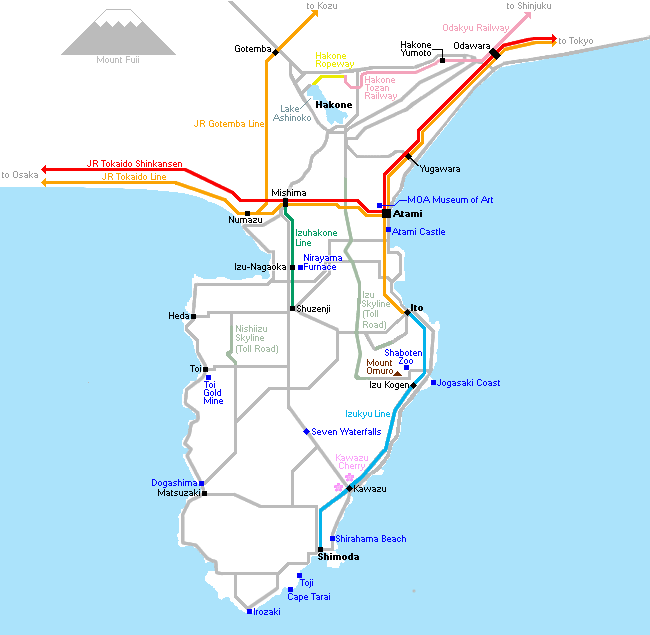
Of course Izu is much larger than just Shimoda. Perhaps @foc was charmed by other towns . . .
Guy
1 Like
It’s been 30 years predicted, so any day now.
1 Like
Money is small part of the problem, men need do more domestic work. Streets safer, kids can not walk out alone with bad traffic. Japan and Estonia young kids take trams and bus alone.
Better childhood, Japanese play sports, football and baseball and others. Japanese have hobbies, some strange but better than looking at screen or long school hours.
Taking a bus is dangerous, see this passenger drag by the bus on the street surface in Taipei
https://www.taiwannews.com.tw/news/6063200
影/驚悚畫面曝!公車夾傷乘客「車底拖行10公尺」 沒等警來逕開走 | 社會萬象 | 社會 | 聯合新聞網
They need fine the bus company millions T$ , not thousands
3 Likes