I know I was lucky but never had this experience. Always kind bosses with generous salaries and vacations (compared to America, Europe is a lazy person’s heaven).
https://www.bls.gov/news.release/wkyeng.t01.htm
If I am reading right, median is around 54KUSD overall, higher for men (59K) than women. But the numbers would vary a lot by region of course and would be much higher for highly skilled workers.
thats the US…
You didn’t mean western US? 
Good salary depends on career stage, your your wants, your needs, whether you plan to retire someday, and, if so, where. That said, some of the lower ranges in the poll might not leave room for meaningful savings, even for a recent college grad with a modest lifestyle–but still might makes sense if part of a bigger plan. The upper end would not be enough to tempt many mid-career professionals from the US (I don’t know other markets) unless they had a need or desire to live in Taipei. Then again, once the kids are all done with college (which now costs up to $85k USD a year for some private schools…), I might be happy with anything that I enjoy, gets me a visa, and pays rent in a decent place while I wait for social security to kick in .
Why are many (not all) salaries stubbornly low in Taiwan? Part of it has to do with an economy that leans on SMEs—and what Michael Turton calls the SME trap, in which an estimated 90% of people who start off working in that part of the economy end up staying in that part of the economy. This is not specific to Taipei, and the findings discussed are from 2016 and 2017, so perhaps this is the wrong thread to post this. But if forumosans are interested, they can check this out:
In a 2016 paper, National Taiwan University researchers Tobias Haepp and Hsin Ping-lung (辛炳隆) showed that underpayment of Taiwanese workers extended back more than two decades even at that time. Capital, by contrast, is overpaid, especially in the manufacturing sector.
The cause of the low salaries is complicated. Locals often attribute them to overeducation: there are too many college graduates.
The issue, argues an excellent chapter on small- and medium-sized enterprises (SMEs) in Taiwan in Industrial Development of Taiwan: Past Achievement and Future Challenges Beyond 2020 by Hsieh Nien-yi (謝念億) of the Chunghwa Institution for Economic Research (CIER) and several other scholars, is the interlocking problems created by Taiwan’s SMEs, the lack of labor mobility and the lack of English skills.
In 2017, government statistics show, there were over 1.4 million SMEs in Taiwan employing more than three-fourths of the labor force, nearly 80 percent of which were in the services sector. Hsieh and her team point out that large enterprises accounted for only 2.2 percent of service sector firms but generated over 70 percent of its sales, with SMEs generating only slightly more than 28 percent of sales.
Additionally, the chapter notes, 5.2 million workers were in the services sector, largely in SMEs. The 70 percent of sales produced by large service sector firms are produced by just half a million workers.
Taiwan’s manufacturing is predominantly concentrated in low value-added manufacturing, despite attention given to a minority of elite firms that are champions in their fields. Low value-added firms have little room to raise wages. The value-added situation in services, the chapter contends, is even lower, with worse prospects for wage increases.
The conclusion is clear: too many workers are “trapped” in SMEs, as Hsieh put it. Once in the SME path workers tend to stay in SMEs, with less than 10 percent managing to escape from the SME world. That means over 90 percent remain there.
This should correspond to the experience of many readers, who watch their friends and former students whirl around a merry-go-round of identical low-paying jobs with long hours, jumping jobs like frogs switching puddles in the rain. This SME trap is exacerbated by the low English ability of this workforce.
Source: Notes from Central Taiwan: Taiwanese migrant workers and the salary crisis - Taipei Times
Guy
Specialty food will always be more expensive.
Only eat vegetarian?
Do not eat pork?
Gluten free?
Only eat kosher/halal?
Only eat European food?
Only eat South East Asian food?
Only eat at Michelin star restaurants?
Only eat at organic?
Only eat Cantonese food?
Allergic to peanut oil?
No MSG?
Only eat when accompanied by alcohol?
Any of the above will inflate your cost by double at least.
To put into perspective, many engineering salary dilluted by many SE Asian (mainly Filipino) engineers that work in science park with salary between 33-48K (minimum required for foreigners with college degree).
Other (non-SE Asian) engineers could easily surpass this threshold.
When I googled for Average Salary in Taipei, Google gave me the following as the top result: What is the Average Salary in Taiwan in 2022?
Average salary in Taiwan is 129,000 TWD. In teaching/education, the average is 137,000 TWD. Is that “good”?
that average salary is teaching in international schools maybe…
To answer your question, yes, its a very good salary, that will allow you to raise a family on a songle income. However, if you want private school for kids, travel abroad every year etc. you need dual income or make more than that.
This can’t be right. I don’t know about Taipei, but I’d say most of my salaried Taiwanese friends in their mid/late 20’s in Kaohsiung make $45k/month ($60k if they teach at KAS or similar). The ones in their early 30’s make $60k-75k.
I’m just talking salary here. Most of my friends are small business owners so they make much more. I’ve never discussed salaries with anybody in their 40’s or above, so I don’t know.
I know salaries in Taipei are higher, but not by much, I’ve been told.
Where do you look? 111, 104, or LinkedIn?
It seems like business owners of almost any business make a ton of cash. But almost every salary position I’ve seen is peanuts, even in tech
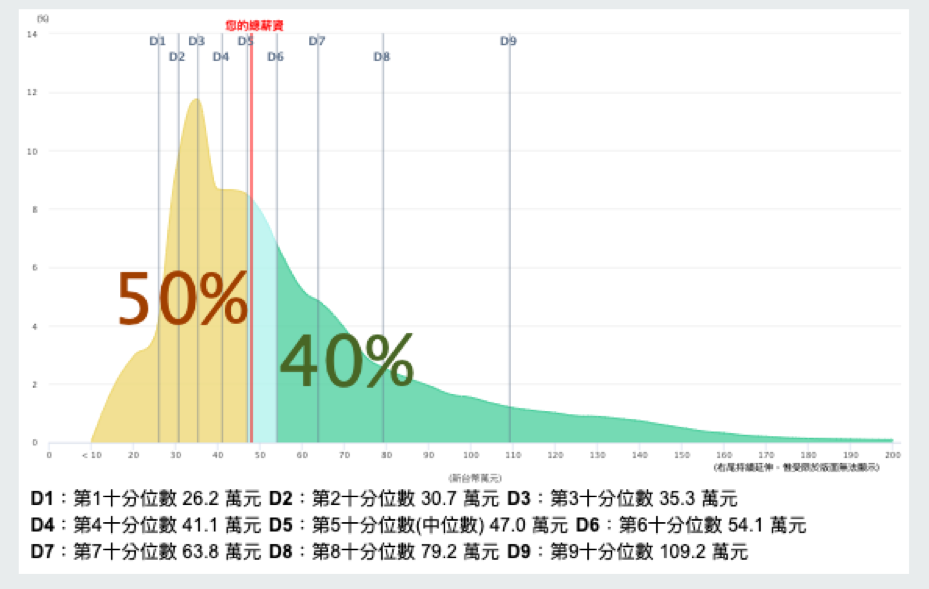
Units in 10K TWD per year.
The median is 470K per year, or around 39K a month.
There are 10% of pops (salarymen) that having salary over 1.092 million TWD annualy.
This counts for teachers, deliverymen, office paper pushers, (real) engineers, government officials, factory workers, food service workers, IT (fake) engineers, bus drivers, etc.
So majority of people (salarymen) ~70% still within 5% tax bracket.
Lastly, pretty sure no foreigners: either expats or migrant workers included in the statistics.
Mostly 104. One was an American MNC and two were small Taiwanese startups. I have mentioned before in another thread, do not pay any attention to the salary stated in the ads. Every single time the actual offer they gave me was 2-3 times higher than the ad.
I’ll leave aside the “good” part and simply say: those numbers (whatever they are) are nonsense.
Guy
Project managers and Specialist positions with higher salaries usually reserved for headhunter commissions.
Some big companies have a deal that hiring (must?) be done through headhunters.
So, if headhunters calling, try be on their good side. They might be your first barrier to high-paying jobs. (Usually they won’t charge you anything ever)
Real managerial position will not be advertised locally. Usually reserved for connections or internal (subsidiaries) referrals. Or for expats in multinational companies.
I think in 104, they just gonna listed as “40k or higher monthly salary”
Tech salaries can be much higher. 300,000+ NTD per month
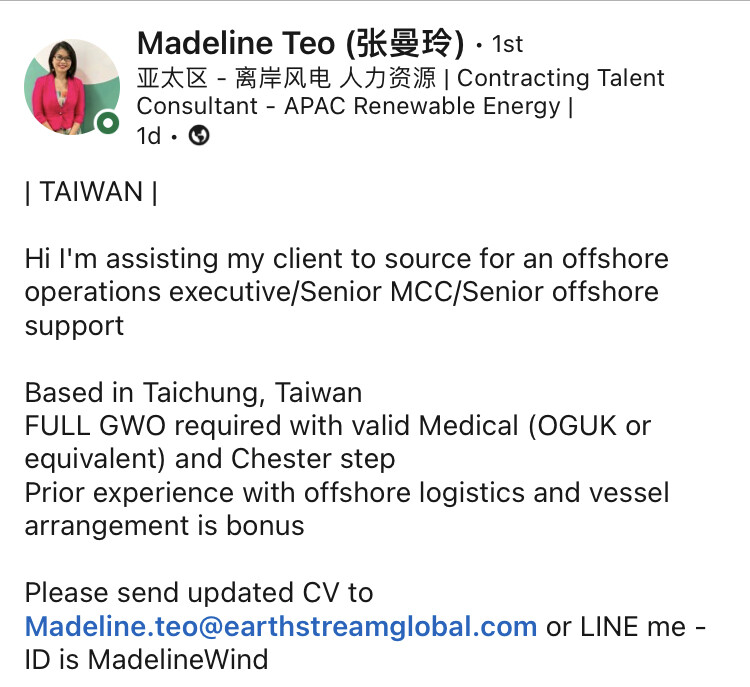
If you want quick buck, keep updated with offshore wind industry in Taiwan, try job titles on wind industry developers (*rsted, Sw@ncor, Jer@, wp&, 1berdrol@, T@iy@) like “Asset Manager”, “Operational Manager”, “Commercial Manager”. They are contract roles with 300k+ a month salary. Usually 1-3 years.
Almost always need headhunters channel.
The job desk much like Barney Stinson’s PLEASE in HIMYM.
If you don’t know…
Provide
Legal
Exculpation
And
Sign
Everything
An example like this opening
Just your typical big names like Google, Microsoft, Amazon would have those type of positions.
Ah so there are decent paying jobs here is what you are saying?
I’m looking to move into either project management, UX research (doesn’t seem possible here unless you also learn design?) Or research consultancy/freelance. I’d also be open to data science.
I was starting to think the only choices were to eventually head back to the USA or try to fangle my way into a remote role (which seems quite difficult if you’re outside the us unless you’re a dev)
Edit: I’m also interested in market research as well