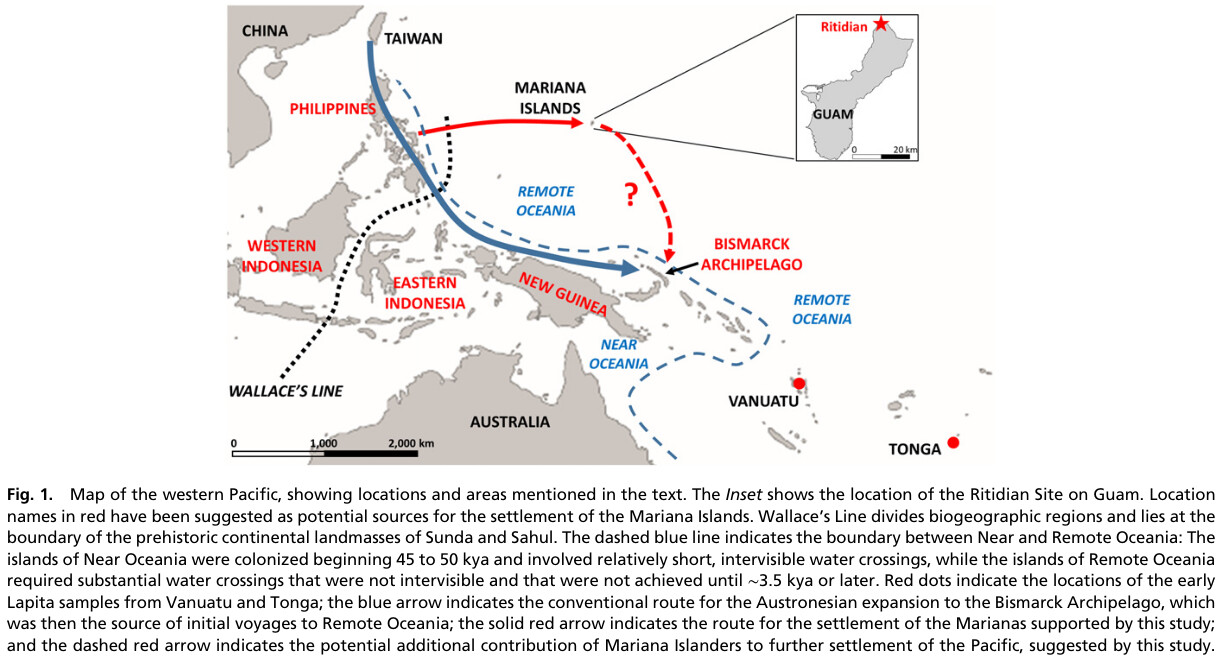
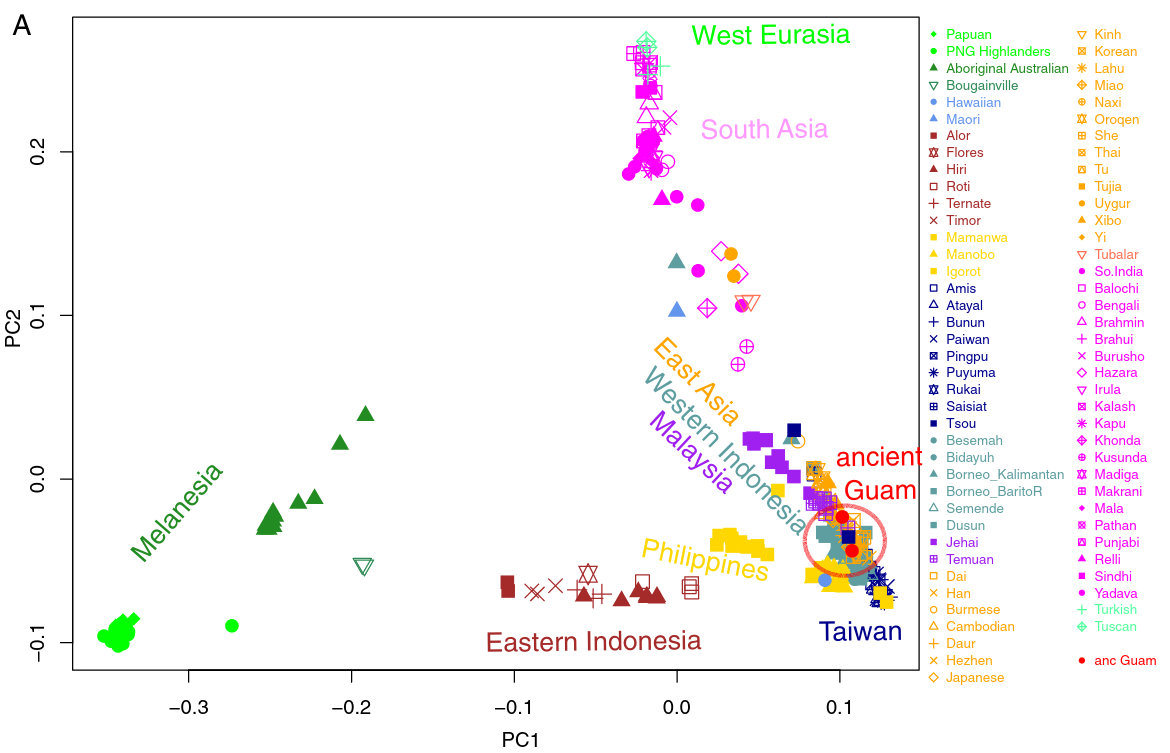
A study of ancient remains found in the caves of Guam’s Ritidian beach found that Guam’s earlist inhabitants are most closely related to the Pangcah (Amis) people of Taiwan and the Kankanaey people of Northern Luzon.
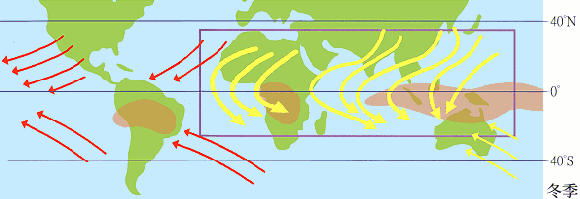
Not clear on why Wallace’s Line is included- are the inhabitants of western Indonesia and Malaysia of different stock than the people of eastern Indonesia, the Philippines, and remote Oceania? Or do they have a different food package than more easterly peoples?
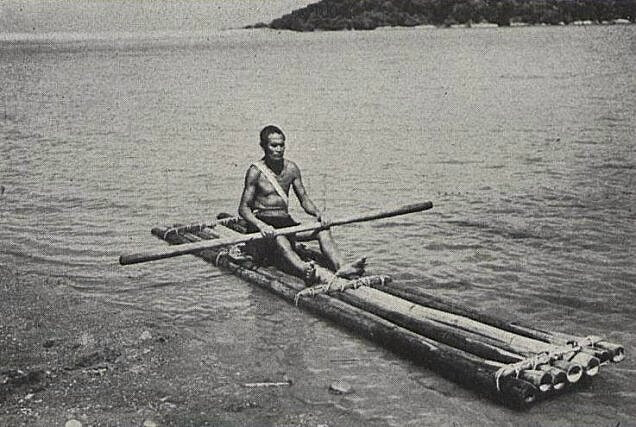
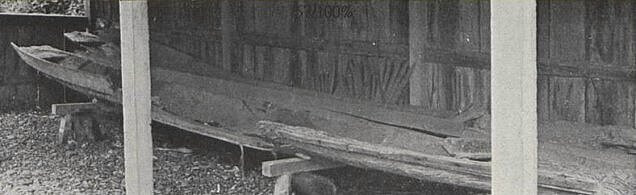
The traditional Pangcah vessel seems to be built with bamboo. Too bad these ancient vessels don’t survive well for us to see how they managed to et across the ocean.
Very cool. There must be some similarities in language. I still remember “hafa adai” on Guam for hello. I went there twice to take a very intense exam. I really liked the people and the island. I’ve been meaning to go back one of these days under less stressful conditions.
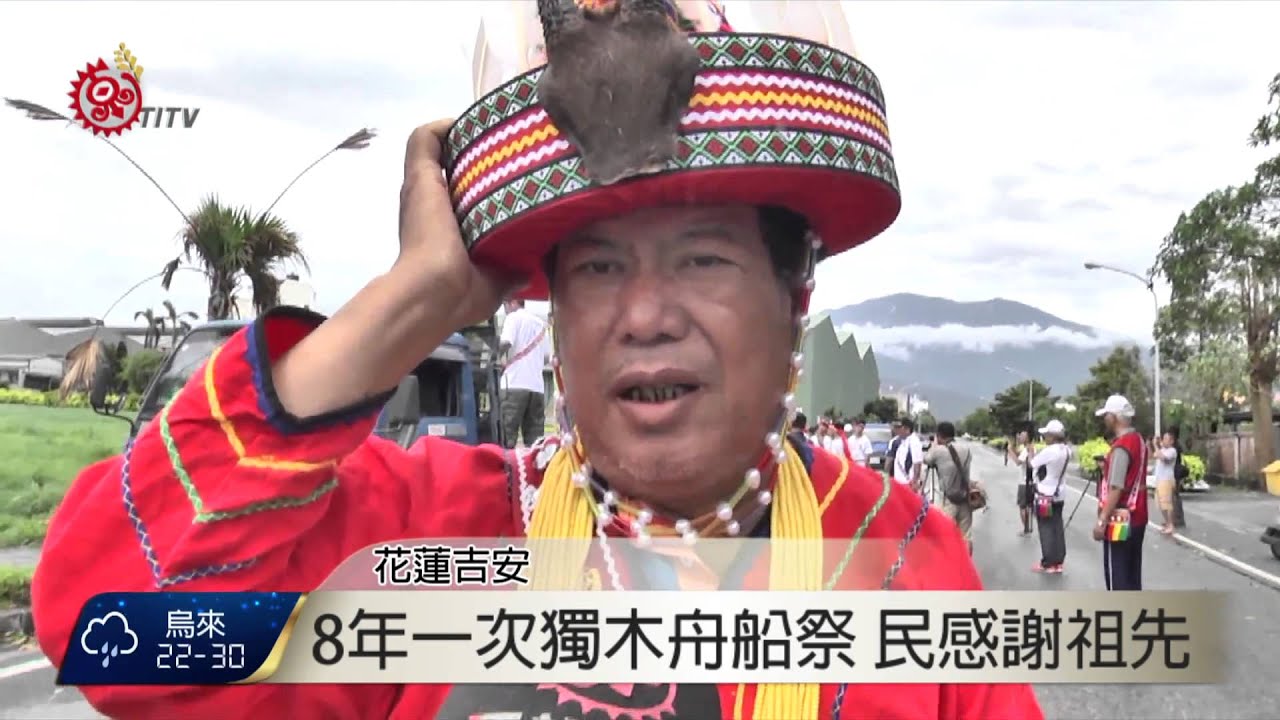
The migrations were so long ago that it could be have been a different culture than the amis that achieved this feat. The Amis could be the descendants of that culture, but not the same culture. Looking at their relative lack of seafaring capability I wonder if this the case.
It’s possible that all the communities’ members who were really good at this left!
Also do not underestimate the impact of waves of colonialism including KMT colonialism which barred many of Taiwan’s peoples from travelling to and from coastal areas due to the KMT’s feud with the Chinese Communists. There were lots of deliberately broken links in knowledge transmission during this era, links that are finally if also slowly being repaired.
The exploration of the Pacific from Asia south of the Tropic of Cancer had to be deliberate. It’s possible to drift from Japan all the way to North America during summer, but it’s much harder to drift eastward down here redardless of the season.
Whether their initial discovery was intensional or not, upon reaching Guam, the Austronesians obviously made many deliberate trips back and forth between Guam and either Taiwan or the Philippines to settle the island.
And what about local intense storms that blew them into a different ocean current?
It’s possible to get lost and then find something. Birds don’t get lost, unless they get blown off Course and some speculate that early man had a better defined inner compass.
The there’s Jung who said the universal unconscious speaks to us and leads us to where we want or need to go .
Not to mention all the Austronesian standard cargo they brought with them to Guam. Rice, taro, Asian yam, breadfruit trees, and many more.
Can’t be sure if they brought paper mulberry trees though. Someone brought banana and sugarcane to the Marianas as well. Not sure what is the earliest date for that yo have happened.