I think part of the issue is the law is also not clear on the tax rule:
Article 20
Starting from 2018, a foreign special professional who has not established household registration in the State, who is approved to reside in the State for the purpose of work for the first time, and who meets specified conditions, engages in professional work, or has obtained an Employment Gold Card under the provisions of Article 9 and during the effective term of the Employment Gold Card is employed to engage in professional work…
So its put on the tax office to interpret what an “effective term of the Gold Card” is, previously if was mentioned if extend the Gold Card first then apply for an APRC could show a soft copy… but still the Gold Card kinda becomes ineffective/canceled when move to APRC.
There hasn’t really been any written official answer on the issue on any gov websites that I’ve seen.
A good approach to clear this up and give confidence to Gold Card holders that the tax benefit would be kept would be a published official answer from the tax office, if the tax office doesn’t have confidence to do that then the law could be updated with similar wording as other benefits such as the extended family visas that specifically address the permanent residence situation:
Article 18
Where a foreign special professional or foreign senior professional has been approved for residence or permanent residence by the NIA, their lineal ascendant may apply to the Ministry of Foreign Affairs or one of its overseas missions for the issuance of a visitor visa, valid for one year
Anyway just my thoughts as I’ve seen this question floating around since 2021 with no clear or published answer.
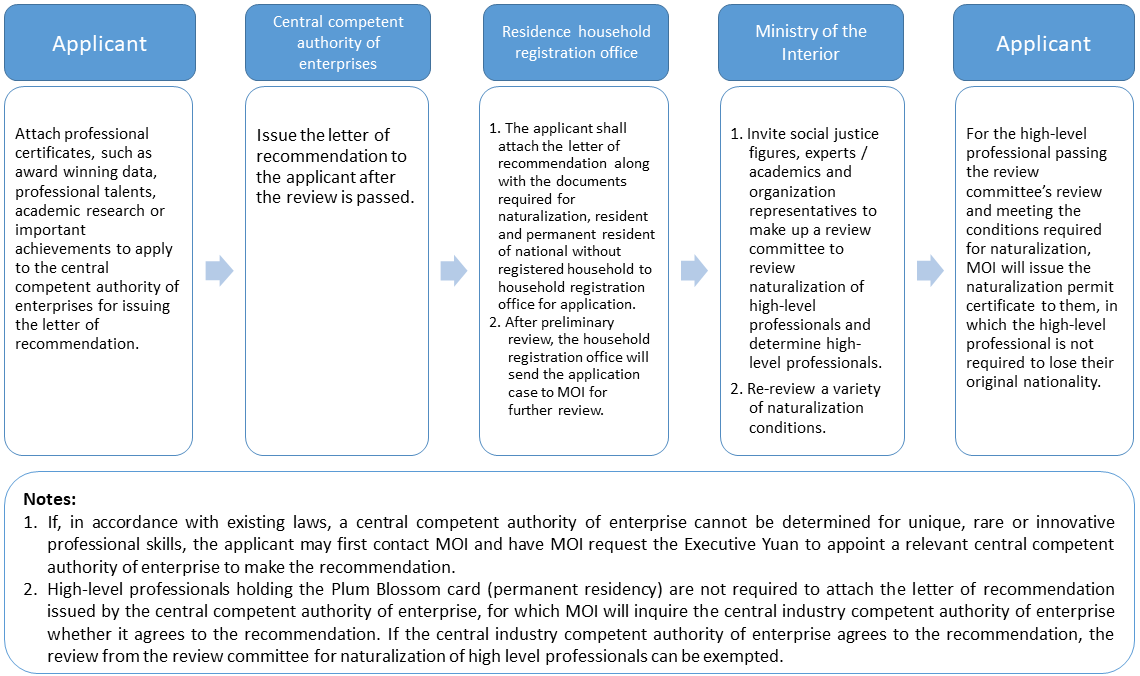
Is this new law, can make a Gold Card holder with professional skills to have naturalization residency and obtain Taiwanese citizenship in 2 years ? Or did I understand wrong ?
yes, if you are a gold card holder who meet the criteria below, the draft says you can naturalize in 2 years without renouncing your original nationality.
Yeah. My meaning is the draft makes no references to being a Gold Card holder. So if on a marriage ARC, APRC etc then anyone can apply to be a Senior Professional. Just making it clear there is no special rules for Gold Card holders.
They use the phrase “high-level professionals” which corresponds neither to GC nor Plum Blossom, so a bit unclear as to what level of expertise they apply
The supporting document(s) issued by the relevant central competent authority or an authorized organization as specified in Article 3 Subparagraph 2 Item 1 refers to a certificate or employment approval letter issued by a government authority
@fifieldt are there any policy guides and contact lists for departments that issue the above letters for foreign senior professionals with regard to both the plum blossom card, and naturalisation.
This is the issue, the criteria r so lax and vague, no one really knows what to do.
U can make a point on “I’m a GC holder already, now would like to upgrade to PBC so can get TW passport and keep mine”, but it ain’t that straight.
There r no actual SOP with all the Central agencies for PBC, they have for GC, but not so much for PBC since so little have ever been issued, even less senior foreign professional status recognitions for recommendations to the MOI panel for the citizenship renunciation exemption.
Yeah I actually think a four-tier system is an interesting one.
1- Blue collar workers
2- Normal White collar
3- Gold Card holders
4- PBC holders
But they need to further flesh them out. Most importantly path to dual citizenship should be extended to all of the above but maybe with different residency requirements. I see no problem with asking 12 or even more years of continuously living here for a blue collar worker but the paths should be such that any individual with enough perseverance can achieve it. Right now blue collar workers can’t even get APRC without massively upskilling efforts.
I agree with the sentiment, especially in regards to things being not flushed out
12 years sounds like a long time though. In some ways I think the residency requirement length should be same, or maybe even, shorter for blue collar workers. It might solve a lot of inefficiencies in the labor market and improve pay, working conditions, and Taiwan’s abysmal workplace injury rate, if foreign blue collar workers could switch employers and keep their health insurance way sooner in the process and without entering the immigration purgatory of being a “runaway” worker.
It’s kind of crazy that you can get an APRC after only a year plus 1 day if you have a PhD and a gold card, but all these blue collar workers working way tougher way more dangerous jobs for years and years have no clear path to one.
This might just be the dreamy liberal in me, but my theory is that giving migrant blue collar workers more favourable immigration status options and better working conditions, that would also improve the lot of workers, foreign and local, across the entire economy. Some of the most exciting unions and collective worker action that I’ve seen in Taiwan has been among the migrant workers and I think it’d be great if better immigration status options made them even bolder in fighting for worker’s rights, and, in the process, improved labor laws and workplace culture for everyone.