It is against this background that China’s fierce, full-spectrum campaign against Japan must be seen. Chinese officials issued furious denunciations. Military pressure intensified around Japan’s southwestern islands. Economic coercion followed, including restrictions on Japanese exports and Chinese tourism to Japan, as well as threats against supply chains. The message was unmistakable: cross China’s Taiwan red lines and pay a hefty price.
It is now apparent that China made a fundamental miscalculation. Rather than intimidating Takaichi into retracting her statement, China’s bullying is pushing Japan toward greater strategic clarity — and closer operational alignment with the US, as well as more explicit contingency planning involving Taiwan.
The Japanese statement on Taiwan matters because it raises the potential costs of aggression for Beijing.
Japan hosts more American troops than any other US ally in the world. American forces based in Okinawa would be indispensable in any Taiwan contingency, making Japan an unavoidable participant regardless of political preferences.
In this light, China’s coercive pressure only reinforces the logic of deeper contingency planning and interoperability among the US, Japan and Taiwan. Beijing’s campaign is accelerating the very security integration it seeks to prevent.
The irony is stark. China claims its pressure is meant to deter “external interference” in what it claims is an “internal matter.” In practice, Beijing is internationalizing the Taiwan issue further — and transforming Japan from a cautious stakeholder into a more determined deterrent actor in the Taiwan Strait.
Far from reinforcing Beijing’s red lines, the Chinese campaign against Tokyo has narrowed strategic ambiguity, deepened regional alignment and raised the potential costs of any use of force against Taiwan.
Beijing has also exposed a broader pattern in its Asian strategy. By targeting Japan — a historic great power — China is signaling how it intends to deal with others in Asia: through intimidation, economic punishment and calibrated nationalist wrath. This is likely to stiffen resistance among those with the capacity to push back.
Indeed, China’s coercion is already accelerating Japan’s military modernization. Tokyo has pledged to double defense spending, acquire long-range strike capabilities, and harden supply chains against economic blackmail. Collectively, these steps enhance deterrence around Taiwan, even if Taiwan is not named explicitly.
I wonder if Japanese lawmakers have a coordinated strategy at work, and either way how far are they gonna keep pushing this?
Meanwhile China is blasting Trump for illegally invading Venzuela and capturing their president.
I really feel irony is dead in 2025.
China is pushing this, not jaoan. everyone else is on self defense mode. Only one country is on the offense here, trying to oppress and cause issues….if they clam down and admit they started a civil war, seperated their own country and killed tens of millions of their own citizens, then stop trying to pretend they own all the land outside their renegade intentions….everyone would be way more at ease.
They don’t, so the world can’t. Basic.

Prefer I said 2026?
Shi Ping was born in Chengdu, Sichuan on 30 January 1962, and his parents are university instructors. During the Cultural Revolution, his parents were sent down to a farm, while Shi was raised by his grandfather, who was a traditional Chinese medicine physician in rural Sichuan. His grandfather had secretly taught the Analects to Shi.
Most of that information was in my link, and doesn’t speak to the question I asked. Do you have anything to contribute?
yes i was wondering who he was. apparently a nobody
no. irony won’t die easily. the year doesn’t matter
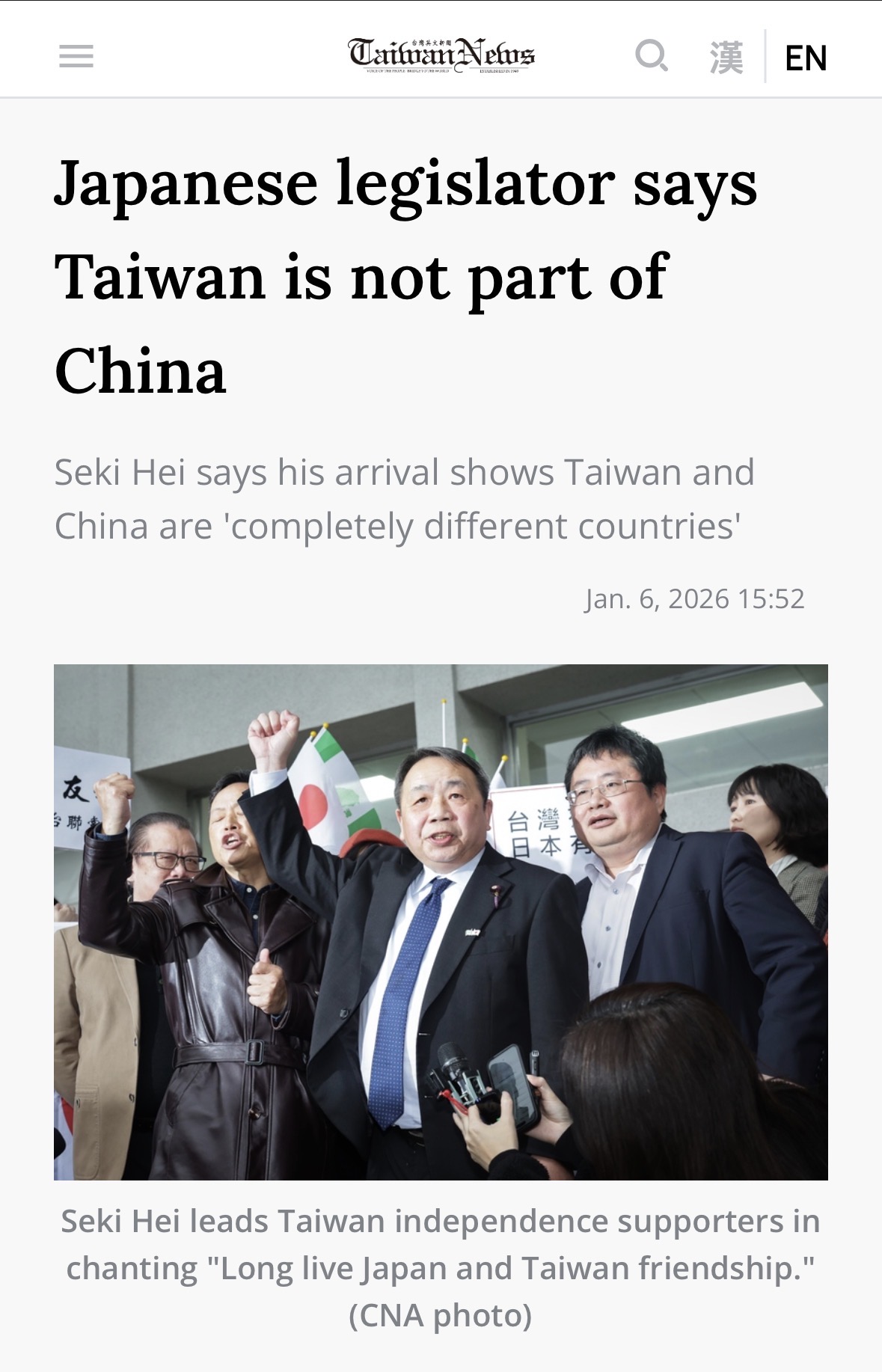
He’s a Japanese lawmaker
Like a US senator
Imagine an american senator coming to Taiwan and saying it was a country? Combined with other moves from Japan, makes one wonder  f there is a coordinated effort underway.
Go see if infowars has an opinion for you to adopt
Credit to him for countering China’s narrative that dominates and normalizes. There should be more of that push back publicly.
If Japan continues their trend, there will be! Not sure who else has the motivation or balls to do the same. I don’t expect it from Korea or the Fils
Someone has to. Lord knows the US is out for the time being.
A dumpster fire is unpredictable. He might decide sharpening the bone spurs for Taiwan is good for poll numbers

Trump’s Greenland push sharpens U.S.-China tensions as Beijing warned against Arctic unilateralism.
China’s Arctic ambitions span minerals, shipping routes and research infrastructure, mirroring the U.S.
China has eyes on Arctic maritime routes that shorten shipping time between Asia and Europe.
In response to the question in the title of this thread: yes they are.
Guy
This year’s Diplomatic Bluebook, to be released by Japan’s Foreign Ministry, will describe China as “an important neighboring country,” instead of “one of the most important bilateral relations,” the phrase used until last year, a draft of the annual report showed Tuesday.
The wording change appears to reflect the current state of Tokyo-Beijing relations, which have deteriorated since Japanese Prime Minister Sanae Takaichi’s remarks last November suggested that an attack on Taiwan could trigger a response from the Self-Defense Forces.
The report will also criticize China for intensifying its unilateral criticism and coercive measures against Japan, according to the draft.
On the Taiwan Strait, where China has been increasing military pressure on Taiwan, the previous report said that peace and stability in the strait are important not only for Japan’s security but also for the stability of the international community.
Right now they’re more worried about the other superpower. Thanks, Trump.
Whoopsie. Idk if the hacker can sell it and not be killed , so maybe he/she should just put it on a CV and get a job at Palantir.