@MalcolmReynolds holding the line up in Shimen! Well done! (Unless you’re in Sanzhi.)
The thing is that cases can easily migrate from Xindian to Wulai and Pinglin. 
My iPhone will occasionally and unpredictably “correct” it to Danshuei.
I thought it was already banned like a week ago, and it’s not like there were people in restaurants before this.
I also surprised about that. Good news in Kaoshuing, seems the report today no new cases locally. There was a few in nearby Pingtung though.
I don’t know, but I asked roughly the same question here a couple of days ago too.
I’m not sure specifically how Taiwan does the PCR tests, that is, whether they’re using actual test kits for each sample (so just a prepackaged box containing the primers, enzymes, extraction reagents, buffers, control samples, etc.) or just have all of those things prepared in bulk in the testing laboratory and only need the samples. The latter would seem more logical for faster testing (cheaper and less wasteful), but I wouldn’t be surprised if they do everything using kits either. In any case, I don’t think the availability of kits/reagents should be the immediate limiting factor at this point – I presume they’ve built up some kind of stockpile by this point. Taiwan seems to produce and export PCR kits to other countries, as well (here and here).
The other main thing needed is some kind of RT-PCR thermocycler, which are pretty much off-the-shelf, relatively cheap instruments about the size of, say, a large rice cooker – these are just automated heaters that do repeating cycles of heating and cooling to separate the nucleic acids (i.e., DNA/RNA), let the primers bind to the desired target, and let the enzyme copy the target sequence, while the signal is being monitored using some kind of fluorescence probe or whatever (so shining light of one wavelength into the sample and measuring the light output at another wavelength). I think this process takes on the order of 2 hours for the 40 cycles, so pretty fast, and multiple samples can usually be run in parallel in some kind of well plate format (so, for example, 96 or 48 samples on a single plate, and I think some thermocyclers can accommodate multiple plates as well). So if you run the numbers you wouldn’t need more than a handful of thermocyclers to meet Taiwan’s daily testing capacity. And thermocyclers aren’t rare – I’ve worked in academic labs where they had several of them in a single lab – so I don’t see how that could be the bottleneck either.
I don’t believe that data processing should be an issue – it’s probably mostly done automatically in the software, with a technician checking the results and that the controls look okay.
If I had to guess, the bottleneck is probably sample preparation – whether it’s done using kits or bulk reagents, someone presumably needs to take the swabs, extract whatever RNA is on there, and plate everything out to put in the thermocycler. They presumably do this in some kind of biosafety lab to protect the operator (I’m not sure the risk here is enormous, but it’s probably there) and avoid cross-contamination as well. I’d be surprised if this is a particularly time-consuming process – maybe a minute or two per sample I’m guessing (a lot of it will be done using multichannel pipettes etc. according to some standardized procedure). There are also automated sample-handling robots to do this stuff even faster (I believe these are used in some medium-throughput testing facilities that were established in the UK in the middle of last year, for example), but I’m not sure whether Taiwan uses those.
In short, I’m not sure where the real bottleneck is. After a year of time to prepare, a testing capacity in the region of 15k tests per day across 112 institutions seems, well, I can’t think of a better word than “pathetic”. Whatever the limiting factor is, I think it shouldn’t still be there at this point.
Also, just found this article. Should probably be filed under “things that didn’t age well”, but it does seem to suggest that at least some facilities in Taiwan use sample-handling robots (the thermocycler is the thing on the right):
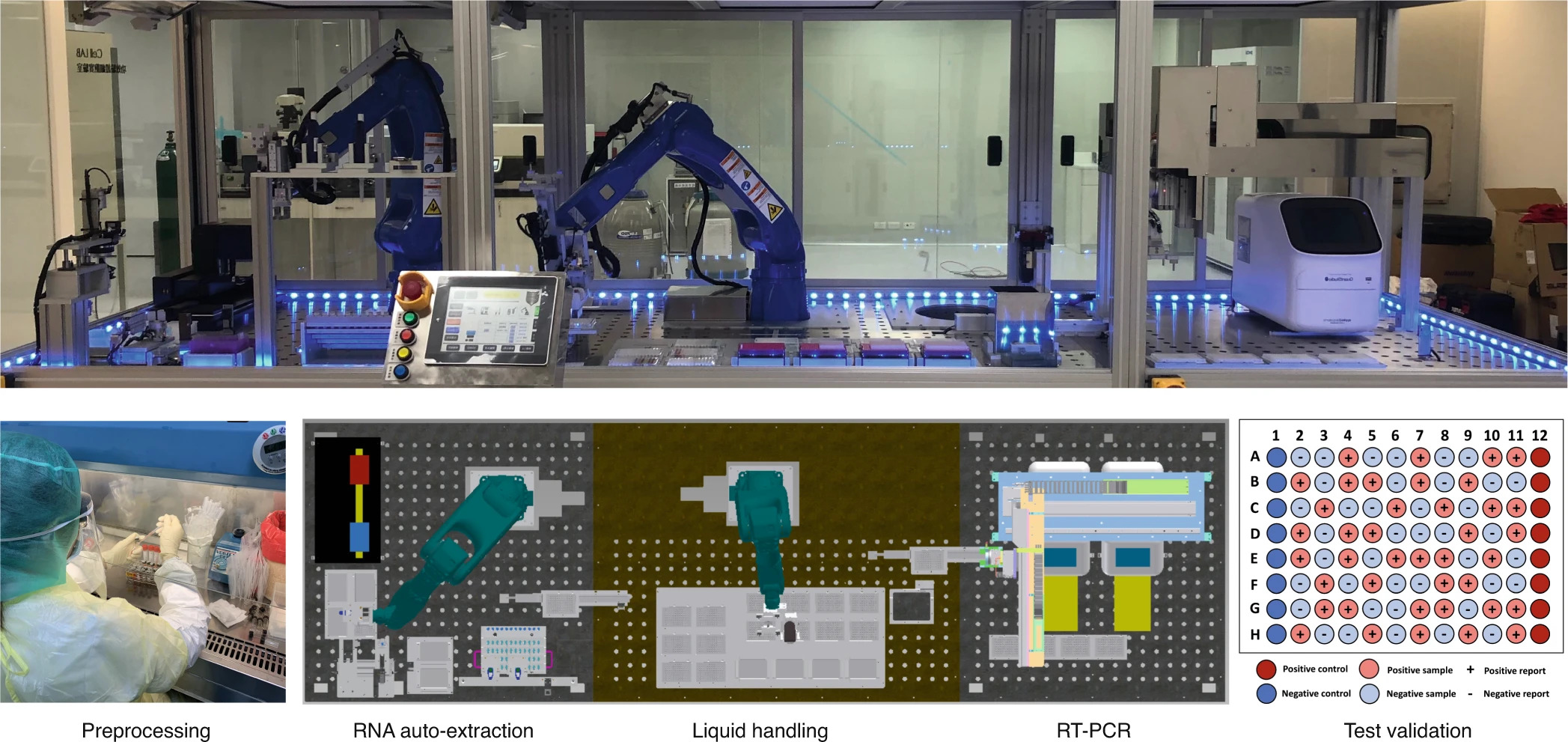
Pandemic preparedness in Taiwan, Nature Biotechnology, July 2020
Edit: After thinking about it a bit more and remembering how banks etc. work here, I wouldn’t actually be surprised if the bottleneck is some administrative/reporting issue, where each test needs to be signed off by 5 people with multiple forms then faxed to the CECC and input into a different system…
I’m sure there’s clusters spreading undetected. Kaohsiung Arena near me was shut down due to a COVID case the other day. That’d be a perfect environment for a spreading event.
I’m in Shimen District, but closer to the town of Sanzhi than Shimen town.
The Sanzhi Case was a student from the Mackay College sometime last week. Quite a few restaurants In town closed out of fear.
So my wife has told me. I’ve voluntarily locked myself down since I can’t surf anyway.
All kinds of things that people don’t think about when under a lockdown.
There’s a reason that mail from overseas is taking like 3 weeks or longer (for even simple business letters). Guessing they (Chung Hwa Post) put them “somewhere” for 14 days.
This could happen for recycling, and maybe even trash. Like put trash in some area of complex for 14 days and then it’s collected. Anything and everything will change.
WHO started this ridiculousness by originally claiming the main source of transmission was contaminated surfaces, when it’s actually aerosols (this is partly why it’s so contagious as it’s much harder to avoid someone breathing or coughing than it is touching a staircase bannister or door handle). The trash would be fine to handle after a few minutes, unless a COVID infected patient literally wiped his nose or coughed directly on it.
Not arguing with your logic, but try telling that to the trash collectors who live with the smell of trash for up to 8 hours a day. An unthankful job.
But under Taiwanese weather conditions this would be like an incubator. I would not want to open garbage bags to recycle stuff after it was laying in the heat for two weeks.
It will be full of mold and what not.
Now can you see why Minister Chen was so reluctant to enact a strict hard lockdown?
Everything will change for the worse. Mass unemployment and all that. And Taiwan exchange will nosedive too.
Don’t get me wrong. I’m not saying that will happen, but rather all kinds of impacts on people’s lives will soon appear that was not thought of before, whether to a certain degree, big or small.
I agree. People arguing for Level 4 are not thinking about how many businesses will shut and how many lives that will destroy.
I still think we can get through this without a hard lockdown (I’d argue with dining, parks, department stores and schools shut, plus societal pressure to stay inside, we’re already in a soft one). If cases were already in the thousands like some were predicting they would be, then I might change my mind.
The government still needs to give out money though. Not more of that stupid coupons either, just cash deposited into our accounts.
Unfortunately, I just showed that chart to my partner, Bad decision, one case means that I am not allowed out, too dangerous I am told.
Dohhh!
Thank you, @icon! Very useful. And what newspaper site is this graph from, please?
1-2 weeks level 4 might cause less damage than 6 weeks of level 3 with the current additional restrictions