Damaged Spark Plug Hole Thread Chaser

And now is some other time.

I used the “torque translation” procedure when I put the head back on. Bit more convincing/consistent this time, though I knocked the box holding the bolts in sequence over, so they are randomised WRT the original order.

Plotted in Calc (which I’ve just started to use. Formats a bit screwed compared to Excel) one can see that Bolt 5 hardly changes angle between 10 and 20 ft lbs, i.e. its stuck. Maybe thats what galling looks like on this view. though I would have expected it at higher torque values.

HeadBoltTorqNangle2

According to the previous owner, this engine has had a head gasket failure, so the bolts have probably been re-used at least 4 times (though of course I don’t know if they were used “dry” by the pros and would doubt it.) This may be enough to compromise the thin black oxide coating and allow galling.

If I have to do it again (which unfortunately seems likely) I’ll probably lubricate them and use the angles.

I may just start from finger tight and use the total angle, since I’m not sure of the rationale for starting at 1/4 torque.

It seems to assume the initial torqueing is not affected by lubrication, which seems unlikely?

DO NOT lubricate head bolts unless the manual says specifically to do so. Assuming not (most don’t) but you feel you absolutely must use “something” then use the Loctite product that’s specifically designed for this use case, (p/n 1158514). A high temp sealer like Permatex #2 could also be an option if the right Loctite product isn’t available.

But I’ll say again, the right answer is (almost always) just leave it clean and dry and torque it correctly. :wall:

(But why? “Well over half of the torque applied to a bolt when it is being torqued up is lost in friction. So if you lubricate a bolt when the manufacturers say that it should be done dry, it will reduce the friction losses which will result in the bolt being overtightened due to the much higher induced load in the bolt . This could lead to a subsequent failure of the bolt.”) :no_no:

Not using this procedure.

I’m not concerned with the torque at all, now, since, once I have the required degrees of rotation, (which I think I now have) I don’t need to measure torque or use a torque wrench, though I probably will out of curiosity.

The idea here, as I undertand it, is that if you turn a threaded fitting through, say, 360 degrees, the end of it will move a distance which depends on the thread pitch

That distance is not affected by friction, which only affects how hard the fitting is to turn.

I suppose there may be a very slight difference due to the lubricant film thickness adding to the thread depth, but that isnt a friction effect, and will be tiny.

That seems clear and valid enough (to me). My problem with the method as described is that it takes 1/4 of the torque spec as a starting point.

This seems to assume that the initial torque is unaffected by lubrication, which seems unlikely, so I THINK finger tight might be a better starting reference point.

The angular difference between finger tight dry head bolts and the same bolts with aluslip was between 0 and 5 degrees, which can be ignored

Torque is a rather uncertain guide to bolt tension, and in this case, simply using the specified torque means I would have to do it with dry, unlubricated threads, which I don’t like doing.

So this might be a better way of doing it, and I should be able to use it to “translate” other dry torque specs I might encounter in the future, so its worth trying to work it out.

Its not my main current concern, though. My main current concern is I can’t get the bloody crank bolt out

But why not? I mean, if that’s literally the way it was designed, presumably by engineers with far more knowledge than all of us randos?

Can’t find a longer lever? Gotta burn some incense to Archimedes! :stuck_out_tongue_winking_eye:

What about using a pneumatic impact wrench?

That would be worth more than the car.

1 Like

Many many times more than the car, since you’d need a generator, an air compressor powered by the generator, the pneumatic impact wrench powered by the air compressor, and a nice truck to carry them all in.

If I had a nice truck (which I’m not allowed to have in Taiwan) I wouldn’t have bought the car.

Plus there is a school of thought that says it is bad for crankshafts to be attacked with impact wrenches. This school of thought presumably doesn’t include any professional mechanics, but that doesn’t make them wrong.

Electric impact wrench (probably starting around the scrap value of the car) might be a possibility, if they got enough juice.

MIGHT be a job for a mobile mechanic, if one knew of one.

You are tempting me to break out the charcoal again, though it would require some ingenuity to apply extreme heat in that location, and I’d worry about damage to bearings, seals, and maybe even crank temper. (I worry a lot).

Access is restricted. There is only space to get a ring spanner on directly and I only have a double-hex in 17mm. I tried a bottle jack on the other end of the ring spanner and it lifted the front of the car off the stands, but no budgee.

When I let it down it pinged off, ricocheted, and narowlly missed my head.

I could perhaps source a 6-point 17mm ring spanner but they seem pretty uncommon so might have to be via the web. Doubt it’ll work anyway.

Using a socket and T bar, you have to use an extension through the port in the wing, which used to have a rubber bung but I lost it. That puts the load from the jack off axis, and it twists out.

Doing it manually with long tubes as levers you need three extensions to get clear of the wheel arch, so as above with nobs on, plus I have a torn up left shoulder so probably arent cabable of applying nearly enough force manually.

The 17mm socket (6 point) is looking pretty beat up and there is some damage to the bolt. I could get a better socket, perhaps one of those profiled to apply load to the flats (can’t remember what they are called) but I doubt that’ll do it.

Taking the engine out is a very very last resort.

I had pretty much decided to give up and wiggle the cam sprocket back on with the original 12 year old belt, but that aint so easy either, so I went back and had another go at the crank bolt.

I can see me alternating between the two indefinately until something breaks, probably me.

Those engineers are probably all dead, and this isn’t their car.
They specified dry for the CB20 engine. They don’t specify at all for the CB22 (which this is) or the CB23, so fuck them.

I rather doubt that maintaining a 37 year old example on a shoestring entered into their corporate consideration at all anyway.

A couple of issues did occur to me with the ““Torque Translation”” method outlined above. though, of course after I put aluslip on the threads.

In a situation where re-torqueing is likely to be required, say because the head gasket compresses further after a few hundred miles, if you use the angle to replace your torque spec, you can’t do it, since the angle wont change.

Only work-around I can think of is to record the final torque reached while setting the final angle, and then re torque to that.

Dunno how accurate that’s likely to be.

There isn’t really any rotational force applied to head bolts in service, so clamping force is whats important, and thread friction doesn’t matter much.

OTOH there definately IS rotational force applied to say…oh… just picked at random…a crank bolt, so I suppose reducing the thread friction there, even while applying the correct clamping force MIGHT be an issue.

Only if I get it off though

This is the way, and turn the wheel out so you can use the tire as a brace to keep the extensions in line. (Would also recommend sourcing one or two of those super long extensions so you don’t have the cumulative slop from all the junctions).
Then get a 10ft (3m) length of steel pipe to be your lever.

Doubtful. IIRC you don’t have access to the port with the wheel on (its off) plus the force is being applied so far off axis that it is likely to twist out with any socket.

Possibly providing it with a fulcrum support of some kind at the end of the lever (maybe stack the wheels up. Maybe thats what you meant?) would help

There is a tool widely available in Taiwan, which I THINK is maybe aimed at riggers or scaffolders, which is a socket with a scary sharp pointy lever handle, which could possibly work as a marlin spike, and is probably also intended to take a tubular extension lever.

The standard version has a ratchet socket and won’t fit, but there are cranked and flat ring spanner versions one of which I think would, and would be ALMOST perfect for this job, except they are 12-point, and maybe not strong enough.

Spent the afternoon in Ktown looking for a 6-point version, but many M-words later have to conclude they probably don’t exist.

Pity.

Not keen on risking it with a 12-point.

If you turn the wheel all the way to the right it should fit perfectly, (unless you’ve got over-sized tires or something). I think you mentioned the rubber bit for the passthrough hole was missing as well, suggest going to a junkyard and getting another one to help with alignment.

But if the engine is in the car why can’t you use the starter trick? :thinking:

Pretty sure this is incorrect, but I’ll have a look.

The rubber bung won’t help with alignment, because its a rubber bung.

I suppose it MIGHT help with alignment if I had one, and drilled a suitable hole in it, making it into a grommet, but IIRC it wasn’t very deep, so would probably just come out if any load came on it.

I can’t use the starter trick right now because my cylinders are packed with rope to stop the engine rotating. Something might give, probably the starter ring gear.

If I undo that, by taking the head off, the starter trick would still be risky (though perhaps not absolutely impossible) because the original timing belt is still hanging around.

To remove the timing belt I have to take the crank bolt off…which is what I would want to use the starter trick for.

Not at all, it’s actually the (unofficially) recommended method. But yeah, I would have tried that before packing the cylinders. :joy:

Seems like you know all your options though, good luck! :sunglasses:

How come? Whats to stop the loose timing belt getting jammed up when the crank rotates?

If one ignores that, because maybe one is feeling lucky, you still have the problem of securing a spanner in place, which will take more than luck.

Childs play

Or not

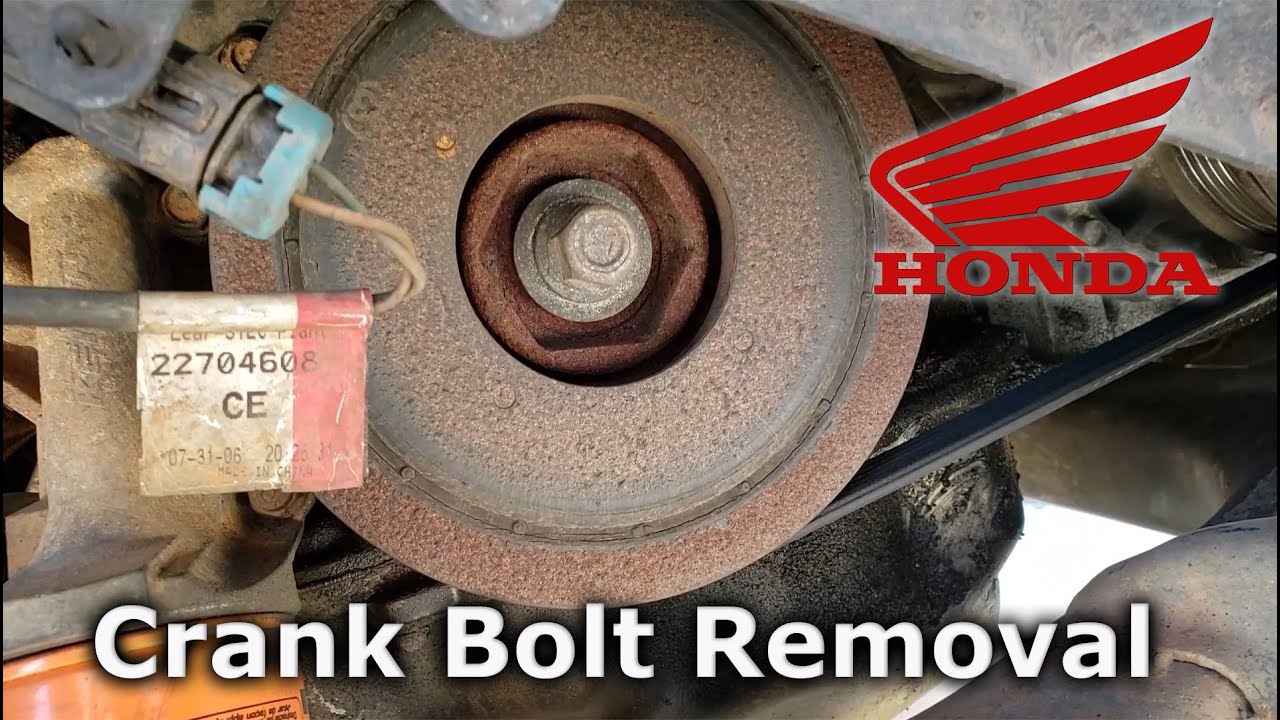
Lots of the “Not” stuff on’t ootoob is Honda, which are apparently pretty tight.

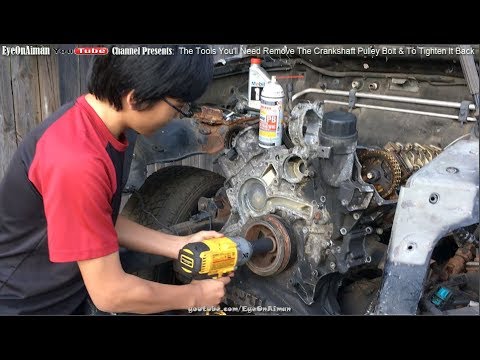
For example

However, there are special tools available for that (crankshaft lock and special impact driver) and access is pretty good.

I should be so lucky

I thought it was a Daihatsu? :thinking:

Correct

duplicate broken post (see below)

Most of the vids of people using long extensions and levers they use an axle stand as a fulcrum.

Using the front wheels (plus some hardwood planks, and some steel tubes) as a fulcrum means you can stand on the extensions to stabilise them, and put your leg and back (and torn up shoulder) muscles into it.

CRAK! not my shoulder. (Well, not JUST my shoulder)

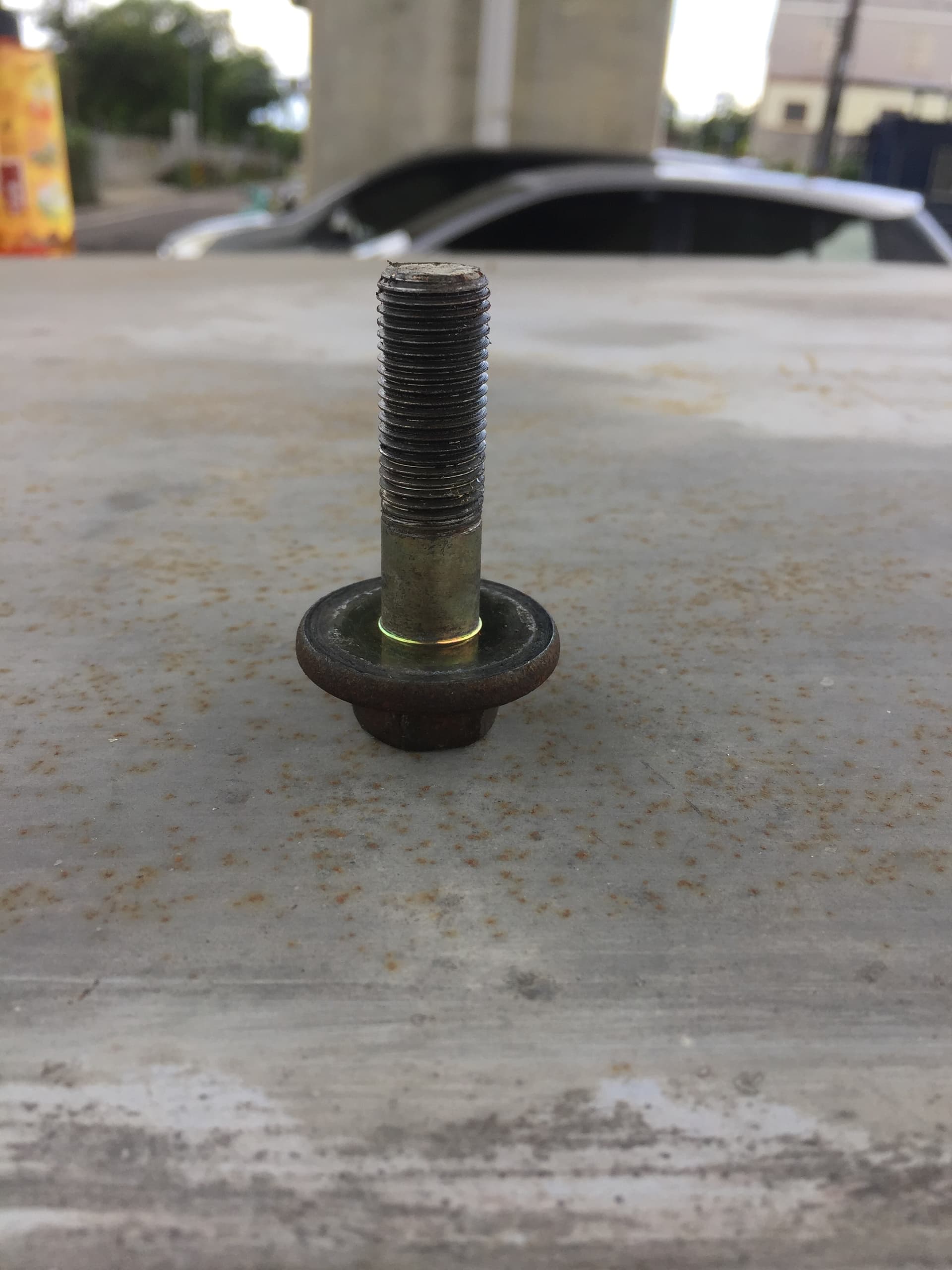
Awkward little bugger. Dunno what the black stuff on the threads is, but evidently not graphite. Maybe iron filings.

Now to get the pulleys off. Outer one is for the aircon, and likely not a standard Daihatsu fitting. No clearance to get them off the crank, so they’ll need to be separated, involving removing 4 recessed and almost completely unreachable bolts, or the engine will have to come out.

If I get it off I might not put it back, assuming I don’t need a shorter crank bolt if I do that

Oops. Images look OK in Linux. Without unzipping still bust on here, but OK from Windows. That’s a pity.

Maybe its STILL the old tar-pit snare and delusion, though it was looking better this time around.

2 Likes