I’ve been wondering how to choose an eSIM plan without getting eSIMs from Chinese telecom companies. This video spend 7000 NTD to try most Japan eSIMs available.
A good observation is that most eSIMs that claims it can allow you to swap networks within Japan will be Chinese telecom products because that is only achievable while data roaming, and it would mean the eSIM is issued by a Hong Kong or China based telecom that is just data roaming in Japan.
I suspect if your eSIM instructs you to turn on data roaming, that would also be a sign that you are using a Chinese telecom product. Instructions for activating povo (KDDI) eSIM did not include turning on data roaming.
Lastly, if you can find out the ICCID for your eSIM before purchase, after the initial two numbers 89, it would be followed by the country code the place that issued the eSIM. So for native Japan eSIM, ICCID would be 8981, for Korea it would be 8982.
Saily basically is using Hong Kong eSIM is roaming in Japan. That means your packets have to travel to Hong Kong first and come back to Japan. That of course has some issues, like delay, and data security issues. Also, Saily is in the same corporation as SurfShark and NordVPN, and with its Asian servers being based in Hong Kong, Saily IPs are VPN IPs, and would often get blocked by banks and other services.
Also, whether eSIM works well depends a lot the base bands that your phone supports. Even if your phone supports all the base bands used by that telecom company, internet speed can still drop off if your phone doesn’t support carrier aggregation for those bands, since some phones will only include CA for bands available for the country where the phone was bought.
For example, these are the base bands used by the 3 major carriers in Japan.
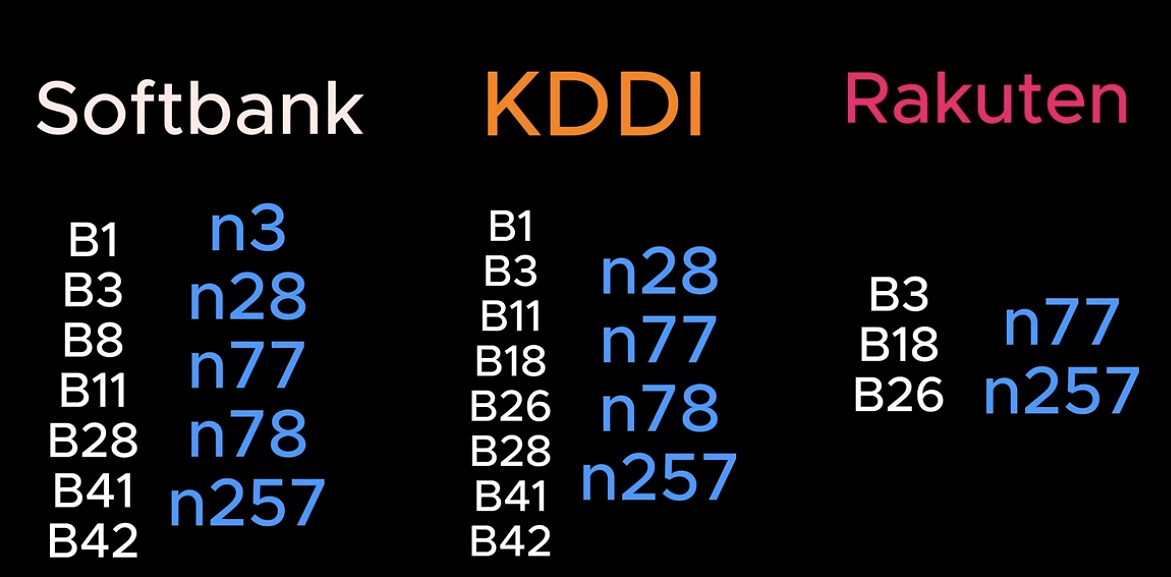
Most eSIM capable phones in Taiwan don’t support all of them.
My Zenfone 12 for example only supports these:
n1 / n2 / n3 / n5 / n7 / n8 / n12 / n18 / n20 / n25 / n26 / n28 / n38 / n40 / n41 / n48 / n66 / n77 / n78 / n79
Taiwan’s Iphone 17 Pro supports:
n1 / n2 / n3 / n5 / n7 / n8 / n12 / n20 / n25 / n26 / n28 / n30 / n38 / n40 / n41 / n48 / n53 / n66 / n70 / n75 / n77 / n78 / n79
Taiwan’s Google Pixel also don’t have n257 support, so say if you get Rakuten SIM card or eSIM for your Taiwan bought phone, you are going to be stuck at base 5G speed.
Your phone is using CA when it indicates your network mode is 5G+. Many carriers only provide None Stand-Alone CA, which uses 4G with 5G, and then you’d also need to check your phone’s 4G base band support.
Someone made a very comprehensive chart of Japanese carriers’ CA support
Tells you whether you’ll get a Japan IP, Taiwan IP, or Hong Kong IP.
All that to say… it seems way too complicated for the average user to figure out before a trip, but next time I’ll use KDDI or its subsidiary povo’s eSIM.


