When I realized that I should learn Taigi back in the early 2000s, it happened to be the time when the proponents of POJ and TLPA deciding they should put side their small differences to team up against other systems like Tongyong as the CSB government was pushing for native language education in schools and had to pick a system. In that old post, I recounted what I remember about the creation of Tailo, the MOE’s current romanization system and how the Ma administration later hijacked it by giving it awkward names.
I recently came across a comprehensive detailing of the history of Taigi romanization in 2 facebook posts:
The author starts with Walter Medhurst’s 1832 A Dictionary of the Hok-Këèm Dialect of the Chinese language, which was published in what was then Batavia. The author believes Medhurst based his dictionary on Tsiā Siù-Lâm’s (謝秀嵐) 1818 dictionary Luī-tsi̍p Ngée-sio̍k-thong Si̍p-ngóo-im (彙集雅俗通十五音). Tsiā was from Tsiang-tsiu (漳州), so his was a Tsiang-tsiu-uē (漳州話) dictionary.
The author of the facebook post went on to claim that Medhurst’s dictionary was the first dictionary of any Tsiang-Tsuân languages (漳泉語) to be organized in alphabetical order. However, this is where the author of the facebook post might have overlooked earlier works because the Spanish wrote dictionaries such as the 1593 Doctrina Christiana en letra y lengua china, the 1604 Dictionarium Sino Hispanicum, and the 1626 Vocabulario de la Lengua Chio Chiu. Portions of the last book seems somewhat alphabetical.
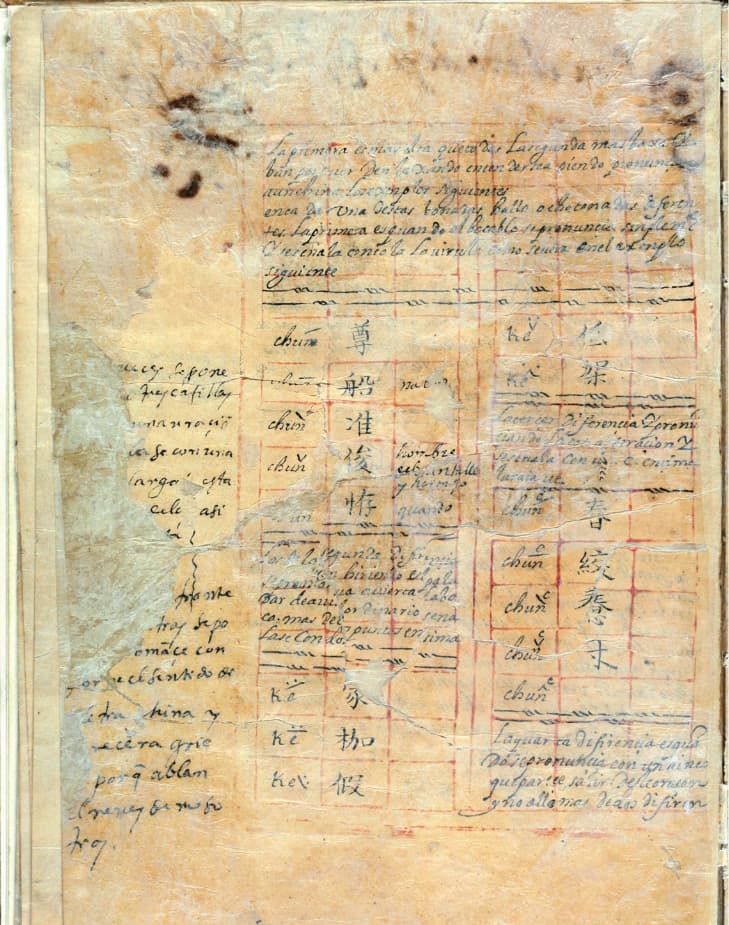
Regardless, in terms of romanization of Tsiang-Tsuân languages (漳泉語), 1604 Dictionarium Sino Hispanicum definitely came first.
Walter Medhurst
You can see how the Old Tsiang-tsiu language differs from the more prevalent Taigi accents today in Medhurst’s A Dictionary of the Hok-Këèm Dialect of the Chinese language
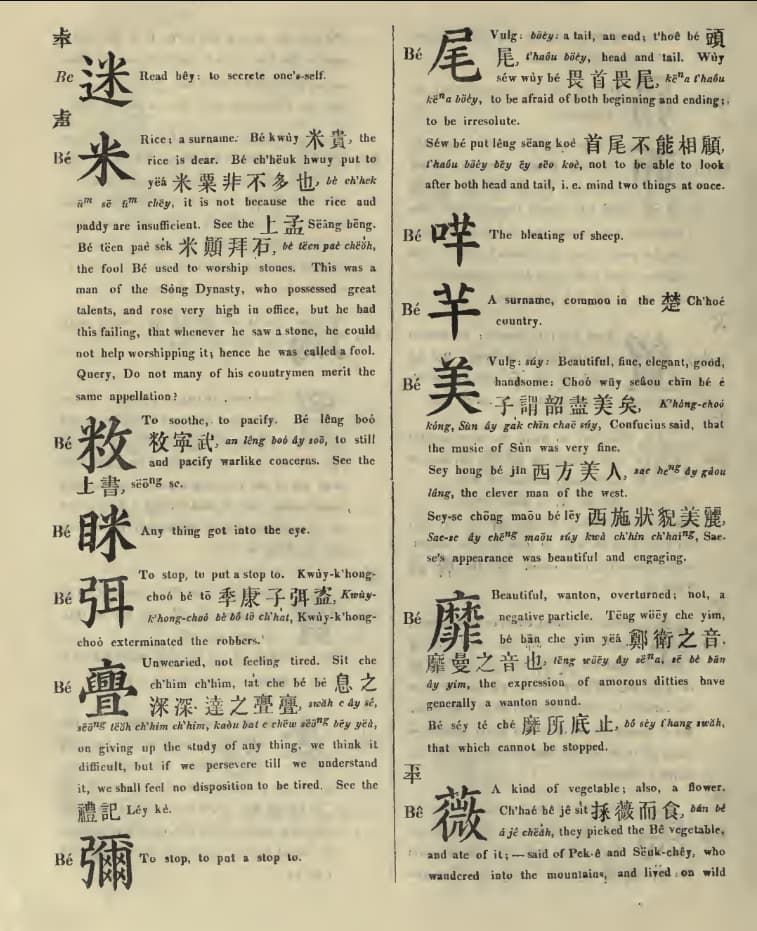
米, 美 are listed under bé in that 1832 dictionary and rhymes with 尾, whereas 米 and 美 could not rhyme for most Taigi speakers, as 米 and 美 are bí and 尾 is bé or bué.
Medhurst’s system
Consonants
| IPA | Tailo | Medhurst |
|---|---|---|
| m | m | m |
| n | n | n |
| ŋ | ng | gn |
| p | p | p |
| pʰ | ph | p’h |
| t | t | t |
| tʰ | th | t’h |
| k | k | k |
| kʰ | kh | k’h |
| b | b | b |
| g | g | g |
| s | s | s |
| ɕ | si | |
| h | h | h |
| l | l | l |
| ts | ts | ch |
| ʦʰ | tsh | ch’h |
| tɕ | tsi- | |
| ʨʰ | tshi- | |
| dz | j | ji- |
| dʑ | j |
For medials with -i-, Medhurst’s system is too complicated to describe in the table.
Vowels and finals
| Medhurst (1832) | ||||||||||
|---|---|---|---|---|---|---|---|---|---|---|
| IPA | a | ia | ua | e | ue | i | o | io | u | ◌̃/-ŋ̍/-m |
| a | ëa | wa | ay | öey | e | o | ëo | oo/wu | ||
| -m | am | ëem | im | |||||||
| -p | ap | ëep | ip | |||||||
| -n | an | ëen | wan | in | un | |||||
| -t | at | ëet | wat | it | ut | |||||
| -ng | ang | ëang | wang | eng | ëung | |||||
| -k | ak | ek | ëuk | eng | ||||||
| -i | ae | wae | ey | wuy | eⁿᵍ | |||||
| -u | aou | ëaou | ew | oe | uᵐ |
Carstairs Douglas
Forty years after Medhurst published his dictionary, Carstairs Douglas published Chinese-English Dictionary of the Vernacular or Spoken Language of Amoy in 1873. Douglas probably found Medhurst’s system overly complicated and inconsistent, and decided to improve upon it. However, this was before the First Opium War, which took place in 1839, so Douglas was confined to Guangzhou like all other foreigners, and did not actually go to Amoy. Instead, like Medhurst, Douglas had to put together his dictionary with the help of diaspora in Indonesia. Having spend a lot of time in Guangzhou, Douglas was influenced by Cantonese romanization at the time.
For consonants:
Douglas kept diacritics just for the tones. So he removed all the apostrophes between ch’h, p’h, t’h and k’h, and separated ch/chh, p/ph, t/th, k/kh when indexing.
He also changed gn- to ng.
He also attempted to change ch- to ts- because he found ch- to be inaccurate before -a, -o, and -u. So in Douglas’ system, 早 is changed from chá to tsá, 知 is changed from chae to tsai, 主 is changed from chóo to tsú. 水 was changed from chúy to tsúi, and 泉 is changed from chwⁿâ to tsuâⁿ.
For vowels and finals:
Douglas changed e and -ë- to -i-. So 台 is changed from taê to tâi and 蕭 is changed from seaou to siau. Also 龍 is changed from lëûng to liông, 仙 is changed from sëen to sien, and 六 is changed from lëu̍k to liok.
Douglas also changed -w- to -o-, so 賴 went from lwā in the Medhurst system to loā, and 蔡 went from ch’hwà to chhoà.
Douglas also changed -oo to -u, -ay/ey to -e, and -öey to -oe. So instead of 武 bóo, we get bú, instead of 茶 tây, we get tê, instead of 會 ēy, we get ē, and instead of 卜 böěyh, we get boeh.
Finally Douglas also simplified -aou to just -au. So 蕭 seaou becomes just siau.
For whatever reason, Douglas omitted -eng and -ek while changing the rest of -ë- to -i-. This exception left 英 as eng instead if ing. It’s something that Rev. Barclay also left unchanged. It might have something to do with them being from the UK.
When syllabic velar nasal ŋ̍ is used as a vowel, Douglas changed eⁿᵍ to just ng, removing the e, and ng are no longer in superscript. So 糖 went from têng to tn̂g. Nasalized vowel was inconsistent in Medhurst’s system. Douglas standardized nasalized vowels with superscript n, and always placed it in the last position, instead of between vowels. So 錢 went from cheêng to chîⁿ, and 山 went from swⁿa to soaⁿ.
Douglas’ system
Consonants
| IPA | Tailo | Douglas |
|---|---|---|
| m | m | m |
| n | n | n |
| ŋ | ng | ng |
| p | p | p |
| pʰ | ph | ph |
| t | t | t |
| tʰ | th | th |
| k | k | k |
| kʰ | kh | kh |
| b | b | b |
| g | g | g |
| s | s | s |
| ɕ | si | si- |
| h | h | h |
| l | l | l |
| ts | ts | ts |
| ʦʰ | tsh | chh |
| tɕ | tsi- | chi- |
| ʨʰ | tshi- | chhi- |
| dz | j | j |
| dʑ | j | ji- |
Vowels and Finals
| Douglas (1873) | ||||||||||
|---|---|---|---|---|---|---|---|---|---|---|
| IPA | a | ia | ua | e | ue | i | o | io | u | ◌̃/-ŋ̍/-m |
| a | ia | oa | e | oe | i | o | io | u | ||
| -m | am | iam | im | om | ||||||
| -p | ap | iap | ip | op | ||||||
| -n | an | ien | oan | in | un | |||||
| -t | at | iet | oat | it | ut | |||||
| -ng | ang | iang | oang | eng | ong | iong | ||||
| -k | ak | iak | oak | ek | ok | iok | ⁿ | |||
| -i | ai | oai | ui | ng | ||||||
| -u | au | iau | iu | ou | ir | m |
Thomas Barclay
Douglas’ system is already very similar to POJ and TL. Thomas Barclay decided to adopt it and altered it slightly.
He changed -ien and -iet to -ian and -iat. Barclay also reverted Douglas’ ts to ch.
Thomas Barclay later published the Tâi-oân Kàu-hōe Kong-pò (台灣教會公報 Taiwan Church News) with this system in 1885 and referred to it as Pe̍h-ōe-jī (POJ).
POJ
Consonants
| IPA | Tailo | POJ |
|---|---|---|
| m | m | m |
| n | n | n |
| ŋ | ng | ng |
| p | p | p |
| pʰ | ph | ph |
| t | t | t |
| tʰ | th | th |
| k | k | k |
| kʰ | kh | kh |
| b | b | b |
| g | g | g |
| s | s | s |
| ɕ | si | si- |
| h | h | h |
| l | l | l |
| ts | ts | ch |
| ʦʰ | tsh | chh |
| tɕ | tsi- | chi- |
| ʨʰ | tshi- | chhi- |
| dz | j | j |
| dʑ | j | ji- |
Vowels and Finals
| POJ (1885) | ||||||||||
|---|---|---|---|---|---|---|---|---|---|---|
| IPA | a | ia | ua | e | ue | i | o | io | u | ◌̃/-ŋ̍/-m |
| a | ia | oa | e | oe | i | o | io | u | ||
| -m | am | iam | im | om | ||||||
| -p | ap | iap | ip | op | ||||||
| -n | an | ian | oan | in | un | |||||
| -t | at | iat | oat | it | ut | |||||
| -ng | ang | iang | oang | eng | ong | iong | ||||
| -k | ak | iak | oak | ek | ok | iok | ⁿ | |||
| -i | ai | oai | ei | ui | ng | |||||
| -u | au | iau | iu | ou | m |
The Dutch System
However, 3 years prior to Barclay publishing newspapers in Tainan using POJ, a Dutch dictionary was published in 1882 called Chineesch-Hollandsch Woordenboek van het Emoi Dialekt. The author of that dictionary is J.J.C Frencken and he was working for the Dutch VOC at the time.
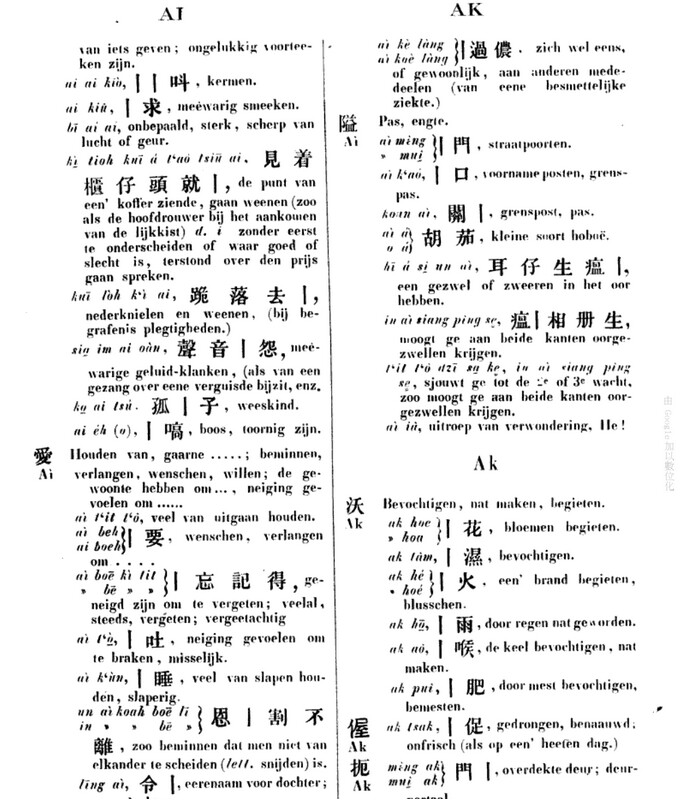
Frencken was actually involved with Douglas’ effort to improve the romanization of Tsiang-Tsuân languages in Indonesia. Frencken felt all voiceless affricates should be romanzied as ts, while Douglas only changed unaspirated voiceless alveolar affricate [ts] to ts. Frencken also felt -i- should consistently be romanized as -i-, instead of having exceptions in -eng and -ek. The details of their discussions are recorded in the 1886 Nederlandsch-Chineesch woordenboek : met de transcriptie der chineesche karakters in het Tsiang-tsiu dialekt published by Gustare Schlegel.
This is what Frencken had to say:
As will be seen, our system of transcription differs in some respects from that of Douglas, though we did our best, during our stay in China, when we had fixed upon our system of transcription, to convert him to it; in which we only partially succeeded.
The principal fault in the system of transcription of Douglas lies in the difference he makes between the words beginning with Ts, which he now writes with Ts, and then again with Ch. The Chinese with Tsiang-tsiu and Amoy do not distinguish these initials, and the Tsiang-tsiu vocabulary 十五音gives as initial for all words beginning with Ts the character 曾tsing, which Douglas transcribes Cheng. Consequently, he galls into an inconsistancy. The 十五音gives for the transcription of this character: as initial 曾tsing; as final 經king; viz.: ts(ing) + (k)ing. As a surname, this same character曾is also pronouced Tsan; according to the十五音: as initial 曾tsing, as final 干; viz.: ts(ing) + (k)an.
Whilst this character ought to be pronounced, according to Chinese authority, Tsing or Tsan,Douglas transcribes the first word with Cheng and the second with Tsan; and so the same in other words. This makes that a whole group of Chinese words with the same initials are separated in his Dictionary into two groups, having arbitratiry the initial Ch or Ts, which two initials, as we have said above are not distinguished in the Tsiang-tsiu-dialect.
A second mistake is, that he has retained the English e for the short i-sound, and thus writes Cheng for Tsing. This, we suppose, is a concession to the English tonal system, which retains obstinately the letter e for the i-sound, though no other nation, except the English, pronounces the e as an i.
So when Frencken wrote his own Dutch dictionary, he made sure those were consistent.
The Dutch System by Frencken
Consonants
| IPA | Tailo | Frencken |
|---|---|---|
| m | m | m |
| n | n | n |
| ŋ | ng | ng |
| p | p | p |
| pʰ | ph | p’ |
| t | t | t |
| tʰ | th | t’ |
| k | k | k |
| kʰ | kh | k’ |
| b | b | b |
| g | g | g |
| s | s | s |
| ɕ | si | si- |
| h | h | h |
| l | l | l |
| ts | ts | ts |
| ʦʰ | tsh | ts’ |
| tɕ | tsi- | tsi- |
| ʨʰ | tshi- | ts’i- |
| dz | j | dz |
| dʑ | j | dzi- |
Vowels and Finals
| Frencken (1882) | ||||||||||
|---|---|---|---|---|---|---|---|---|---|---|
| IPA | a | ia | ua | e | ue | i | o | io | u | ◌̃/-ŋ̍/-m |
| a | ie/ia | oa | e | oe | i | o | io | u | ||
| -m | am | iem | im | |||||||
| -p | ap | iep | ip | |||||||
| -n | an | ien | oan | in | un | |||||
| -t | at | iet | oat | it | ut | |||||
| -ng | ang | oang | ing | ong | iong | |||||
| -k | ak | ik | ok | iok | _ | |||||
| -i | ai | oai | ui | eng | ||||||
| -u | ao | iao | iu | o̱ | em |
Taiwan Romanziation
Taiwan Romanziation (a.k.a. Tâi-uân Lô-ma-jī, 台灣羅馬字, 台羅, TL, KIP, Kàu-io̍k-pōo, 教育部) basically combined the benefits of the Dutch system and POJ to make a consistent romanization system that is capable to representing different Taigi accents (regional variations of Tsiang-tsiu, Tsuân-tsiu, and Amoy languages) while staying as close to IPA as possible. For nasalzied vowel, nn was used instead of the tilda or superscirpt n. For more traditional Tsuân-tsiu dialects, ee denotes [ɛ], ir denotes [ɨ] or [ɯ], er denotes ə, and ere denotes [əe].
As mentioned before, in the 90s and early 2000s, most Taigi linguistics scholars were pushing for TLPA, which attempted to combine the merits of both POJ and Frencken’s system, while making it easier to display on pre-unicode computers. However, POJ proponents couldn’t get onboard with TLPA adapting aspects of the Frencken’s system and instead worked with the Tongyong camp to fight to become the new standard. Tongyong for Taigi, or Dāi-ghî tōng-iōng pīng-im (台語通用拼音 DL), uses d for [t], t for [th], b for [p], p for [ph], and bh for [b], and was obviously much less compatible with POJ, but back in the 90s, DL claimed they have Type A and B systems, with Type B being POJ. By the time Tongyong was about to become the standard for spelling Mandarin, Taigi and Hakka, the Tongyong people ditched Type B all together, and that forced the POJ supporters to form a new alliance with the TLPA camp. That’s what gave birth to TL (Tâi-uân Lô-ma-jī) in 2005. The KMT had been raging war against Tongyong in all sectors since 2002. As the result, the KMT leg legislative yuan opted for TL in 2006, but in the process forcefully changed the name from Tâi-uân Lô-ma-jī (台灣羅馬字) the system to be called 台灣閩南語羅馬字拼音方案, literally Taiwan Minnan Roman-Alphabet-Based Phonetic Transcription System. However, regardless of what it was called, TL was not designed to merely act as a phonetic transcription system. It is based on written traditions of Frencken’s and Barclay’s systems, and had the support of both TLPA and POJ proponents, at least back in 2005/
TL
Consonants
| IPA | Tailo | Medhurst | Douglas | POJ | Frencken | Example |
|---|---|---|---|---|---|---|
| m | m | m | m | m | m | 綿(mî) |
| n | n | n | n | n | n | 耐(nāi) |
| ŋ | ng | gn | ng | ng | ng | 雅(ngá) |
| p | p | p | p | p | p | 邊(pian) |
| pʰ | ph | p’h | ph | ph | p’ | 波(pho) |
| t | t | t | t | t | t | 地(tē) |
| tʰ | th | t’h | th | th | t’ | 兔(thòo) |
| k | k | k | k | k | k | 求(kiû) |
| kʰ | kh | k’h | kh | kh | k’ | 去(khì) |
| b | b | b | b | b | b | 文(bûn) |
| g | g | g | g | g | g | 語(gí) |
| s | s | s | s | s | s | 衫(sann) |
| ɕ | si | si- | si- | si- | 寫(siá) | |
| h | h | h | h | h | h | 喜(hí) |
| l | l | l | l | l | l | 柳(liú) |
| ts | ts | ch | ts | ch | ts | 曾(tsan) |
| ʦʰ | tsh | ch’h | chh | chh | ts’ | 出(tshut) |
| tɕ | tsi- | chi- | chi- | tsi- | 尖(tsiam) | |
| ʨʰ | tshi- | chhi- | chhi- | ts’i- | 手(tshiú) | |
| dz | j | j | j | j | dz | 熱(jua̍h) |
| dʑ | j | ji- | ji- | dzi- | 入(ji̍p) |
Vowels and Finals
| TL (2005) | ||||||||||
|---|---|---|---|---|---|---|---|---|---|---|
| IPA | a | ia | ua | e | ue | i | o | io | u/ɨ | ◌̃/-ŋ̍/-m |
| a | ia | ua | e | ue | i | o | io | u | ||
| -m | am | iam | im | om | ||||||
| -p | ap | iap | ip | op | ||||||
| -n | an | ian | uan | in | un | |||||
| -t | at | iat | uat | it | ut | |||||
| -ng | ang | iang | uang | ing | ong | iong | ||||
| -k | ak | iak | uak | ik | ok | iok | nn | |||
| -i | ai | uai | ei | ui | ng | |||||
| -u | au | iau | iu | ou | ir | m |
The Evolution of Taigi romanization

