@urodacus
Thanks a lot. Although there is a small lockpad next to the thread. Is it opened right?. I am asking this due to it may confuse someone in the main forum if wants to stop by and reply here but may not do so due the small icon.
Actually not. The solution posted by @overflow does uses triangle similarity and if you look at my original post I clearly mentioned that I was constraining the solution to avoid that route. In other words to no use it.
The thing is that this problem belongs to a chapter which has only introduced the following concepts:
-
The sum of angles in a triangle equals 180 degrees because of the identity from the sum of internal angles in a polygon. S=180(n-2), where n is the number of vertex in this case n=3.
-
Triangle congruence, cases SAS, SSS and ASA.
Special lines in triangles and their intersections, orthocenter, barycenter, incenter, circumcenter and excenter.
-
As a consequence from the above, it is likely that using circles may be allowed as they appear as a result of the radius formed either by the circumcenter or incenter. For obvious reasons, with more or less difficulty the alluded high school identity of the inscribed angle can be derived easily.
-
Angles formed by the intersection of angle bisectors in a triangle. That is the intersection of the internal angles bisectors of two vertices which makes up for x=90+a/2. The intersection of two external angle bisectors which is x=90-a/2 and the intersection of an internal angle bisector with an external angle bisector which is x=a/2.
-
Special right triangles, with those being 30-60-90, 45-45-90, 37-53-90 and 15-75-90.
-
Identity that relates that the line connecting the midpoints of a triangle is half of the size of its base.
Thus using only these and no theorems relating similarity it should be solved.
There is a solution which uses similarity as mentioned and is relatively simple than the construction made but again this isn’t exactly the answer that I was looking for thus I asked if somebody known a way to do it bypassing this advanced concept. And I say this in terms of my book point of view of building up skills.
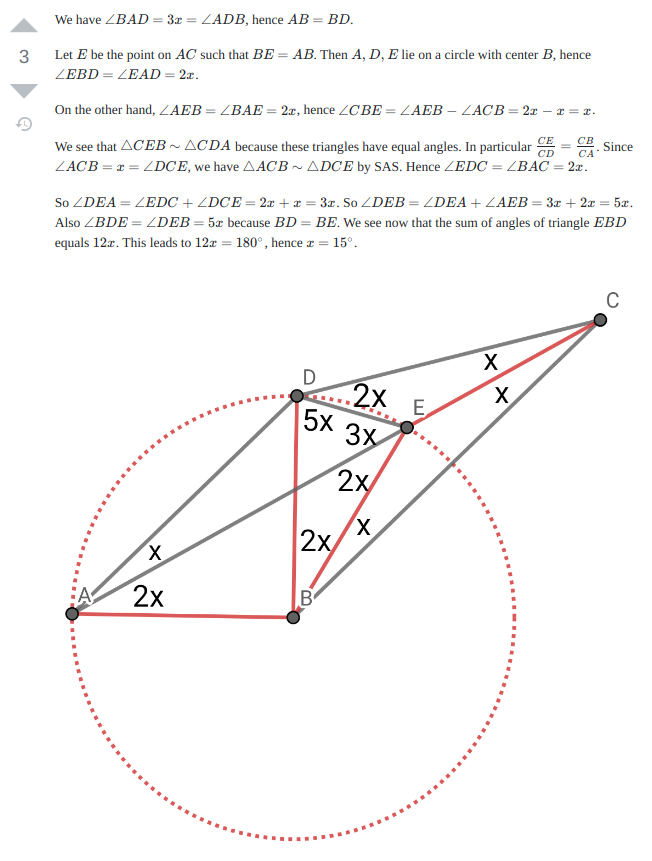
Now looking at the proposed solution it is somewhat difficult to catch the part regarding on how angle EDC is the same as angle EAB.
The geometrical argument discussed uses similarity case SAS (side angle side). Assuming that the angle in two triangles is congruent but their sides are proportional to a known ratio.
Then there is that because triangle CEB is similar to triangle CDA from the criteria of angle-angle (AA) with those being angle DAE same as DCE same as ECB and angle EBC. Thus goes on to say from this a ratio is CE/CB=CD/CA
, I changed to this notation in the answer is stated as CE/CD=CB/CA, but to me the former is more logical and easier to understand.
Thus that is the ratio, let’s say k.
In order to find angle EDC we need to use similiarity of two triangles once again. Since we have the ratio now all is left is to find a congruent angle to use the criteria of side angle side.
Now comes the coup of grace, that angle DAC = angle DCE = x it establishes the congruent angle between triangle ACB and triangle DCE. Which had been chosen on purpose to relate their lenghts.
This part is needed to call for the SAS criteria of triangle similarity. We have ratio and the congruent angle.
This part is missing in the original answer,
because CE=kCB, this k=CD/CA and CD=kCA.
Therefore looking at those two triangles we establish that the opposing angle to CE is the same as the opposing angle to CB. Therefore angle EDC=2x.
The question here is how did you get to know use triangles DCE with triangle ACB. This part I believe it is ingenuity because there are too many triangles there, but the one which we do know something other than our first two choices is triangle ACB.
At this point you may understand that for every specifical problem in geometry you need some dose of enlightenment to invent a particular solution for such problem. I know that not everyone has this gift. But I believe it isn’t galaxies away to get use to it.
Regarding the rest is just obvious to use the fact that triangle DEB is isosceles and the sum of interior angles in a triangle adds up to 180 we get 15 which is our answer.
However this solution is not the allowed method of solving. As mentioned lines above is out of the scope from the topics presented so far in my book and as such it would be some sort of maybe early bird or puzzle presented as challenge. Upon inspecting the order of chapters as similarity is presented way after, I still assume that the author intended that the student would solve it with the already known tools.
So all and all, does someone has other ideas?. I mentioned above that I may want to try contact Mathematical socienty in Taiwan for this. I haven’t writen yet but maybe they will be interested. I’d appreciate this remains open so it may gather some potential players or whoever known to solve this by the allowed methods.
By the way @11173 are you also into geometry?.
 I’m in tears laughing. scrolling through and just keep seeing different people post the same diagram over and over. We got pencil drawings, CAD drawings, photos of a computer screen drawings, screenshots of other drawings not related to the original…we got it all here… except answers