Probably not a lot, but the idea is use very small AC units that draws maybe a few hundred watts rather than thousands. Better if it can run on batteries, meaning you can still sleep if there’s a power outage during the summer.
If it draws a couple of hundred watts it can run nonstop for all I care and the electric bill will still be really low, instead of say a 2 ton AC running nonstop to keep a large room cool. It’s really wasteful if you think about it.
But if heat and mass transfer is gradually occurring across the net, which it will be because it’s a net, you’re ultimately going to be trying to cool the entire room anyway*, using a small unit that isn’t capable of doing that, in which case wouldn’t you get the same result from just running a regular AC on a higher temperature setting that uses less energy?
You seem to expend a lot of energy (mental, not electrical) on trying to minimize your use of AC and the associated electricity cost. Don’t you think it might be more productive at some point to try and increase your income so this isn’t a concern? My last electricity bill was NT$2657, covering mid-June to mid-August I think, so less than 8 hours of minimum wage work per month, and that was with working from home and having at least one AC unit on at 23–25°C probably an average of 20+ hours per day. It’s really pretty cheap.
How often are you experiencing power outages in the summer anyway? I remember one, possibly two, in the four years I’ve lived in this apartment (not including the time I forgot to pay my electricity bill).
(* Also, isn’t a small unit like that just going to be venting the heat inside the rest of the room anyway?)
These have compressors and all that. It’s an AC unit.
But they’re a lot smaller than ones for rooms, presumably so they can run on batteries. If you cook just about a couple of cubic meter of space around your bed, instead of say about 50 cubic meter of your room, it’s going to require a lot less energy, and therefore electricity.
You’re probably going to open all doors in windows to your room, but if your personal AC draws about as much as a fridge, who cares if it runs nearly continuously?
And you’re going to have a tent of some kind over the bed to stop air from leaking out. That’s half the battle. It’s not going to be super efficient but it doesn’t need to be, but my understanding with those battery powered AC is that they tend to be inverter, and so they are going to have much better efficiency compared to window units.
Then the real point, in addition to the smaller volume, is using an inherently more modern and efficient AC unit?
I don’t see how you’re going to minimize the heat/mass transfer across the net in any kind of convenient/non-bizarre way, though I suppose it might be possible to establish some kind of equilibrium and cool the smaller volume (however leaky) more cheaply than cooling the entire room with a less efficient older unit.
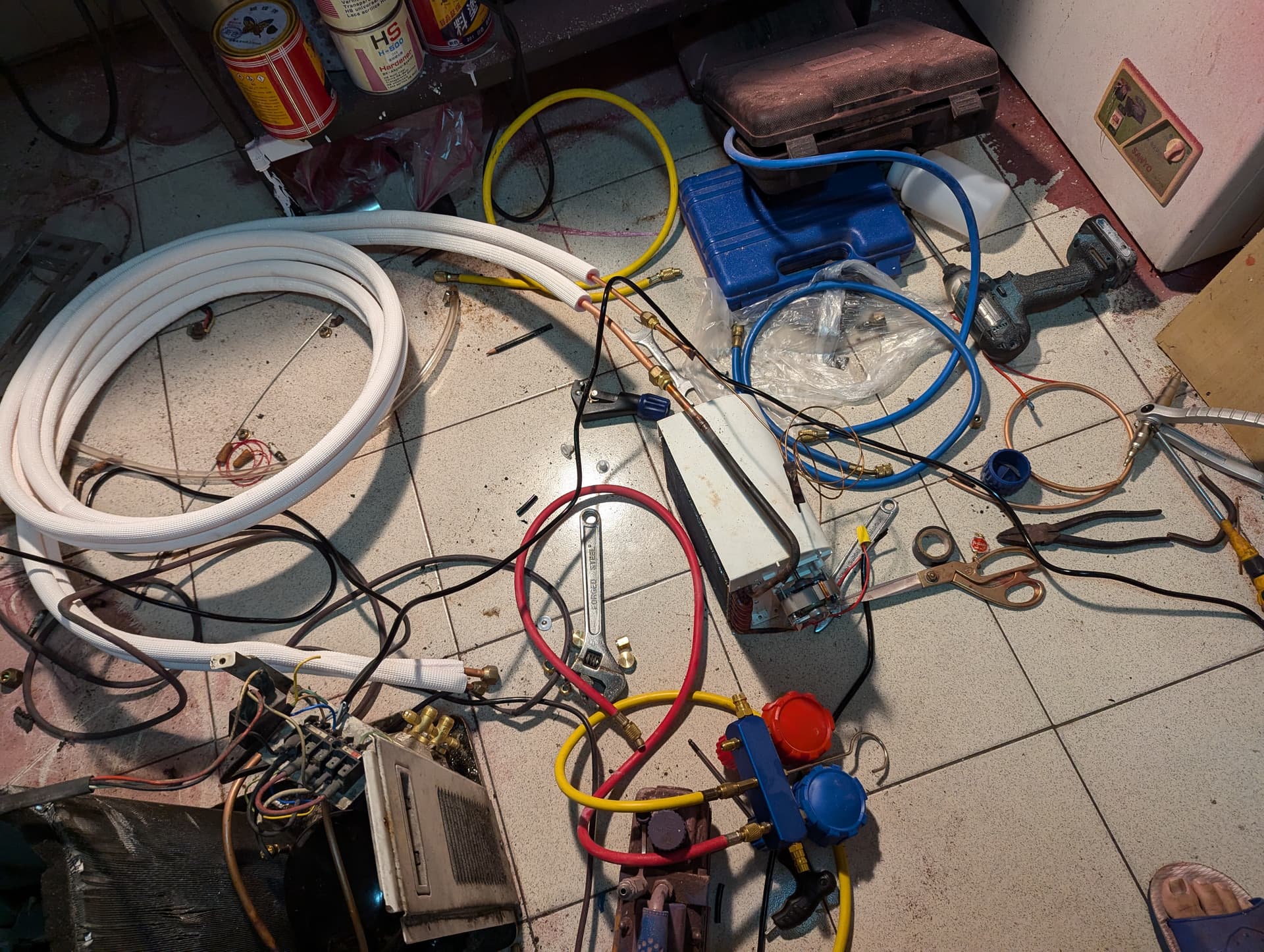
I bought those small bed space ac to reduce my electricity usage. I’m not sure it did in any appreciable way, however I discovered some big problems with them. First, the plastic base that the heavy compressor kept cracking, asking it to hold together in use is impossible. Not to mention needing to vent hot air outside which has proven to be a big problem… So what I did was remove the compressor, ditched the tiny little evaporator coil (which proved to be inadequate), I have a condenser unit of a mini split that’s got a busted compressor. I removed the compressor, threw it out, put in the much smaller compressor, with an oversized condenser coil, but more importantly this will be outside. Idea is use a very large condenser coil to easily eject heat and increase their capacity, reduce power consumption (I was shown a document of tests done by Copeland that attests to the fact that if you reduce condenser temperature, you increase the efficiency of the air conditioner.
Right now results are promising, the picture shown is only a bench test, but I’m getting a lot more cool air out of it while the compressor barely sees any load…
This is the chart from Copeland I’m referencing… it shows a fair bit of gain in term of efficiency if you can get the condenser cooler (it explains why the AC works better in spring/fall rather than summer, while using less electricity).
C stands for capacity (in btu/hour), P stands for power consumption (in watts), A stands for amp draw, last line before the %, E stands for EER. As you can see just dropping the condenser temp by about 30F increases efficiency by 50%.
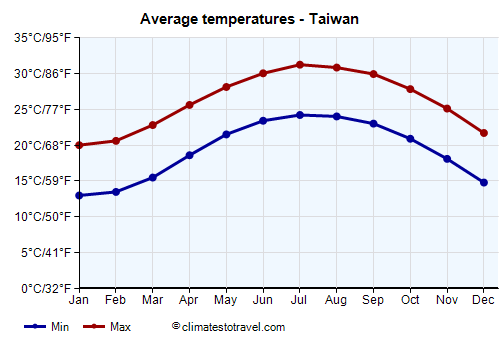
You could very well cool the condenser to about 80F or so by sticking a swamp cooler in front of the coils… dew points will be around that in the summer in Taiwan. This makes the AC really efficient.
I wonder why manufacturers just don’t do this. They could increase efficiency just by making the condenser coil bigger. Sure this makes it less useful in heating mode… but how often do we need heating mode in Taiwan?
It’s a bit too late in the year now for a reliable comparison, but at some point perhaps you should compare your daily electricity usage before and after to see whether it was all worth it (including the equipment, material, and time costs since you first started talking about this a year ago (not sure whether you made earlier posts about this)).
Assuming you manage not to suffocate once you’ve got the insulating tent set up around your bed, of course.
Anyway, err… good work… I guess, for turning the initial idea into some kind of reality. Personally I think I’m probably going to stick with the conventional wall-mounted whole-room AC unit — I realize it’s not installed yet, but the current setup looks, err… a tad unaesthetic…
I (sincerely) hope it doesn’t explode on you in the night or anything, but I assume you’ve taken all the necessary safety precautions.
A few things need to happen for the install to work… I need a way to drain the water that the evaporator makes when cooling. Right now I got a ice maker tray… I will have to attach a drain line to this so the water can drain somewhere else where I don’t have to stick buckets under it the whole time… I also need to build a shell around this evaporator so it can be mounted. Biggest problem was the huge hose that needed to move the hot air (and the hose itself got HOT. I want to cool the bed space, but I don’t want the room around it to get hotter which undermines the effort.
I do need to get a kill-o-watt to give me a good comparison.
A wild guess would be that they don’t want to add cost (at least two additions: the sc itself plus better ie even more non-rust parts inside condenser cooler itself, to handle the additional sc moisture).
Still an interesting idea, though, especially within sub- to tropical latitudes.
Everything in engineering and manufacturing is a tradeoff. Size, packaging, cost, installation / placement / collecting… you know, some the reasons you have a heap of parts making a cool little test project instead of a sweet appliance.
And there’s those tradeoffs…
4-5 months in Taipei?
But then what’s the overall efficiency of the system? And more size and packaging issues.
I see, bought cheep and not up to scratch.
Now investing time and money to make it fit for purpose when a little more expensive model would have already done the job (and probably cheaper in the long run).
I tried looking for RV AC unit, and most of them cost too much, like no less than about 12,000nt.
This mini AC could just add maybe 500nt in parts (such as having the bottom plate be made of metal) and it would have been perfect. Instead it uses fragile acrylic based plastic… The system itself is good, it’s just those plastic parts that’s not.