Oh yes!!! It ain’t easy or smooth sailing…but if you diligently follow the steps, then it can be done without much of a hiccup as these departments follow strict SOP.
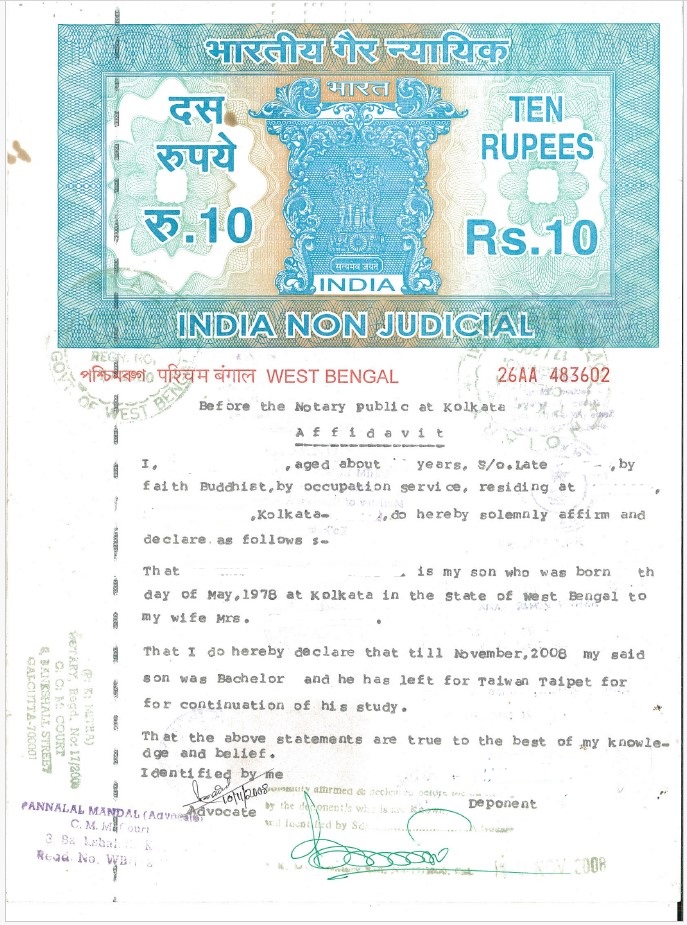
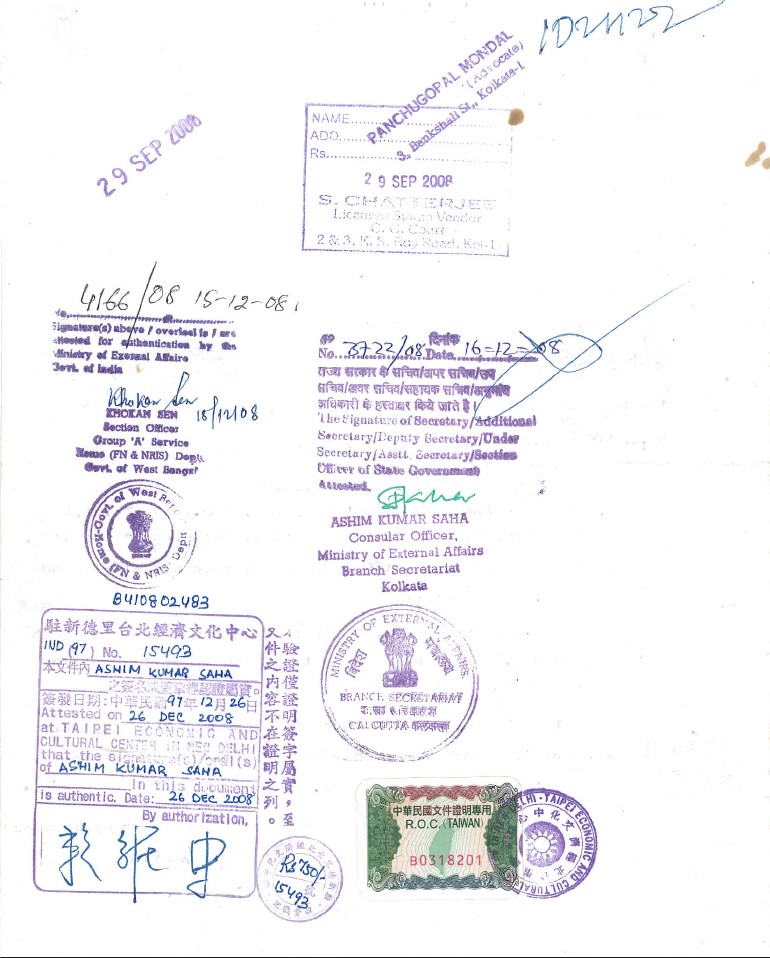
This was my Single Certificate which I got attested by TECO in Delhi
Multiple stamps by the Local court that issued the cert…then stamped again by the Ministry of External Affairs in my State, then stamped again by the TECO in Delhi. There was also a stamp by BOCA in Taiwan which I forgot to scan
TECO and BOCA will only authenticate the Original Documents, so you will have to pay a one time fee each for your birth certificate, marriage certificate & death certificate. I forgot how much TECO charged me (Pretty sure the price have increased since 2008)
BOCA charged me NTD400 for the attestation in 2015 (Prices may have increased now). The notary public that attests the translations will only charge you per case (NTD750 in 2015, prices may have increased now). They asked me how many copies I wanted for them to stamp…I said 6. So they photocopied 6 copies of my translation and stamped all 6 copies for the price of NTD750.
The translation agency will just give you 1 or 2 copies of the translation. You can photocopy more if you want to. Similarly, the notary public will stamp on all your photocopies for the price of one. They are charging you for the service of checking if the translation is correct or not, they don’t charge for the number of stamps they stamp. Stamp ink is cheap
Does this mean that they effectively mutilate the original document by placing an imprint (a raised stamp that deforms the paper) on the original document’s paper?
The TECO page at https://www.roc-taiwan.org/ussfo_en/post/114.html says that “The raised Stamps will affix on the original document. If you want them intact, please advise us and have an extra copy ready.” This sounds like they will mutilate the original document, and if you don’t want that, then you need to provide an “extra copy”.
Do you know if this “extra copy” (to avoid damaging the original copy) can be a plain photocopy?
I won’t go so far as saying the Original doc gets mutilated when they place their stamp on it…it just gets slightly raised, that’s all. Moreover, the stamp is on the reverse side (the blank side) of the document and as such, the front side (正面) remains unaffected. You can see the 2 pics I posted above of my single certificate…does the Front side seem “mutilated”?
I’m not sure what TECO means with this sentence “If you want them intact, please advise us and have an extra copy ready”…They could mean that you need to prepare 2 Originals if you’re worried about stamps being placed on it or they could mean you need to prepare a photocopy of the Original and bring both so they could verify the Original and stamp the photocopy and stamping an additional “與正本相符” stamp on the copy. It’s best if you can call TECO in advance and ask them about it.
Thanks for your opinion on this. You’re right, I should contact TECO and figure out what exactly they mean.
I assume that if you want them to preserve the original, then you include a photocopy, and they stamp the photocopy.
The alternative that you mentioned, where you submit two original copies to TECO, doesn’t really make sense to me, because in that case there seems to be no need to send the second original to TECO – you could just keep the second original for yourself (as the unaltered copy) and TECO then stamps the other copy that you send them.
The reason I’m worried about this is that it takes time, effort, and money to track down these certificates like death certificates, and I really don’t like the idea of TECO stamping/deforming/altering/mutilating the only original copy that I have. I might need that document again in the future, maybe for a different purpose. I want to hang on to the unaltered original for that purpose.
Anyway, I’ll contact TECO when the time draws nearer. Still formulating my game plan for how to get everything ready.
No. They mean an extra “original”. So, if you’re trying to authenticate a birth certificate for example, that means you need to request a total of 2 “originals” from the government of your place of birth.
Aiiieee, you have dashed my hopes. What a hassle. Oh well, at least I know now.
Still, I may try to ask the responsible TECO office if they might be willing to preserve the original and authenticate the photocopy. Who knows, I might get lucky. After all, the TECO office homepage that I linked said that you should advise them if you want the original unaltered. If you need to prepare a 2nd original copy yourself, then why do you need to advise them of anything? You just keep the 2nd original for yourself. So the fact that they are open to being “advised” of the need to preserve the original hints to me that they might be open to authenticating a photocopy.
They might be able to make special exceptions upon request and authenticate documents without altering them even if you can’t provide a second original.
But when I asked them to authenticate my laminated birth certificate, they said they couldn’t do that as the lamination prevents the seal, so I had to request another original.
To confirm, are you saying that both translation of the documents (in my case, three 1-page documents) and the notarization can all be done in one day? That seems like pretty fast turnaround time for document translation.
Doing a bit of (English-language) web searching, I found these courthouse notary services:
Is that the kind of place you are talking about? These offices, however, don’t seem to do translations, only notarizations.
I also found this:
That last page says translation times of one week, but for rush service (presumably much more expensive) it can be reduced to 1 day.
Hmm… interestingly, that last service also offers a remote translation and notarization where you don’t have to go to Taipei! That might be worth looking into.
However, this would change the order of the steps. You suggested this order:
Via postal mail, contact TECO (in the origin country, e.g. USA) for authentication of of English documents.
In person, in Taiwan, visit BOCA for authentication of TECO-authenticated English documents.
In person, in Taiwan, contact courthouse notary for Chinese translation + notarization of all TECO-and-BOCA-authenticated English documents.
If I were to use the postal-mail service of the above Taipei translation/notary service, then my order of steps would be:
Via postal mail, contact TECO (in the origin country, e.g. USA) for authentication of of English documents.
Via postal mail, contact remote translation/notary service in Taiwan for Chinese translation + notarization of TECO-authenticated English documents.
In person, in Taiwan, visit BOCA for authentication of notarized, TECO-authenticated English documents and their notarized translations.
Do you think this changed order of steps (reversing the order steps 2 and 3) is okay?
If we need to keep the original order of steps (1. TECO, 2. BOCA, 3. Translate+notarize), then still, the above service (MONTORU) maybe can help, because they can apparently do BOCA document authentication also. I guess you need to appoint them as your agent or something.
Above, I had argued that maybe TECO (at least, the one specific TECO office in USA that I am researching) is willing to authenticate a photocopy of the document.
But that’s only half of the equation, since we need authentication from both TECO and BOCA. The other half of the equation is what BOCA will accept – will they authenticate a copy, or will they only authenticate the original? I tried reading Bureau of Consular Affairs, Ministry of Foreign Affairs, Republic of China(Taiwan)-Document Authentication Services but could not come to any conclusion yet regarding originals vs. photocopies of documents that have already been authenticated by TECO. If TECO is willing to authenticate a photocopy, then I would hope that BOCA would also accept that photocopy. But, it’s still an unknown factor and could be a risk.
More troubling, though, is the requirement stated on the above BOCA web page that:
Is this true in practice?
If yes, then this means that you always need TECO to authenticate TWO copies – one for the BOCA to keep forever,, and one for you to use. Furthermore, if BOCA only is willing to authenticate originals and not photocopies, then this means that before going to BOCA you always have to prepare two original copies.
Did you have to provide BOCA with two copies of each document that you wanted authenticated at BOCA? Were they both original copies? @springonion@comfy123
No! I only provided one Original Document to be authenticated and paid only NTD400 and not NTD600. I remember the lady at the counter asked me to make a copy of the Original for her records and that I used their pay-per-use copy machine to make photocopies.
Actually, this also raises some interesting questions about how exactly the new law is supposed to work in practice.
To gather my supporting documents (除戶謄本) for an eventual HHR application, I think that first, I need to go directly to the HHR office in Taiwan, prove who I am (descendant of a deceased lineal relative who was a Taiwanese citizen with HHR), then ask for the copy of my deceased relative’s 除戶謄本, which is one of the documents required for an HHR application based on a deceased lineal relative.
Then, only after I have that document in hand, am I ready to prepare all of the other documents to apply for HHR.
But, under the new law, to apply for HHR, where is this HHR application to be done? Directly in Taiwan at the HHR office? Or at an overseas TECO? My intuitive understanding (based on no specific evidence) is that you must live in Taiwan and hence must apply at the HHR office in Taiwan; I think the requirement to go through TECO was based on the old system where NWOHRs first had to apply for permission (i.e. a TARC) to stay in Taiwan.
But with the new law, that permission is automatically granted, without the need to apply for anything… right? So qualifying NWOHRs can just move to Taiwan and apply for HHR immediately, at the Taiwan HHR office? So TECO plays no role in the HHR application for NWOHRs who qualify under the new law?
hhr cannot be applied from/at overseas. this part may be regulated by household registration act and related rehulations.
the permission automatically granted is the right to enter on a NWOHR passport without an entry exit permit. if they want to reside without hhr, they still need a tarc.
and you can apply for tarc in Taiwan too.
this is right. if you were born overseas, and adult, you are not qualify for this.
if you qualify, they may just authenticate some documents. when you are not qualify, you need to get a NWOHR passport.
No. All documents are: One original, and one photocopy.
They authenticate the original ONLY and return it to you to keep forever. They keep the photocopy. I don’t know what that “verified/notarized copy” nonsense means. It doesn’t need to be notarized by you (maybe they do it internally).
So the TARC is effectively irrelevant? I mean, it would still exist for the NWOHR’s in Taiwan without HHR that choose not to establish HHR even under this new law for some reason. But for the majority of us looking for citizenship, the TARC is irrelevant.
The new legislation really only affects one category of TARC holders (out of the many), which is adult NWOHR born overseas to parents with HHR.
TARCs will still be issued to all other categories of NWOHR who do not immediately qualify for HHR, as well as residents from Mainland, Hong Kong, and Macau.