https://www.nytimes.com/2026/02/24/technology/taiwan-china-chips-silicon-valley-tsmc.html
Grok Summary
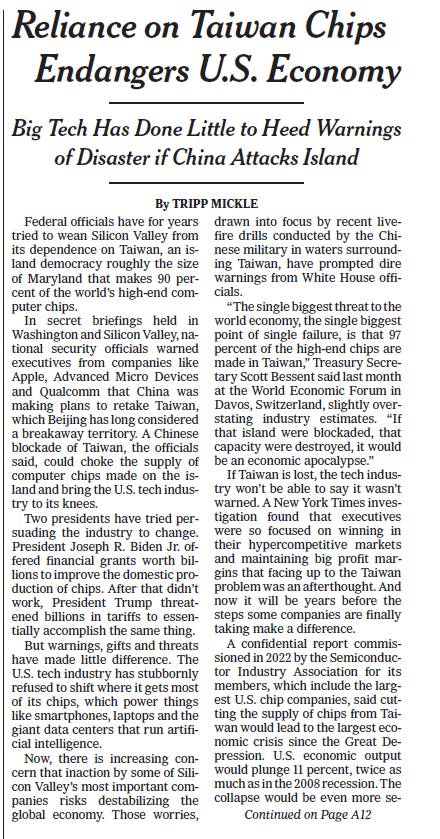
This New York Times article published today, titled “The Looming Taiwan Chip Disaster That Silicon Valley Has Long Ignored,” presents an urgent assessment of the geopolitical vulnerabilities inherent in the global semiconductor supply chain. Authored by Tripp Mickle following extensive interviews and document reviews, it centers on Taiwan’s dominant position in producing approximately 90% of the world’s most advanced (high-end) computer chips, primarily through Taiwan Semiconductor Manufacturing Company (TSMC). The piece argues that Silicon Valley and the broader U.S. tech sector have persistently downplayed or resisted efforts to reduce this dependency, despite repeated warnings from U.S. national security officials.
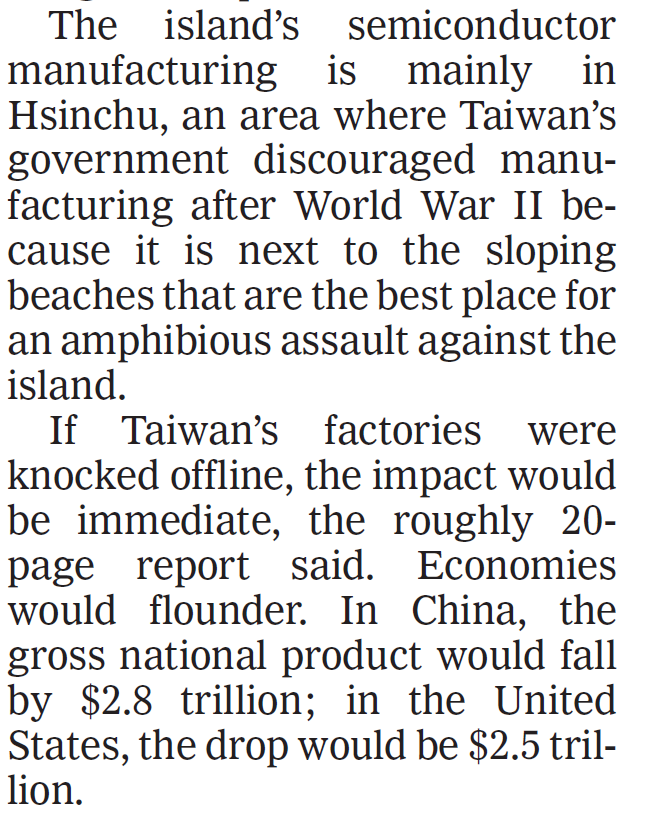
Key elements include classified briefings delivered to executives at major firms such as Apple, Advanced Micro Devices, and Qualcomm, highlighting China’s preparations to potentially retake Taiwan—viewed by Beijing as a breakaway territory—possibly through invasion or blockade. Recent Chinese military live-fire drills around the island are cited as escalating indicators of risk. U.S. administrations have pursued diversification strategies: financial incentives under President Biden and tariff threats under President Trump, yet industry reluctance persists due to higher costs and technological lags in overseas facilities (e.g., TSMC’s Arizona plants trailing Taiwan’s cutting-edge processes by a generation). The article quotes Treasury Secretary Scott Bessent describing a potential cutoff as “an economic apocalypse,” with estimates from prior reports suggesting severe global repercussions, including an 11% drop in U.S. GDP in extreme scenarios.
For Forumosans, this reporting aligns with—and amplifies—long-standing local awareness of the island’s precarious strategic position. Many expatriates who have lived here for years or decades already perceive Taiwan’s semiconductor prowess not merely as an economic asset but as a double-edged “silicon shield”: it deters aggression by making disruption prohibitively costly for the world (and China itself), yet it also concentrates existential risk on the island. The article’s emphasis on U.S. warnings and Silicon Valley’s inertia may resonate as a confirmation of what residents observe daily: persistent cross-strait military tensions, frequent PLA incursions into Taiwan’s air defense identification zone, and the island’s role as a global chokepoint.
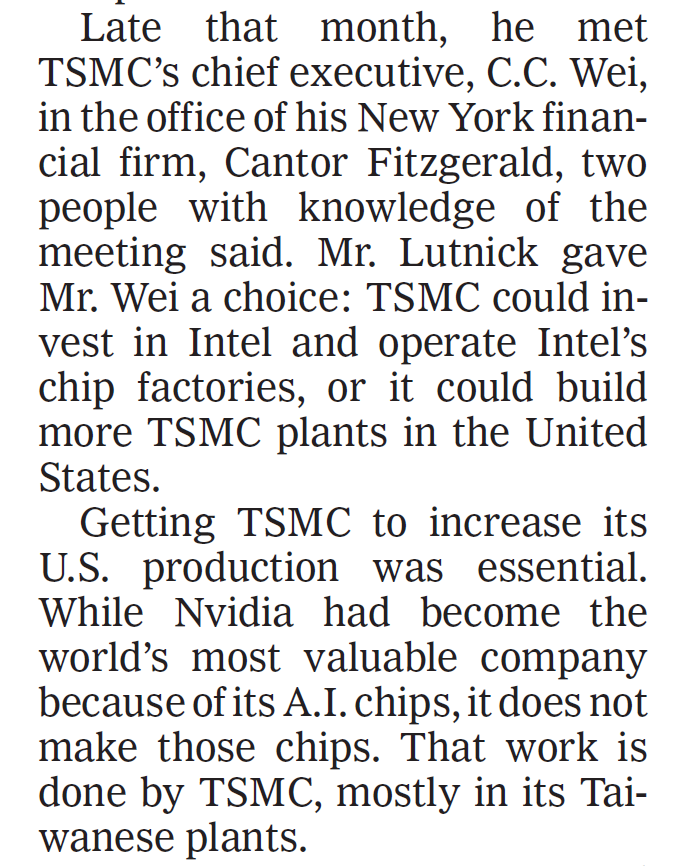
Recent context further informs this perspective. In early 2026, U.S.-Taiwan trade negotiations resulted in tariff reductions for Taiwanese exports in exchange for commitments to expand TSMC’s U.S. footprint, including additional fabrication plants in Arizona (potentially doubling prior plans to create a major cluster outside Asia). Such moves represent deliberate risk mitigation through geographic diversification, yet experts in Taiwan have noted that advanced node production (critical for AI, smartphones, and high-performance computing) remains overwhelmingly concentrated on the island due to infrastructure, talent ecosystems, and cost efficiencies. This overseas expansion is thus viewed locally less as a diminishment of Taiwan’s importance than as pragmatic insurance—reducing vulnerability without fully relocating the core capability.
For foreign residents, the article may evoke a familiar tension between daily life stability and underlying uncertainty. Taiwan continues to function as a vibrant, open society with robust economic growth driven by the tech sector, yet geopolitical headlines periodically heighten vigilance. The piece does not introduce fundamentally new information for those attuned to cross-strait dynamics but serves as a high-profile reminder from a major U.S. outlet that the risks remain acute and insufficiently addressed internationally. It underscores why many long-term expatriates value Taiwan’s resilience while remaining mindful of contingency planning in an era of elevated tensions.