The Pentagon is warning China in blunt language that despite Beijing's massive military buildup, it lacks the power for a successful attack against rival Taiwan.

 The annual report on China's military, released Friday, is likely to add to rising tension between Washington and Beijing at a time when U.S. lawmakers are considering bills that would punish China for what they contend are predatory trade practices. [/quote]
Here is my rant about why Taiwan needs to distance itself from Washington. Not that Taipei won’t appreciate Washington’s help if the Strait Issue ever escalates into a military war.
–start rant
Just because US couldn’t pursuade PRC to increase the value of the RMB fast enough, Taiwan is dragged into the mess. I mean seriously how immature is that. US factories are moving into PRC, US consumers want cheap goods made in the PRC, and somehow Taiwan is the counterbalance to why the RMB should be valued at 40% of what it currently is.
Talk about politics that makes no sense. So if the RMB goes up 40%, the USA will give PRC permission to invade ROC with no consequences? :taz:
One of the guests on CNBC had a great comment on the RMB re-valuation issue.
“When’s the last time you walked into a store that sold inexpensive, quality products… and insisted that they raise their prices on you, so that you wouldn’t buy as much?”
The business community know that this is just political pandering… but of course, in a democracy, political pandering is superior to all else.
-The out of work factory worker that would further not be able to afford the PRC made goods once the RMB goes up 40%.
-The import businesses that will lose profit or sales when the RMB goes up 40%
For the life of me I cannot figure out who they are pandering to.
In my local wal-mart I can buy the exact same night market children’s clothing that I could have bought in Taiwan, and for sometimes the same price, usually only about 30 to 50 NT more. That’s pretty terrifying, in the long run, for America. But if things were reversed, China telling the States to inflate it’s currency would just be laughed outta town.
And many Americans simply could not afford not to buy those cheap Chinese goods. A sudden inflation of Chinese currency would simply cause recession here. China would still have no real reason to buy more expensive American goods. It could, and would deal with many other nations more cheaply and with less political side effect.
And really, Taiwan is very week playing card in a thin deck. Do you REALLY think the U.S. would intervene in any meaningfull way if China were to invade Taiwan? The U.S. is obligated only to sell arms to Taiwan. The U.S. has nothing to lose by Taiwan’s absorbtion into China, other than access to the water and airspace, which are valuable, but compared to the mighty dollar, and with the military stretched pretty thin in other places (where China could assist forces that oppose the States, adding more pressure), I think the U.S. won’t do much more than talk and sell submarines and missiles.
Well I have no real question of US intervention if China tries to invade, basically only Kerry has ever said that “we do not necessarily have to defend Taiwan”.
Plus the US has sent carriers to Taiwan’s defense twice and China always stopped. Heck the CCP hasn’t even made good on their threat that Kinmen and Matzu be returned to China otherwise there would be war. Basically the US sent their carriers in and the CCP withdrew, that was decades ago and China has had plenty of chances to invade since.
Finally, although the US Army may be stretched thin, but the rest of the military and the dozen+ carriers are not. Taiwan VS China will be more of a naval and air war.
One more thing; the Kitty Hawk is being replaced in a year in Okinawa, upping the defense.
-The out of work factory worker that would further not be able to afford the PRC made goods once the RMB goes up 40%.
-The import businesses that will lose profit or sales when the RMB goes up 40%
For the life of me I cannot figure out who they are pandering to.[/quote]
That was actually exactly the comment made by several participants on CNBC as well. But the truth is, the “average” voter isn’t making the full connection on this issue. On the one hand, they “know” their jobs are being eliminated due to imports originating from China. The threat there is obvious. But in their minds at least, they’re buying their products from Walmart… not China.
Could you imagine if the US Congress was talking about placing a 40% sales tax on Walmart products…? But doing the same on “Chinese products” somehow seems more innocuous.
I’m not optimistic on this point. I think there’s definitely political points to be won here, and I think the political parties will fight for it with a passion. But there’s a light at the end of the tunnel… I personally think after campaign season is over, whatever self-destructive policies the politicians put in place temporarily will be rolled back, and it will be business as usual.
The problem here lies on the political part from the beginning. As long as the CCP doesn’t let the Yuan be traded normally, it will always be a political matter.
And somehow Taiwan is the key to RMB trading normally?
That’s the message the USA gave PRC.
So not only does the policy make very little domestic sense in terms of business and consumer sales.
But from the international perspective that is what USA believe Taiwan is worth, a 40% increase in the RMB and PRC can have its way with Taiwan with no consequences, or at least till the next election cycle.
[quote=“cctang”]One of the guests on CNBC had a great comment on the RMB re-valuation issue.
“When’s the last time you walked into a store that sold inexpensive, quality products… and insisted that they raise their prices on you, so that you wouldn’t buy as much?”
The business community know that this is just political pandering… but of course, in a democracy, political pandering is superior to all else.[/quote]
How could anyone following the news recently put China and quality products in the same reference?
Quality medical products - guaranteed to kill you… wait, China is exporting population control methods… they are the top on matter…
Because of the drop of the NT in relation to the RMB, the exports in Taiwan have increased, making the government increase the expected GDP growth. If the gap between manufacturing in Taiwan and manufacturing in China would decrease, I don’t know how the rest of the world would follow. My company operates in a “choose Taiwan” method, except if the price difference is just to big (90% of the cases, it isn’t). And if you had a better business environment (just come to Computex in a few weeks) and better financial platforms (believe me, Taiwanese offer a lot more than Chinese in terms of cooperation), then the Made in Taiwan (which beats Made in China by a world) will start to become more appealing.
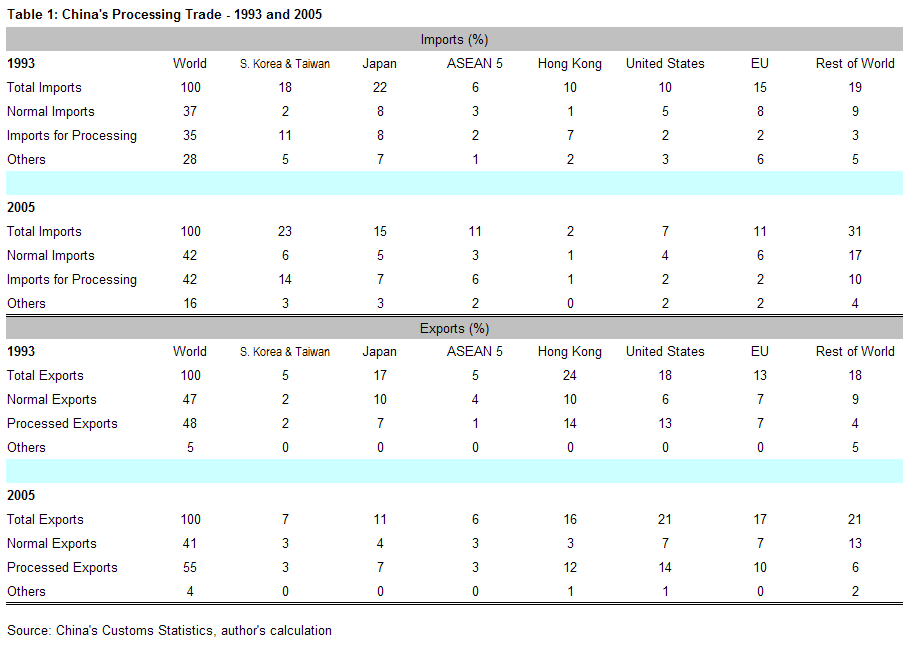
The increase in the RMB would mostly benefit Taiwan, Korea and Japan (which account for 38% of the imports of China (see picture).
In one hand, the increase of the RMB would be fuelling the middle class to increase their spending, improving the economy in the long term.
On the other hand, the increase on the RMB would make a new vague of unemployed personnel (specially on the textile manufacturing), because it would lead to the disappearance of the profits (and we all know how many anti-dumping taxes Chinese textile products have around the world). Let us remind people that much of the workforce in China has low levels of specialization, so it will be hard for people who suddenly loose their jobs to survive.
So, the slow appreciation of the RMB is a method of trying to balance the huge growth, because the RMB is not appreciating at the value it should. Also, a quick appreciation of the RMB may be bad for HK, as people would loose the advantage of living there - although it has been good for the tourism…
There is no credible “evidence” the RMB is “undervalued”, only misinformed speculation by US trade protectionists.
Increasing the value of the RMB relative to the USD will not increase American propensity to save, the low rate of which is the real cause of America’s economic problems.
LL, as I said before, the ones who will win more with the increase will be the Asian partners. Don’t forget that US are very good at killing foreign economies (Japan anyone)…
[quote=“Lord Lucan”]1. There is no credible “evidence” the RMB is “undervalued”, only misinformed speculation by US trade protectionists.
Increasing the value of the RMB relative to the USD will not increase American propensity to save, the low rate of which is the real cause of America’s economic problems.[/quote]
Nor, I would add, would it cause any real change in the retail prices of Chinese made goods in Walmart. My guess is that about 85% of the cost of making most of the Chinese goods on Walmart shelves was paid for in US dollars, not RMB. If people don’t get that, then they understand fuck all about China’s economy.
Maybe a better way for the Americans is to negotiate with Asian countries for a hair cut to her mounting debts, privatise Washington - with Asian jointly dictating the budgetary spending policy of US, as well as disarmaments of weapons of all kinds to save costs.
That’s also in compliance with IMF’s best economic policies and practises, right
I’ll just add that no one seemed to complain about Beijing’s “political” interference in currency back in 1997, when it refused to follow the depreciation domino effect that had swept southeast Asia. Knowing that doing so would put its exports at a temporary disadvantage, Beijing decided to absorb the short-term pain for the long-term advantage that a stable currency would represent to the region.