[quote=“Yglesias”] [quote]The president-elect is expected to name [Cass] Sunstein—his friend and informal adviser—to head the Office of Information and Regulatory Affairs, a transition official said late Wednesday.
A low-profile position in the current administration, the job is likely to be a higher-wattage one after Obama takes office this month.[/quote]
Sunstein seems like an unusually high-wattage person for this somewhat obscure job, further reenforcing the extent to which Obama is assembling a real team of all-stars where you have a bunch of people in secondary positions who would have enough stature to take on higher-profile jobs. OIR itself is a sub-part of the Office of Management and Budget and even though nobody’s ever heart of it, it has rather sweeping influence across the whole ambit of regulatory activities. Since there’s talk of doing a big overhaul of financial regulations that will be an obvious focus, but there’s lots and lots of regulating happening all over the place.[/quote]
[quote=“Behavioral Revolution”]Thaler and Sunstein advocate for “libertarian paternalism” (also known as “light paternalism”), which is the theory that government should intervene to help people make better choices without actually restricting their freedom to choose. The really exciting aspect of this pick, at least to someone with my sensibilities, is not how much regulation it predicts but what kind. Sunstein, along with Richard Thaler (another informal Obama campaign advisor) recently published Nudge, a fantastic book about how to apply behavioral economics to public policy. With the advent of neuroeconomics, behavioral approaches to economic theory are rapidly gaining influence, and this pick signals that economic thought as implemented in government is finally catching up. The Milton Freidman style free market positive economics is predicated on an idea of humans as agents who seek to perfectly maximize their utility in economic decision making. Behavioral economics opposes this conception of human nature, observing that in many cases cognitive biases force us into decisions that are less than perfectly rational or just plain bad.
Thaler and Sunstein advocate for “libertarian paternalism” (also known as “light paternalism”), which is the theory that government should intervene to help people make better choices without actually restricting their freedom to choose. [/quote]
Sunstein’s one of your favourites, isn’t he, Hobbes? What do you think?
Very interesting, I agree. I have a lot of respect for Sunstein as someone who (in my experience, anyway) is extremely bright and creative and honest in his intellectual endeavors. I think it’s very important to him to be fair to both sides and to try to get things right, regardless of whether the answer supports one political view or another. But he does have something about him that reminds you a little bit of the eccentric academic right out of central casting on some sitcom, the well meaning and brilliant professor who sometimes trips over things because he’s always reading a book as he walks around.
So it doesn’t surprise me that Obama has picked someone who is very smart, pragmatic, and open-minded, but it does surprise me a little in that sometimes you want a bit more of the hard-ass brawler types (think Rahm Emanuel) to lead administrative offices. Maybe that’s not what this particular job needs. Or maybe Cass has more of that side to him than I realize.
Wow, what a change from the bone-headed bush years.
[quote]Cass R. Sunstein (born September 21, 1954) is an American legal scholar, particularly in the fields of constitutional law, administrative law, environmental law, and law and behavioral economics. Sunstein taught at the University of Chicago Law School for 27 years, where he continues to teach as the Harry Kalven Visiting Professor. Sunstein is currently Felix Frankfurter Professor of Law at Harvard Law School. . .
He earned a Bachelor of Arts degree in 1975 from Harvard College. . . a J.D. magna cum laude from Harvard Law School, where he was executive editor of the Harvard Civil Rights-Civil Liberties Law Review and part of the winning team of the Ames Moot Court Competition. He served as a law clerk first for Justice Benjamin Kaplan of the Massachusetts Supreme Judicial Court (1978-1979) and later for Justice Thurgood Marshall of the Supreme Court (1979-1980).[/quote] en.wikipedia.org/wiki/Cass_Sunstein
About time a President starting appointing people because they’re extremely bright and well-qualified and not because they’ve got a strong axe to grind and are willing to overlook technicalities such as the Constitution or the Geneva Convention. Sunstein sounds like a great choice. I hope he’s not defeated by some petty political BS.
Books
Nudge: Improving Decisions about Health, Wealth, and Happiness with Richard Thaler (Yale University Press, 2008)
Worst-Case Scenarios, (Harvard University Press 2007) Republic.com 2.0 (Princeton University Press 2007)
Are Judges Political? An Empirical Investigation of the Federal Judiciary with David Schkade, Lisa Ellman, and Andres Sawicki, (Brookings Institution Press 2006)
Infotopia: How Many Minds Produce Knowledge, (Oxford University Press 2006)
The Second Bill of Rights: Franklin Delano Roosevelt’s Unfinished Revolution and Why We Need It More Than Ever, (Basic Books 2006)
Radicals in Robes: Why Extreme Right-Wing Courts Are Wrong for America (Basic Books 2005)
Constitutional Law 5th ed. with G. Stone, L.M. Seidman, P. Karlan, and M. Tushnet, (Aspen 2005)
The Laws of Fear: Beyond the Precautionary Principle (based on the Seeley Lectures 2004 at Cambridge University), (Cambridge University Press 2005)
The Second Bill of Rights: Franklin Delano Roosevelt’s Unfinished Revolution and Why We Need It More Than Ever (Basic Books 2004)
Why Societies Need Dissent, (Harvard University Press 2003).
Animal Rights: Current Controversies and New Directions edited with Martha Nussbaum, (Oxford University Press 2004)
Risk and Reason, (Cambridge University Press 2002) (Trad. esp.: Riesgo y razón, Buenos Aires/Madrid, Katz editores S.A, 2006, ISBN 8460983501)
The Cost-Benefit State, (American Bar Association 2002)
Punitive Damages: How Juries Decide with Reid Hastie, John Payne and David Schkade, (University of Chicago Press 2002) Republic.com, (Princeton University Press 2002)
Administrative Law and Regulatory Policy with Stephen Breyer, Richard B. Stewart, and Matthew Spitzer, (1999; new edition 2002)
Free Markets and Social Justice, (2002)
Designing Democracy: What Constitutions Do (Oxford University Press 2001)
The Vote: Bush, Gore & the Supreme Court with Richard Epstein, (University of Chicago Press 2001)
Constitutional Law 4th ed. with Stone, Seidman, and Tushnet, (2001)
Behavioral Law and Economics, (editor, Cambridge University Press 2000)
One Case At A Time: Judicial Minimalism on the Supreme Court (Harvard University Press 1999)
The Cost of Rights with Stephen Holmes, (1999, W.W. Norton paperback 2000)
Clones and Clones: Facts and Fantasies About Human Cloning with Martha Nussbaum, (W.W. Norton 1998)
Legal Reasoning and Political Conflict, (Oxford University Press 1996)
Free Markets and Social Justice, (Oxford University Press 1997)
Democracy and the Problem of Free Speech, (The Free Press 1993)
The Partial Constitution, (Harvard University Press 1993)
After the Rights Revolution: Reconceiving the Regulatory State, (Harvard University Press 1990)
Constitutional Law, (Little, Brown & Co. 1st edition 1986; 2d edition 1991; 3d edition 1995)
The Bill of Rights and the Modern State co-editor with Geoffey R. Stone and Richard A. Epstein, (University of Chicago Press 1992)
Feminism and Political Theory, (editor, University of Chicago Press 1990) en.wikipedia.org/wiki/Cass_Sunstein
The guy has written 33 books in 18 years. [/quote]
Yeah, his workrate is phenomenal. And when he’s not writing or lecturing he’s almost always reading something. I wasn’t kidding about the walking around with a paperback book held open with one hand in front of him.
Wikipedia mentions his dog, Perry, and how he brought Perry on Greta Van Susteren’s show with him. What it doesn’t mention is that Perry would also come to school with him, attend class with him up at the front of the room by the blackboards, sit in the school lounge with him, walk through the library with him, and ride the elevator up to his office to hang out with him while he worked.
Speaking of his office… that was classic as well. Here’s a picture of his office on a good day with the caption in the school magazine reading: “Cass Sunstein seems to have cleaned…”
(I love the various neckties thrown randomly around the room )
it’s a conspiracy. Obama is slowly recruiting all the smart professors from Chicago School of Law. The White House will be full of legal scholars and other know-it-alls from Chicago and Harvard. This will be a far cry from the past. We must fight this insidious takeover by smart guys.
McNamara was the classic scientific manager and a very smart guy, but does a law professor who specializes in half a dozen fields and has written 33 books in 18 years really pale in comparison?
The only book by Sunstein which I’ve read is Radical in Robes, and it was very unimpressive. He never adequately addresses how judges who are not bound to a strict interpretation of the U.S. Constitution will not abuse their authority to arbitrarily make things up as they go. Instead, Sunstein wants to split the difference between “fundamentalism” and allowing judges to make it up by pushing a vague legal philosophy called “minimalism”, which makes it seem like judges respect precedent and the U.S. Constitution, while not being bound by them.
Some of Sunstein’s criticisms of what he calls “fundamentalism” are sound, but he never nails down an alternative legal philosophy that will prevent judges from making up decisions willy-nilly.
McNamara was the classic scientific manager and a very smart guy, but does a law professor who specializes in half a dozen fields and has written 33 books in 18 years really pale in comparison?[/quote]
McNamara was a classic asshole who thought that his, and his cohorts’, Ivy league degrees made them smarter than everyone else. In fact that’s why Kennedy chose them, because of their intelligence and the proper schools that they went to. McNamara, McGeorge Bundy and his brother William, and John McNaughton (to name a few of them) all thought that their intellect made them better adapt at Foreign Policy and Defense decisions than the military generals’ experience. There hasn’t been someone nearly as arrogant in that position, however Rumsfield came close.
I hope Mr. Sunstein doesn’t take after those illustrious predecessors. His academic qualifications are outstanding, not to mention his endeavor to write his way into having a whole library wing to himself. The only thing that worries me is that he doesn’t have any non-academic work experience. Being brilliant in the realm of academia is challenging, but experience from having actually dealt with compromising between the ideal and the real.
Maybe someone here can help me understand this “Soft Paternalism” theory. To me it sounds like the underlying assumption is that people have freedom to make wrong decisions, but we, being smarter than you, will try and guide you to making what we think are better decisions. Is that a wrong analysis?
[quote]McNamara was a classic asshole who thought that his, and his cohorts’, Ivy league degrees made them smarter than everyone else. In fact that’s why Kennedy chose them, because of their intelligence and the proper schools that they went to. McNamara, McGeorge Bundy and his brother William, and John McNaughton (to name a few of them) all thought that their intellect made them better adapt at Foreign Policy and Defense decisions than the military generals’ experience. There hasn’t been someone nearly as arrogant in that position, however Rumsfield came close.
I hope Mr. Sunstein doesn’t take after those illustrious predecessors. His academic qualifications are outstanding, not to mention his endeavor to write his way into having a whole library wing to himself. The only thing that worries me is that he doesn’t have any non-academic work experience. Being brilliant in the realm of academia is challenging, but experience from having actually dealt with compromising between the ideal and the real.
Maybe someone here can help me understand this “Soft Paternalism” theory. To me it sounds like the underlying assumption is that people have freedom to make wrong decisions, but we, being smarter than you, will try and guide you to making what we think are better decisions. Is that a wrong analysis?[/quote]
McNamara was a bright guy who proved competent under one president, but became ‘corrupted’ under another.
There’s a big difference between intelligence and judgment. Just because someone is exceptionally bright doesn’t mean that they will display good judgment in office. McNamara displayed good judgment during the Cuban Missile Crisis when he advocated a naval blockade of Cuba instead of an air strike as the Joint Chiefs and Bundy recommended. I think McNamara and Dean Rusk were the only Cabinet members who stood firmly against an air strike from the beginning.
The military generals wanted JFK to bomb the Soviets in Cuba. Even Eisenhower and Dean Acheson wanted an air strike. Fortunately McNamara and Rusk succeeded in convincing Kennedy to use a quarantine.
Unfortunately McNamara did not display good judgment in Vietnam as he showed during the Cuban Missile Crisis. I think part of this has to do with the commander in chief, LBJ in particular. Had Kennedy lived, I doubt that McNamara would have abused his power the way he did under LBJ.
In The Best and the Brightest, Halberstam wrote that many of the excesses McNamara committed under LBJ would not have occurred under JFK. Kennedy thrived in an intellectual environment where people can debate each other before making a crucial decision. LBJ was insecure, loathed dissent, and valued loyalty above everything else (kind of like Bush). So McNamara had limited opportunities to flex his intellectual muscle under LBJ.
The same applies to McGeorge Bundy. The intellectual environment that JFK encouraged enabled McNamara to convince Bundy to change his air strike position to a quarantine.
The mismatch between Bundy’s intellect with LBJ’s governing style was a major reason why he left the administration early. Power breeds arrogance. And arrogance corrupts the mind. LBJ’s governing style, like Bush, accentuated this paternalism mindset among his Cabinet. That helped cause the Vietnam debacle.
McNamara was no doubt a bright guy, having been one of the Whiz Kids at Ford Motor.
There’s a big difference between intelligence and judgment. Just because someone is exceptionally bright doesn’t mean that they will display good judgment in office. McNamara did display good judgment during the Cuban Missile Crisis when he advocated a naval blockade of Cuba instead of an air strike as the Joint Chiefs and Bundy recommended. I think McNamara and Dean Rusk were the only Cabinet members who stood firmly against an air strike from the beginning.
The Joint Chiefs, military advisors, and even Eisenhower and Dean Acheson wanted JFK to bomb the Soviets in Cuba. Fortunately McNamara and Rusk succeeded in convincing Kennedy to use a quarantine first.
It’s too bad that McNamara did not display the good judgment in Vietnam as he did during the Cuban Missile Crisis. I think part of this has to do with the commander in chief, LBJ in particular. Had Kennedy lived, I doubt that McNamara would have abused his power the way he did under LBJ.
I was reading The Best and the Brightest, and Halberstam wrote that many of the excesses McNamara committed under LBJ would not have occurred under JFK. Kennedy thrived in an intellectual environment where people can debate each other. He liked to surround himself with confident, competent people who were not afraid to disagree with him. LBJ was insecure, loathed dissent, and valued loyalty above everything else (kind of like Bush). So McNamara didn’t have much of a chance to flex his intellectual muscle under LBJ.
The same applies to McGeorge Bundy. Because of the scholarly environment that Kennedy encouraged to draw out different viewpoints, Bundy eventually came around to changing his air strike position to a quarantine.
The mismatch between Bundy’s intellect with LBJ’s governing style was a major reason why he left the administration early.[/quote]
I haven’t read the Best and the Brightest yet. I’m halfway through Dereliction of Duty: Lyndon Johnson, Robert McNamara, The Joint Chiefs of Staff, and The Lies That Lead to Vietnam" by H.R. McMaster. I think you’ll find the portrayal of many of people previously mentioned quiet different than you expected.
I would agree with everything you wrote about LBJ. Having not earned the Presidency, he was terrified about dissent. I wouldn’t agree with what you wrote about JFK. The read I have gotten of him, from the memos included in the book, is that he did not trust the JCS and did not get their opinions unless it was absolutely necessary. He surrounded himself with smart people who had the proper “breeding” like him and did not trust the more formal military structure. He dismantled the National Security Council (NSC) because it was too cumbersome for his style, and instead of relying on military experience, looked to his advisers for their opinion. In short, he insulated himself from the people whose opinions he didn’t want to hear; the military.
I’ll also agree though, that McNamara was able to exploit LBJ’s weakness for unity to his own goal. I think that the seeds were sown in the Kennedy administration, and had Kennedy not been assassinated, the same situation would have occurred. In fact, the majority of the problem that the JCS had with their advice not being heard came from the fact that Kennedy marginalized them so much.
Kennedy’s personal feelings towards military planners can best be summed up in the following quote:
The blockade was screwed from the beginning because of what McNamara was doing. He didn’t view it as a military excursion but as a “communication” tool between Kennedy and Khrushchev. That kind of thinking played heavily in McNamara’s Vietnam War ideas, about how to send “messages” to Hanoi. It also help him refine his infamous “graduated approach” idea. Rather than understanding war as two belligerents trying to topple one another, he believed that you could add and remove forces to change the enemy’s will. He didn’t understand Clausewitz and how wars are waged.
From the beginning he, and his Whiz Kids, felt that military experience had no bearing on Defense issues. They felt, in the words of General Curtis LeMay “that the Harvard Business School method of solving problems would solve any problem in the world… They were better than all the rest of us; otherwise they wouldn’t have gotten their superior educations, as they saw it”. He actively suppressed the JCS recommendations in favor of his civilian analysts. The military officers on the JCS, whose job it was to give the president accurate information, weren’t allowed in the EXCOM (Executive Committee) of the NSC. There was only one professional military officer on EXCOM and that was General Taylor.
I think that McNamara was an arrogant, egotistical prick who did everything in his power to take control over the military. He went in during the blockade and between him and President Kennedy, told the Admirals where, how and what to do with their ships. Rather than give them a strategic order (blockade Cuba) they were trying to run the operational side (what ships where, doing what) of the blockade from their desks. That’s not the point of the Secretary of Defense or the President. In fact, that kind of arrogance is what reinforced McNamara’s idea that the Vietnam War could be run from Washington. His statistical tracking methods said that the “body count” was far more important than holding land and lead to idiotic situations like Hamburger Hill.
LBJ won one of the greatest electoral victories in U.S. history in 1964, just one year after the assassination of JFK. How is that not earning the presidency?
LBJ won one of the greatest electoral victories in U.S. history in 1964, just one year after the assassination of JFK. How is that not earning the presidency?[/quote]
In 1963 he didn’t. I wasn’t clear about the time line of that sentence. From documents and memos in the LBJ library, in 1963 LBJ felt that he was given the presidency because of an assassin’s bullet, not on any merits of his own. You are correct though, that in 1964 he won big like he wanted to. In fact, he wanted to with by the largest electoral victory in history in order to reinforce both his own mind and that of the public’s, that he was a competent president in his own right.
[quote]I haven’t read the Best and the Brightest yet. I’m halfway through Dereliction of Duty: Lyndon Johnson, Robert McNamara, The Joint Chiefs of Staff, and The Lies That Lead to Vietnam" by H.R. McMaster. I think you’ll find the portrayal of many of people previously mentioned quiet different than you expected.
I would agree with everything you wrote about LBJ. Having not earned the Presidency, he was terrified about dissent. I wouldn’t agree with what you wrote about JFK. The read I have gotten of him, from the memos included in the book, is that he did not trust the JCS and did not get their opinions unless it was absolutely necessary. He surrounded himself with smart people who had the proper “breeding” like him and did not trust the more formal military structure. He dismantled the National Security Council (NSC) because it was too cumbersome for his style, and instead of relying on military experience, looked to his advisers for their opinion. In short, he insulated himself from the people whose opinions he didn’t want to hear; the military.
I’ll also agree though, that McNamara was able to exploit LBJ’s weakness for unity to his own goal. I think that the seeds were sown in the Kennedy administration, and had Kennedy not been assassinated, the same situation would have occurred. In fact, the majority of the problem that the JCS had with their advice not being heard came from the fact that Kennedy marginalized them so much…
From the beginning he, and his Whiz Kids, felt that military experience had no bearing on Defense issues. They felt, in the words of General Curtis LeMay “that the Harvard Business School method of solving problems would solve any problem in the world… They were better than all the rest of us; otherwise they wouldn’t have gotten their superior educations, as they saw it”. He actively suppressed the JCS recommendations in favor of his civilian analysts. The military officers on the JCS, whose job it was to give the president accurate information, weren’t allowed in the EXCOM (Executive Committee) of the NSC. There was only one professional military officer on EXCOM and that was General Taylor.[/quote]
Kennedy distrusted the military brass after the Bay of Pigs invasion. He believed that the JCS provided him with faulty intelligence that led to the disaster. His opinion of them plummeted after the Cuban Missile Crisis, when they steadfastly pressed for an air strike despite the potential consequences.
Kennedy particularly loathed LeMay. When he asked LeMay about the Soviet response in the event that an air strike killed Russians in Cuba, LeMay replied that the Soviets would do nothing. Kennedy found this response from LeMay astounding. LeMay was the Dr. Strangelove who wanted to bomb North Vietnam back into the Stone Age.
I do agree that Kennedy had too much faith in people who had the same breeding as him, especially General Taylor. Taylor was a scholar-general who epitomized the handsome, athletic, scholarly man that Kennedy so admired. He was fluent in seven languages. RFK even named one of his sons after Taylor. He was a big favorite of the Kennedys.
He was one of the few generals that Kennedy respected because of his moderate, rational temperament and keen intellect. However JFK should not have entrusted in Taylor just because he had the same breeding. Taylor later became a diehard supporter of LBJ’s conduct of the Vietnam War to the very end.
Kennedy should have put more faith in men like Edward Lansdale, who led the successful counterinsurgency effort against the Huks in the Philippines. Lansdale argued that the way to win a war against an elusive enemy is not by sheer firepower, but by winning the hearts and minds of the populace. Employing covert operations and building institutions on the ground to connect with the people is the path to victory. Lansdale said that you can’t bomb and blast your way to victory. That got him into conflict with Taylor, who favored conventional warfare against the Vietcong. His conflict with Taylor was his downfall.
McNamara and LBJ tried to micromanage the war to the extent that they tied Westmoreland’s hands. Westmoreland was unjustly criticized by the media, but he was the man on the ground who had a clearer sense of what to do. What he could do in Vietnam was severely constrained by the civilians in Washington.
I guess that Truman’s experience with MacArthur during the Korean War convinced LBJ not to delegate too much authority to his generals in Vietnam. That’s the same mistake Bush, Rumsfeld, and Bremer made in Iraq.


 [/quote]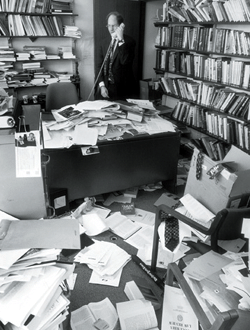
 )
)