Nice thermal infrared imagery confirming how the cities of Taipei, Tainan, and Taitung radiate heat back into the air.
The concrete and steel that make up the city act as a giant heat sink, and by mid-afternoon – when this image was captured – urban Taiwan was radiating heat back onto its poor citizens.
But the cities in Taiwan could easily be designed better. Of course this would require things like “planning” and “enforcement” and “compliance.” Many forumosans celebrate the absence of all the above (which they construe as “freedom”). I do not.
I will let residents of other cities weigh in on this matter, but as a resident of Taipei City I would say this: stop cutting down all the damn trees and covering every square inch with concrete luxury housing/shopping malls/hotel complexes/scandal-ridden stadia. Otherwise we will continue to face hotter and hotter city spaces–with all the attendant damage to our health, productivity, and eventually wealth.
Moving out Linkou will work until all of Linkou is covered with concrete.
Living beside pools of waters or surrounded by bamboo forests is not an attractive position unfortunately.
cool article but i don’t see this being very high on taiwanese prioritys. doubt anything would change about this within my lifetime. the authors suggestion is pretty funny…
“Taiwan would do well to sacrifice a few centimeters of space in apartments to put up some insulation, especially on the ceilings.
Editor: Edward White”
HAHAHAaaaaa has he seen taiwanese apartments or what? at least those in taipei. they are less apartments and more cells.
Not Taichung. I actually find it cold here in the evening and night, even in the summer, having lived in Kaohsiung for years before that. There is little humidity and it doesn’t get contained in the night like Taipei and Kaohsiung.
This is not inconsistent with the heat-storage effect of concrete - it tends to warm up quickly and re-radiate the heat quickly. There have been some studies in Egypt suggesting that concrete houses exacerbate the night/day extremes to an extent that makes them completely uninhabitable.
What’s really irritating is that this sort of thing has been known about for decades, and city planners (not just in Taiwan) ignore it completely. Or quite possibly aren’t aware of either the physics or the empirical research.
I was talking about outside at night. But as far as homes, I don’t know how these old people do it. Living in a concrete box house and they don’t want to turn on the air conditioning for even a few minutes because it costs too much. A solitary fan runs all night.
Taichung does get slightly cooler evenings than taipei, I can confirm. It gets noticeable around August time for some reason, probably the coastal winds. I’m sure it used to have much bigger day night temp changes but now it retains heat more and of course more buildings block the wind.
If you put in roads through countryside they have similar effects.
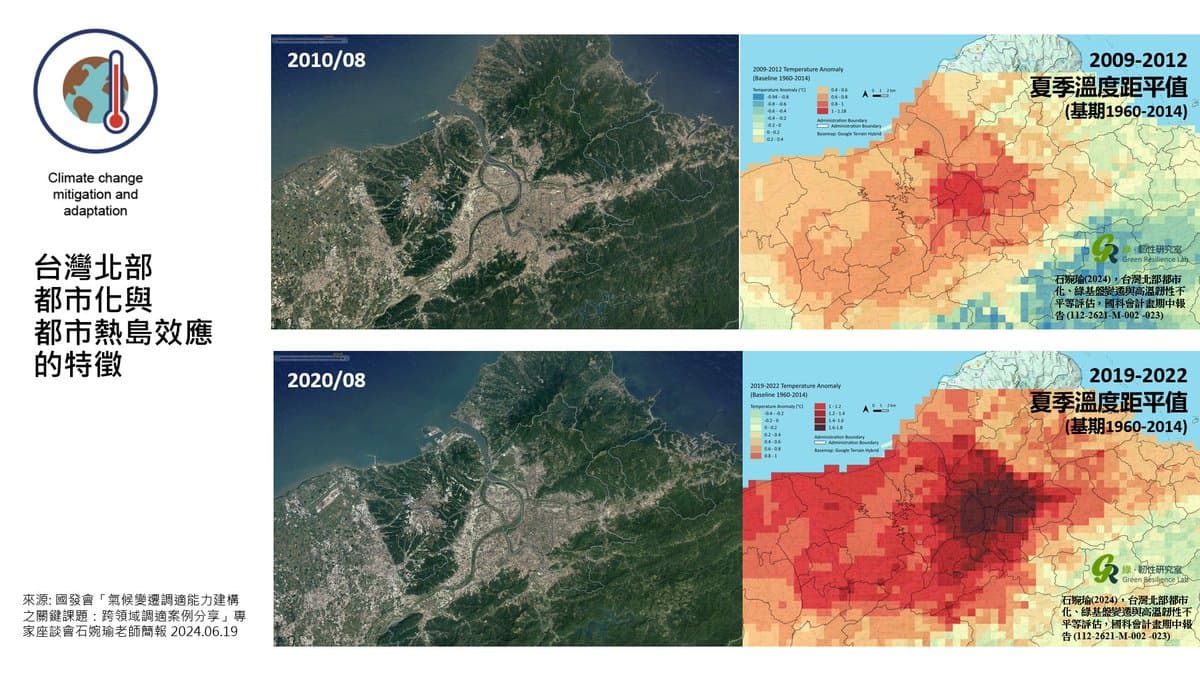
I am reviving this thread to show some findings by Dr Wan-yu Shih, a professor at NTU working on green infrastructure and heat risk. She shows how the so-called “urban heat island effect” (aka the urban heat sink named in the title of this thread) is changing, and not for the better. The green space in Guishan / Linkuo is, according to Dr Shih, no longer enough to help cool things down. The Taipei basin is the worst, as we know, but the Taoyuan plateau is also heating up too.
Hard to believe Linkou plain was prime tea growing country and there are still some tea farms up there . It still gets foggy in the winter but less and less I suppose.
Wait, hold up. So this “warming” stuff is most likely caused primarily by the (rather obvious) things that I and others have already suggested, and not co2? Well, how about that. A win for science, for once.
I’m just wondering what can be done to mitigate this? Like solar panels (likely to make things worse)?
Or is there a way to somehow shade a city with a swarm of solar powered drones hovering high above a city to block out the sun during the mid day? I bet that can lower temperature by at least 10 degrees.
Or do we grow plants over buildings, and stretch nets between buildings filled with plants? Just so you know plants will damage buildings.
Not sure what we can do about it. I figure this is one way to really mitigate the amount of electricity AC uses.