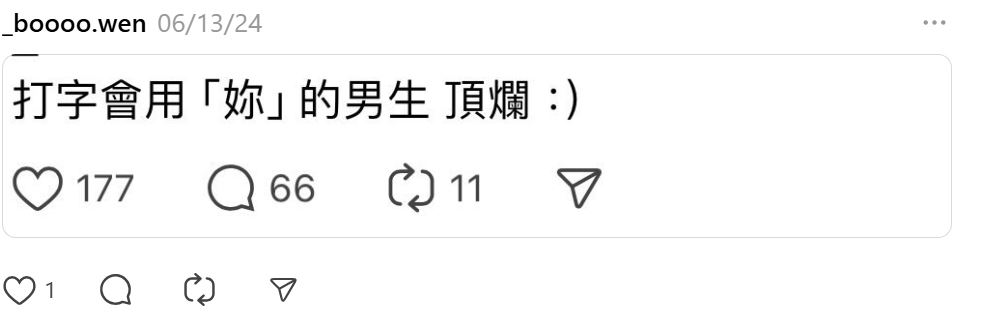
When texting a woman, do you use 你 or 妳?
- 你
- 妳
0
voters
When texting a woman, do you use 你 or 妳?
One is neutral one is for girls.
You should refer to me with 袮 because I am a fucking god.
I say no but am quite curious to know what other posters think.
The reason I don’t use it is because it seems very tricky and nuanced. For that reason, I think it is is better for a non-native speaker to play it safe and stick with 你.
I have a similar view about swearing in Mandarin. I don’t have any objections to profanity but it almost always sounds wrong when I hear non-native speakers doing it.
Other thoughts?
How is it tricky? If she is a girl she is 妳
This was my thinking as well. Taiwan doesn’t have the whole woke gender thing happening here yet. Females are referred to as females. Why even ask?
The playing it safe card does have merit. When in doubt, go with commonality. No need for fancy. But if one knows the person is female, and especially if there is any kind of formality/politeness required, I say go proper. It shows you tried to be polite at least, rather than lazy. Eg. For work.
When it comes to swearing though, there are easy ones to use here, guilt free. But I talk worse than a trucker to my own lottery in law haha… so my opinion might lower the bar 
Fairpoints. I think it’s easier here than north America. But for sure some people disagree here still. When in doubt, no one complains about 你. To be honest I have not seen much care about 你 vs. 妳. And many of my best friends are fiercely proud 鐵 T’s 
I see far more outcry on titles in regards to 您 vs. 你. More about the arrogance and entitlement than the gender.
Frankly I think we should go the way of spoken and just have one word. Make it easy. I am happier than a pig in shit if someone refers to me as 它 and cares little of my penis/vagina situation 
I agree that it is easier than North America.
I also don’t think it is very useful to import concepts like ‘woke’ to try to understand this. There are echoes of North American concerns in the background of some comments about this though.
One common view I see is that some women like to use 妳 when addressing other women in some contexts. A man is kind of intruding clumsily on that space when he uses 妳. I don’t think that all or even most women who feel this way are feminists.
In any event, if she really likes you, any offense will doubtless be overlooked. Especially if you are a foreigner who can’t really be expected to understand these things.
Given it’s in written form, it wouldn’t be obvious which gender is using it without more context though…or i would think. So it could seem like a non issue.
If the gender is known maybe it’s different. I suspect the online dating scene, as an example, might highlight some of the more extreme sensitivities perhaps? But if 2 people were playing an online game with gendered chaeacters. Or coworkers were communicating something work related and they knew each other’s gender. I’m not sure I see the issue.
I still do 妳, especially to mom and wife. I do wonder if I should just ditch the 19th century attempt to alter the writing system to make written Mandarin more like European languages that gender everything. Then again, I could just write in Taigi and write 汝 for you of all genders.
Didn’t realize this was so old! Any details? Did someone in particular champion this?
Is there a character where the 您 has 女 instead of 亻? How can you be polite to a lady if there is not? 
No. 妳 and 她 were invented after the century of humiliation.
I’ve wondered about this at times too. I have asked numerous Taiwan friends and colleagues and they all say online, in texts and messages, they use 你 in general. If it’s someone female close to you, family, close friend, something like that, then 妳 might come into play. Most if not all of the Taiwanese I asked just use 你 universally.
I feel like it makes sense. The radical is 人, women are 人, so why specify women. Unless it’s like German, where women might feel left out or unwanted if the feminine -in ending is left out.
How do woke pronouns work in chinese… 他們/他們 ?
I agree. He and she make problems in English too. It is the most logical. Let’s embrace universal pronouns before they start fucking around with plural vs singular 
Wouldn’t this have originated earlier from the Portuguese missionary activity during the Qin Dynasty? Portuguese - by my recollection and quick google search - is a gendered language much like Spanish with masculinized or feminized nouns, pronouns, and adjectives.
The Portuguese were there since the Ming dynasty. However, at the time the court only wanted to trade for canons, but didn’t think highly of the European culture and customs.
It would take serious non-stop defeats for people to stop looking down on Europeans.