AI generated summary for those who, umm, appreciate the irony:
The author, whose kids attend public schools in Massachusetts, writes about the rapid and largely unconsented rollout of AI tools in K-8 classrooms — from Amazon-branded “AI certificates” given to third graders, to Google Gemini being pre-installed on school-issued Chromebooks and nudging sixth graders to let it write and design their assignments for them.
The piece lays out the growing research concerns: studies from MIT, Carnegie Mellon, and Oxford suggest that students who rely on AI for problem-solving perform significantly worse and give up more easily once the AI is taken away. Researchers also warn that chatbots, which mimic emotional intimacy, may interfere with the social development that is so critical in the tween years. The broader argument is that AI shortcuts the very struggle that builds thinking, creativity, and persistence in young people.
On the corporate side, the article raises serious questions about Google’s Gemini being made available to children of all ages, about school officials receiving fellowships funded by Google and ed-tech investors, and about teacher and parent voices being largely left out of the conversation.
Some parents and educators are pushing back through coalitions calling for a two-year pause on AI in K-12 classrooms. The article closes with a simple but pointed question: what if what we want from AI in our kids’ schools is simply nothing?
AI in your kids’ classroom — where do you stand?
I’m fine with it — AI is the future and kids should learn it early
I’m cautious — some uses are okay but it needs much stricter limits
I’m opposed — kids should develop their own thinking first
I don’t have kids in school but I have a strong opinion anyway
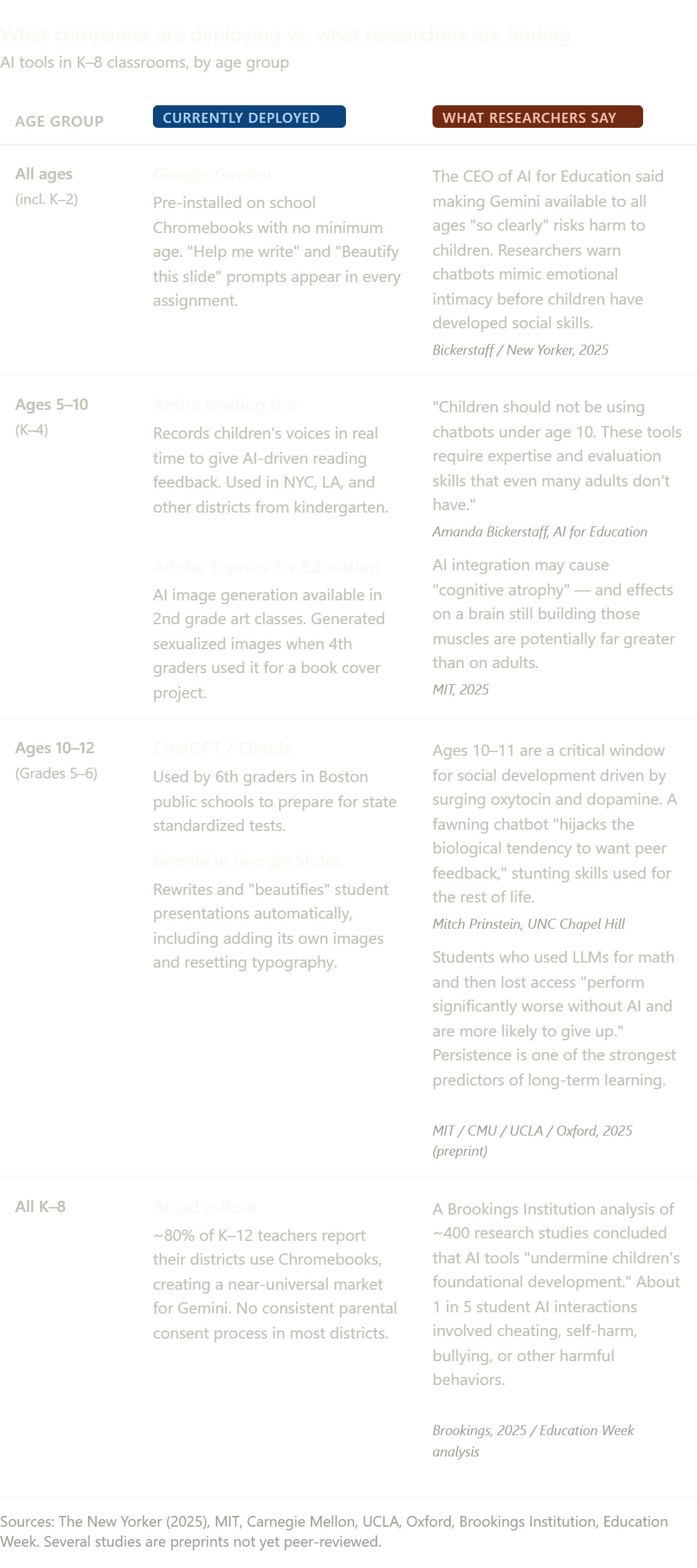
Google Gemini: Pre-installed on school Chromebooks with no minimum age. “Help me write” and “Beautify this slide” prompts appear in every assignment.
The CEO of AI for Education said making Gemini available to all ages “so clearly” risks harm to children. Researchers warn chatbots mimic emotional intimacy before children have developed social skills. (Bickerstaff / New Yorker, 2025)
Ages 5–10 (K–4)
Amira reading bot: Records children’s voices in real time to give AI-driven reading feedback. Used in NYC, LA, and other districts from kindergarten.
“Children should not be using chatbots under age 10. These tools require expertise and evaluation skills that even many adults don’t have.” (Amanda Bickerstaff, AI for Education)
Ages 5–10 (K–4)
Adobe Express for Education: AI image generation available in 2nd grade art classes. Generated sexualized images when 4th graders used it for a book cover project.
AI integration may cause “cognitive atrophy” — and effects on a brain still building those muscles are potentially far greater than on adults. (MIT, 2025)
Ages 10–12 (Grades 5–6)
ChatGPT / Claude: Used by 6th graders in Boston public schools to prepare for state standardized tests.
Ages 10–11 are a critical window for social development driven by surging oxytocin and dopamine. A fawning chatbot “hijacks the biological tendency to want peer feedback,” stunting skills used for the rest of life. (Mitch Prinstein, UNC Chapel Hill)
Ages 10–12 (Grades 5–6)
Gemini in Google Slides: Rewrites and “beautifies” student presentations automatically, including adding its own images and resetting typography.
Students who used LLMs for math and then lost access “perform significantly worse without AI and are more likely to give up.” Persistence is one of the strongest predictors of long-term learning. (MIT / CMU / UCLA / Oxford, 2025 (preprint))
All K–8
Broad rollout: ~80% of K–12 teachers report their districts use Chromebooks, creating a near-universal market for Gemini. No consistent parental consent process in most districts.
A Brookings Institution analysis of ~400 research studies concluded that AI tools “undermine children’s foundational development.” About 1 in 5 student AI interactions involved cheating, self-harm, bullying, or other harmful behaviors. (Brookings, 2025 / Education Week analysis)
Sources: The New Yorker (2025), MIT, Carnegie Mellon, UCLA, Oxford, Brookings Institution, Education Week. Several studies are preprints not yet peer-reviewed.
How about the education boards of the world ask the AI tools of the world to develop new curricula that will prepare the young ones for the challenges ahead?
I am not quite sure what children should learn these days. For example foreign languages. The tools that are available now and will be available soon are likely to give you instant translations all the time. Think headsets or implants that will decipher any voice and any script immediately. Why should anyone go through years of learning a language, often in the boring and ineffective ways schools provide, when there are tools that give you translations for every imaginable language instantly? Sure, you could argue that there will be instances where there are no tools available or where there is no electricity or Internet access, but these situations will be increasingly rare, unless of course, the whole system breaks down. But in that case, other survival skills will be more important than foreign-language skills anyway. Same goes for handwriting. The use of writing on paper has been reduced significantly and typing is increasingly replaced by dictating and the machine doing the rest. The world is changing and so should the education system. Technology is unstoppable at this point.
I’m not fully convinced. Anyone who actually learns the language will still have a competitive edge in communication, which then translates to a competitive edge in persuasion, deal-making, winning friends, and influencing people. It’s going to be a long time before AI tools will be able to approach human skill in navigating real-time, interruptible, turn-driven but sometimes overlapping and multi-party conversations.
Even if the voice-based auto-translation tools work quickly, there will always be a few-seconds delay due to word order differences in languages requiring the whole context in order to correctly translate. Someone who speaks the language themselves will be able to keep up with the pace of the conversation, while someone who relies on the seconds-late machine-assisted translation risks becoming like the guy in the video below – always making a comment just a little too late.
AI generated summary and more for those who, umm, appreciate the irony:
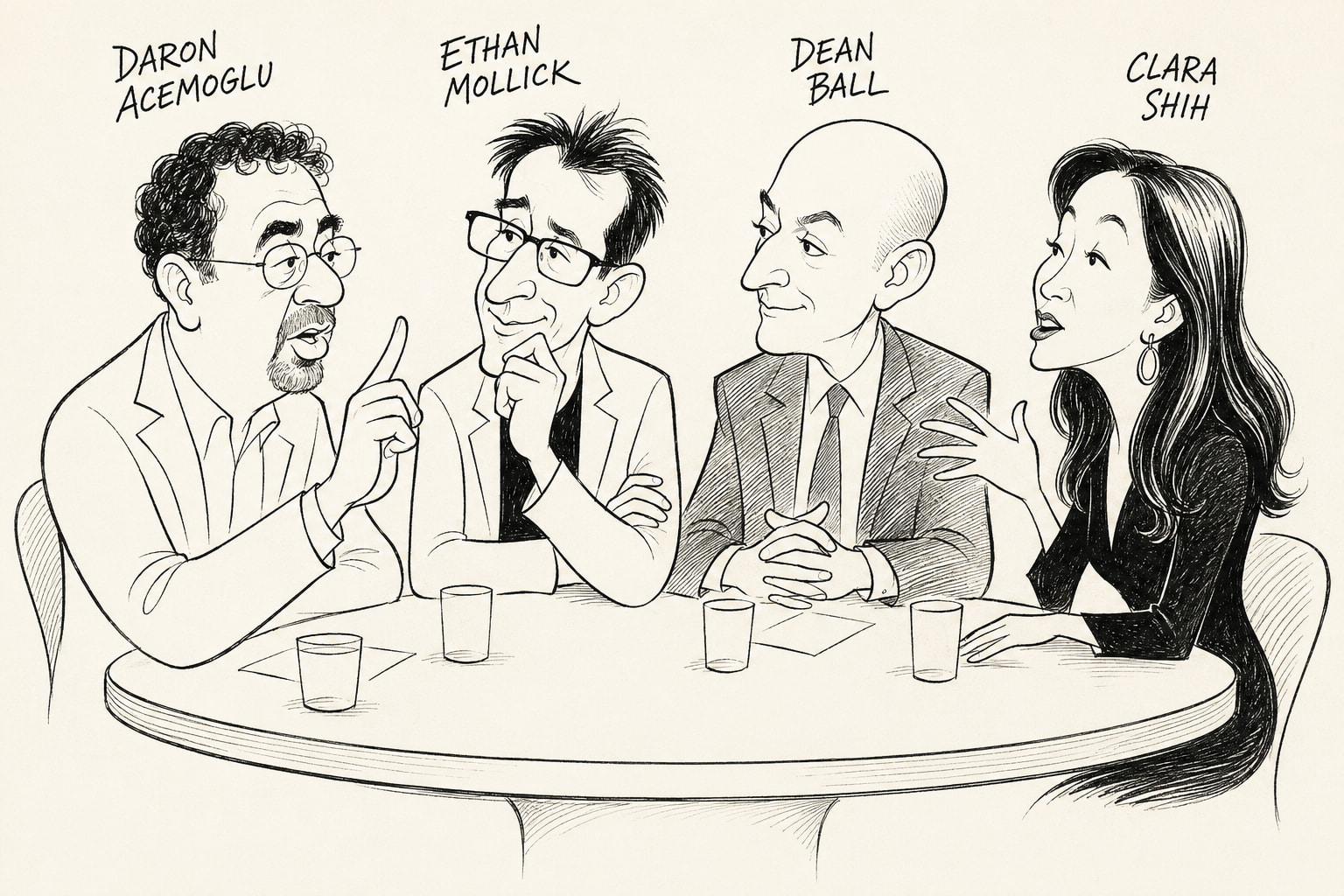
A recent New York Times panel brought together economist Daron Acemoglu, AI researcher Ethan Mollick, policy analyst Dean Ball, and former Salesforce executive Clara Shih to discuss who is likely to thrive in an AI-driven economy.
Surprisingly, there was broad agreement that the future is not simply “AI replaces humans.” Instead, the debate centered on whether AI will primarily augment workers, create a small elite of AI supervisors, or eliminate large numbers of entry-level and routine white-collar jobs. Some panelists argued that AI could dramatically lower the barriers to entrepreneurship and make skilled individuals far more productive, while others warned that industries such as insurance, customer service, administrative work, consulting, and parts of software development may see substantial disruption. Several experts emphasized that practical experience, judgment, and the ability to evaluate AI-generated work may become more valuable than producing the work itself. The most interesting point was perhaps that nobody really knows which occupations will be safest.
The strongest consensus was that workers who continuously learn, adapt, experiment with AI tools, and develop broad problem-solving abilities will likely have an advantage. At the same time, concerns remain about how young people will gain experience if traditional apprenticeship and entry-level roles disappear. The discussion was notable because even among experts who strongly disagree on AI’s long-term impact, there was little confidence that existing educational and career pathways are preparing students adequately for what may come next.
Which statement best matches your view of AI’s impact on careers over the next 10 years?
Mostly creates new opportunities and industries
Roughly balances job creation and job destruction
Eliminates more jobs than it creates
Too early to tell
0voters
If you were advising a 14-year-old student today, what would you emphasize most?
The students at this middle school in Kentucky got a surprise when they received this year’s class information. The booklet was rife with errors and nonsense that was produced by AI and obviously not proofread by anyone.