It’s not the same though. If I say Minnan, I’m talking about a group of closely related, considerably mutually intelligible languages, spread around South Fujian, Taiwan, and Southeast Asia. That is a thing, right? There has to be some name for it.
Mandarin didn’t exist then.
Yes true but the father of mandarin did and we wouldn’t be able to understand them
I wonder how much of the olde engish we would understand if we went to 10th century England
Just like words for foreign languages in any given language.
Not much at all. Here are a few lines of Beowulf in old English from more or less around that time (probably).
Hwät! we Gâr-Dena in geâr-dagum
þeód-cyninga þrym gefrunon,
hû þâ äðelingas ellen fremedon.
Oft Scyld Scêfing sceaðena þreátum,
monegum mægðum meodo-setla ofteáh.
Egsode eorl, syððan ærest wearð
feá-sceaft funden: he þäs frôfre gebâd,
weôx under wolcnum, weorð-myndum ðâh,
ôð þät him æghwylc þâra ymb-sittendra
ofer hron-râde hýran scolde,
gomban gyldan: þät wäs gôd cyning!
þäm eafera wäs äfter cenned
geong in geardum, þone god sende
folce tô frôfre; fyren-þearfe ongeat,
Dam !! See we can’t time travel
It would be pointless
Nobody would understand us
Plus the above sounds like the tv station messed up the audio feed
We would fair a little better in Elizabethan england.
Chaucer is about 400 years later and we can understand more of the text. I seriously doubt that any of us would be able to understand any of it at first if we heard it spoken by a native speaker of middle English. Probably like listening to Scots. I have never been able to understand Shakespearean English spoken on the stage even where I have read the play advance.
Experience, though noon auctoritee
Were in this world, is right ynogh to me
To speke of wo that is in mariage;
For, lordynges, sith I twelf yeer was of age,
5 Thonked be God, that is eterne on lyve,
Housbondes at chirche dore I have had fyve -
For I so ofte have ywedded bee -
And alle were worthy men in hir degree.
But me was toold, certeyn, nat longe agoon is,
10 That sith that Crist ne wente nevere but onis
They should remake The Sword In the Stone in olde English and have modern English subs
Just think in 200 years nobody will have remembered we existed and if mankind is still around English and Mandarin then may be quite different
Hey, isn’t that the setting for Firefly?
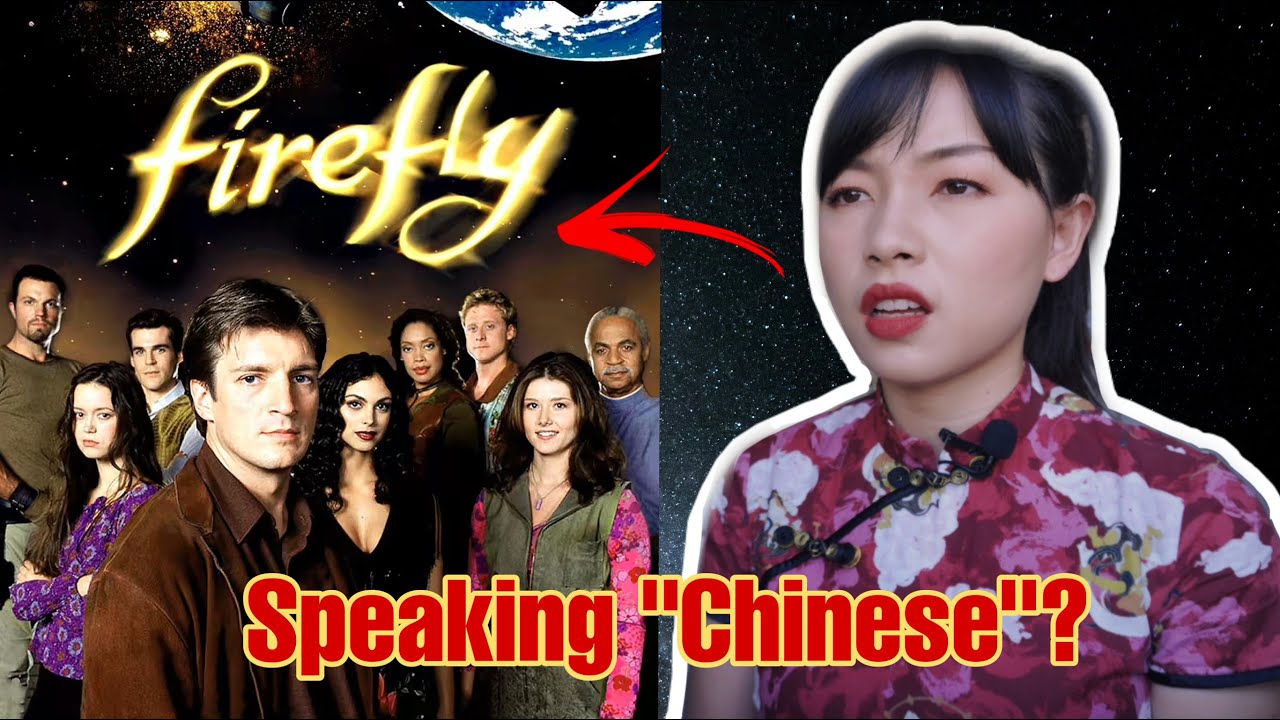
And you are correct @tommy525 no one is going to understand Alan Tudyk’s Mandarin then!
Bonus material from AI
The show creators wanted to portray a realistically integrated future society. Joss Whedon, the show’s creator, believed that instead of the two superpowers destroying each other, they would eventually merge and blend their cultures. He considered this especially plausible in a western frontier setting, noting that “The Wild West was full of people from the Far East, and so the mixture of those two cultures — that’s what history is, it’s culture in a blender”
From one of my favorite podcasts, you can hear how it might have sounded in its original language.

Jump over to 17:42 to hear an immediate sample. The speaker is originally from North Carolina
Sounds great.

Except some chinese would have difficulty reading chinese written before 1956…
Even in 1815, when Robert Morrison wrote the first English-Chinese dictionary most people in Beijing were still speaking the Chinese Koine, which was based on Nankinese, and was much closer to Middle Chinese that was spoken since the Tang dynasty.
It is a thing, although I question the mutual intelligibility, and it’s exactly the linguistic sub-family that 趙元任 coined in 1930. Prior to that, if anyone bothered to give the language they speak a name, they simply named it after a small geographical region, such as Amoy or Teochew.
It’s like asking how did people in the Philippines refer to their related languages prior to people naming it Philippinic, well they simply didn’t have a name for it.
First of all, the script has changed a great deal since the time of the Annals. This will give you an idea of what small seal script looked liked (and there were many varities):
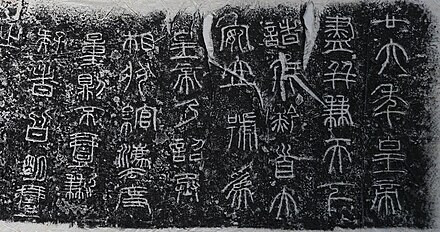
Second, the grammar, usage, and syntax of the Chinese used in the pre-Qin period is very different. Most educated people cannot read the Annals without a LOT of annotation and explanation.
It’s possible to read classical Chinese with a lot of effort and study.
Classical Chinese is kind of like the classical Greek of the ancient world. It is indeed under the surface of written language and has a profound influence even today. But it is not at all true that most modern Chinese people can read it even if they are educated. They can certainly learn it more intuitively and easily than a European but they have to put the work in.
English is a Germanic language
So to say let’s use this to differentiate ourselves from Germany does not compute?
How about English is the same in the UK, so don’t differentiate the US from the UK?

Speak for yourself!
Pretty sure my 13th century English would eclipse my mandarin ability in a couple of weeks lol.
Pretty sure for much of the 13the century, Mandarin in China was Mongolian.
Look this is my fantasy and I am time travelling back to England specifically.
What they speak there is way easier than Mandarin.