Taiwan’s Identity: Time to Drop Mandarin?

From AI

The Long Pause represents a significant period in Pacific migration history, marking a thousand-year gap between the settlement of Western and Eastern Polynesia.

Timeline and Geography

Early settlers reached West Polynesia (Vanuatu, New Caledonia, Fiji, Samoa, and Tonga) by 800 BC. After this initial settlement, there was a prolonged pause before expansion continued to the Cook Islands, Hawaii, Rapa Nui, and Aotearoa. The settlement of Tahiti and the Cook Islands didn’t occur until around 1000 AD.

Possible Explanations

Several theories explain this millennium-long break in migration:

Environmental Factors
Computer modeling suggests that changes in wind direction and ocean currents may have created challenging navigation conditions.

Technological Development
The pause might have been necessary for the development of better seafaring technology. Early expeditions used waka ama (outrigger canoes), while the later-developed waka hourua (double-hulled canoes) could handle longer journeys and rougher seas with heavier cargo loads.

Navigation Challenges
Research by Montenegro and colleagues suggests that early Polynesians lacked the technology to sail efficiently against prevailing wind patterns, making eastward expansion particularly challenging.

Historical Impact

This pause had significant implications for Pacific cultural development. During this period, distinctive cultures emerged in different island groups, and specialized knowledge of navigation and boat-building became highly valued, with experts (tohunga) holding prestigious positions in their communities.

But the “they” you are referring to are long gone…and if the current KMT made this suggestion then all DPP supporters would automatically be opposed.

I am referring to the government of Taiwan.

The “they” is still there

There’s a theory that the Amis are descended from Austronesians who originally spread from Taiwan to the the Philippines, but much later some came back.

In this updated list, some of the crossed out phrases do exist, and some of the romanizations are correct, but it’s the English explanation given that’s slightly off. For example, hó-bô? is more like asking “yes?” or “will that be okay?”. Even if you add lí to it, “lí hó-bô?” means how are you and not exactly are you okay. Are you okay is more like “lí ū iàu-kín bô?”

That doesn’t make much sense as Chinese civilization originated around the Yellow River area in northern China - you know, the broad plains where Mandarin is the local dialect today.

yeah i kinda thought that too. but AI says different:

AI Overview

Learn more

This statement is generally considered accurate; based on linguistic research, Minnan (also called Southern Min) is considered to be older than Cantonese, which is itself older than modern Mandarin, with Minnan showing traces of even older language features compared to the other two.

Explanation:

  • Minnan’s Antiquity:

Minnan dialects, particularly those spoken in the southern Fujian province, are thought to have diverged from other Chinese languages earlier, possibly around the Han dynasty, preserving features of older Chinese that are not found in other dialects like Cantonese or Mandarin.

  • Cantonese as Middle Chinese:

While considered older than Mandarin, Cantonese is generally seen as having retained more characteristics of Middle Chinese, an intermediary stage of the language, compared to Mandarin which has undergone more significant sound changes.

  • Modern Mandarin Development:

Modern Mandarin, as we know it today, is a standardized language that developed relatively recently, primarily during the Republican era in China, making it the youngest of the three.

++++++++++++++++++

Therefore what we call “Taiwanese” is actually Minnan and therefore precedes modern Mandarin.

Ai again:

AI Overview
Learn more
Old Chinese, also known as Archaic Chinese, is the oldest attested stage of the Chinese language and the ancestor of all modern Chinese languages:
Earliest examples
The earliest examples of Chinese are divinatory inscriptions on oracle bones from around 1250 BC, in the Late Shang period.
Common language
Old Chinese was the common language during the early and middle Zhou Dynasty (11th to 7th centuries B.C.).
Features
Old Chinese had a rich sound system with consonants differentiated by aspiration or rough breathing.
Reconstructing Old Chinese
Philologists from the Qing dynasty began work on reconstructing Old Chinese.
The history of the Chinese languages can be divided into several periods:
Proto-Sinitic: The period of the most ancient inscriptions and poetry.
Archaic (Old) Chinese: The 8th to 3rd century BC.
Ancient (Middle) Chinese: Through AD 907.
Modern Chinese: From c. the 10th century to modern times.
The Chinese language is unique in that it doesn’t use an alphabet. Instead, each character, known as Hanzi (漢字), represents a word or morpheme. There are about 56,000 characters, but only around 3,000 are in everyday use.
+++++++++++++++

tommy here:
(thus the mandarin spoken today is akin to the english spoken today being completely different from Olde English. There was Archaic Chinese preceding modern mandarin>… wonder if that was similar to what the emporer and his consorts spoke?)

IF we went back to ancient china our modern mandarin would not be intelligible.

That’s because there was a migration of chinese southward (expansionism) taking those (now southern) languages with them. What was to become mandarin only became a language of the seat of power when emperor Yongle moved the captial to beijing from nanjing (after killing his family).

I don’t think so, that would be hard to even imagine. My understanding is Mandarin is relatively recent though compared to the south Chinese languages that have been slowly percolating for a thousand years or more.

It makes more sense if you know the general contours of Chinese history. After the Han empire, northern China was invaded repeatedly and ruled (most of the time) by northern conquerers from the steppes for 1,000 years or so.

The elites and probably many others moved south and the center of gravity of Chinese civilization shifted permanently south to the Yangtze river basin. They took their languages with them and more fully colonized places like Fujian and Guangdong with them. It seems that these older Sinitic languages were prestigious and more conservative.

In the north, there were many phonetic changes as the Sinitic languages there changed to accomodate foreign sounds from steppe languages (among other things). Early Mandarin appeared during the Yuan, which of course was a Mongolian dynasty with its southern capital in Beijing. This is probably when it became a lingua franca for people from all over China proper to communicate with one another. Lots of simplification of a complex process here.

So instead of mother tongue it should referred to as the step(pe) grand niece’s tongue??

Guys, we’ve been over this. You shouldn’t call the language Minnan, as that’s the name of the linguistic sub-family-group invented by a linguist, 趙元任, in the 1930s, so saying there is a language named Minnan is as idiotic as saying there’s a language named Romance. Imagine someone saying “I speak French”, and some dude insists “no, you speak Romance, French should be the language spoken by the Franks near Frankfurt.”

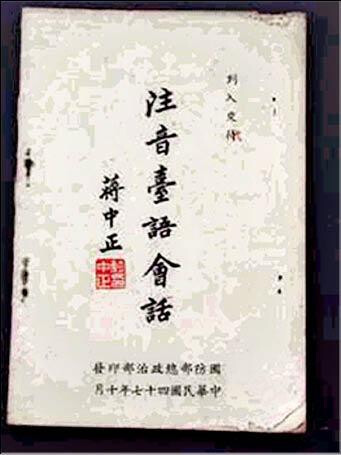
Taigi speakers didn’t choose to name their language Taigi. It’s yet another exonym that dates back at least 200 years. Taigi aka Taiuanue has been called that by officials since the Qing dynasty. It was called that by the Japanese. It was called that by the KMT. CKS even sponsored a dictionary using Zhuyin to spell out Taigi, titled “Zhuyin for Taigi Phrases”.

Saying Taigi shouldn’t be called Taigi because there are other languages in Taiwan is as silly as saying Hakka shouldn’t be called Hakka because Hakka means immigrants, and there are other immigrant languages in Taiwan, one of which is Taigi.

Let’s rehash a rehash. The current form of Mandarin did not come into existence until the late 1800s.

Amen!

So, it’s been developing over a relatively recent period of time, as I said. But it’s not as if it leapt into existence in the late 1800’s.

Taigi is called Minnan hua in mandarin
I said so in Taiwanese here

Thank you

Minnan is the same as hokkien
Taiwan’s hokkien does have some differences like French Canadian to French French but is basically hokkien or Minnan hua

You are saying that is idiotic ?

Many Taiwanese I know say Minnan hua so they are idiots ?

Right. Perhaps an analogy would be Shakespeare’s or even Chaucer’s English vs. the modern form. Every modern language is different from its medieval or early modern form (I assume).

Well let’s
Face it
Taiwanese is a CHINESE language

So to say let’s use this to differentiate ourselves from
China does not compute !

This math don’t math

If we want to differentiate ourselves from
China we better pick a Formosan original inhabitant language or even Japanese

Taiwanese much as I respect it as my first language is a language
From China

Luckily though Taiwanese speakers of mandarin do have a particular accent that sets us apart from
China Chinese after only speaking less
than one sentence

They spot us instantly

Yes, except that Mandarin’s development was relatively compressed, under the influence of northern neighbors I understand. I need to read more of what @hansioux has previously posted tomorrow :slight_smile:

My short said in taigi that taigi is hokkien is Minnan

Yup and I bet if they transported the posters from this thread to 1000AD China we probably would have a hard time understanding the mandarin spoken then