Click here for pictures and a link to a Prius English information site.
Click here for the Prius Taiwan site.
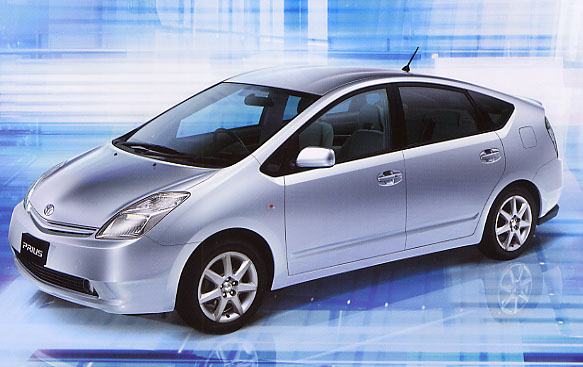

The Toyota Prius hasn’t been a hit in Taiwan to say the least. Since debuting over a year ago, there have only been about 300 vehicles sold island wide, and sales are greatly flagging. With next to no advertising campaign, little environmental education or care, not much incentive for the public to purchase cleaner cars by the government, and relatively cheap fuel abound, the Prius is yet to be a consideration for many in Taiwan and the 1.2 million NT price tag is no help. To make a prius even less desirable, some diesel fueled vehicles are more economical to run, using much cheaper fuel and returning about the same number of miles/kilometers to the gallon/litre, if not more. So with all this said, why on earth did I buy a Prius?
I had looked at all kinds of cars before making my purchase and the Prius doesn’t compare to many. There are many significant differences, that for some will seem strange, yet for some like myself will seem like the vehicle it is and that is a great clean breath of fresh air; a refreshing change from the simple and mundane internal combustion engines of the last 100 years. A beacon of hope, which is lighting the way for even more daring experiments in vehicle design and development that will perhaps one day mean that we wont have to keep going on about horse power and CCs, but instead brag about how renewable our vehicle’s energy sources are and how far vehicles have come in terms of design. The Prius therefore deserves its own style of review and this is it.
Firstly I’m not going to try and compare it to another car, but cars in general. This may seem odd, but then as I explained it’s not a typical type of car.
The Cabin
The cabin of the Prius is spacious to say the least. The plastics in the cabin are of top Toyota quality and design and build have not been compromised in any area. The layout of the dashboard is made easy by the simplistic controls and read outs. Fpr example the speedometer is a digital projected display, projected just below the windscreen and there is a distinct lack of distracting dials and knobs, made tidy by the central touch screen which offers control of air conditioning elements and vents, information on fuel economy and music selections, and if adapted can offer an external view of the car through cameras and can operate itunes. The cabin offers as much leg room as a medium to large saloon car and so seating is not a problem at all, even for the tallest of drivers. The ceiling is higher than most saloon cars or hatch backs and leaves a good few inches between a six foot driver or passenger and ceiling, and the floor pan is low, giving an airy feel, as well as a good degree of comfort, made even slightly better by the reasonably supportive grey leather seats. The rear seating isn’t forgotten about either, having good leg room, comfortable seats and ISOFIX technology for the allowance of the safest and most practical child seating available. The hump in the rear floor is there, but is low, allowing reasonable space for a fifth passenger in the middle, secured by a third seat belt instead of a lap belt. Although the boot space is large, it is shallow due to batteries situated under the floor and the tail of the roof line is a slanted rear hatch, which doesn’t allow for the loading of tall objects, although the rear seats do fold flat, allowing for a very large loading space, which is much better than most four door saloons.
Extras
The Prius in Taiwan is available in only one package, and everything is standard, so there is no choice but to accept the six airbags and 5 star NCAP safety rating, cruise control, climate control, ABS, traction control, electric mirrors, single disk CD player, computer LCD centrally mounted display, steering wheel stereo and climate control buttons and electronic steering, which is a fair package of gadgets to keep most drivers happy during the most tedious driving conditions.
There are various websites in the states that are selling hacks for the in cabin display, allowing it to perform hidden functions and adapt to D.I.Y. plugin cjextras such as external cameras, ipod interfaces with itunes, which can be controlled by the touch screen display and more, perhaps for the first time making an affordable car seem like a more personable piece of equipment such as a telephone or P.C.
On the down side to the interior, the electrically adjusted mirrors do not fold in at the touch of any button and must be manually folded, and the steering wheel is only adjustable up and down, not telescopically which is a function that really should be there to accommodate differing types and sizes of driver. The Prius in some countries also comes with the option of a self parking function, which literally parks the car for the driver, incorporating the use of the electronic steering and bumper mounted radar, although the car in Taiwan cannot come with this option and may be missed by some as the rear view from the driver’s seat is largely restricted by the split rear window and thick rear pillars, made even worse by rain on the anti U.V. layer which is fitted to our car’s windows, leaving almost no rear view at all when reversing at night; quite a scary situation indeed.
Owners in Asia do however have the benefit of one option that isn’t available on all cars abroad, which is the addition of an ‘E.V.’ switch. This switch under low speed and sufficient battery charge conditions, offers full electric mode to the driver which makes for very low vehicle noise when creeping home at night. A maximum of 2 kilometers can be reached in E.V. mode under perfect conditions, but will not power the vehicle if the vehicle has run out of petrol/gas, as a fail safe kicks in and will cut the vehicle’s power.
The Drive
Even when considering the hard economy tyres and non independent rear suspension of the Prius, the ride is very good indeed, and comparable to some of the better family cars on the market. The steering is accurate and positive in corners and the car stays firm with little body roll. The electronic steering is without much feel at speed and in corners however, due to minimum driver effort, but is a bonus at low speed maneuvers, making the most difficult and tiring turns easy, even for the frailest of drivers. The front and rear disk brakes provide very sharp and positive stopping power, although take some getting used to, due to the almost full stop or no stop nature of the pedal. The tires of the Prius don’t help the noise levels at speed, which can be quite high at times, certainly when traveling concrete road surfaces. The isolative and insulation materials used on the Prius are of a minimum and of low weight, making up for the extra weight of on board batteries situated in the floor, just behind the rear seats. This means that the car, although quiet at average speeds largely depends on the type of tyres fitted to reduce the levels of road noise at speed.
The drive is most different to most cars in city and during congestion, and the Prius excels in this area. When stopped or at low speed, the car often shuts down the engine and relies on an electric motor and batteries for both propulsion and power to the electrical systems, including the air-conditioning. This gives the car almost ghost like qualities, and at these times often feels more like a space ship than a car. Pedestrians beware though, as few people hear it coming at low speed and frequently walk into its path, or walk ahead of it, totally unaware of its presence until the driver is eventually forced to either blip the horn or flash the lights, without frightening the life out of people. The single geared variable transmission also adds another odd sense to the car, which is the lack of acceleration. The car isn’t a great accelerator, but the single gear means that the vehicle never jerks from one gear to another, providing an almost constant ‘G’ all the way up to the vehicle’s top speed. This also means that flooring the accelerator gives little feeling of greater acceleration than simply driving normally, but for the high revving engine that gets noisy when driven hard, providing little incentive to drive hard, but a greater incentive to conserve more fuel and drive quietly.
Trying to explain how the hybrid system works.
The batteries of the Prius are not charged by plugging the car into a wall socket as with some electric vehicles, but are charged by the motor/converter that woks in combination with the engine, transmission and electrical circuit. When accelerating hard or climbing, the motor and engine work together, providing maximum torque in harmony with the variable gearbox, which are all computer controlled to boost and balance efficiency with maximum effort. When cruising at low speed the engine is frequently shut down and the motor does much of the work. When cruising at high speed, the engine does most of the work and the motor is often switched to charging the batteries. When stopped, the motor and engine are turned off to conserve power, and when the vehicle is slowing or descending the engine is turned off and the motor switches to converting the vehicle’s motive force into electricity to recharge the batteries. If the batteries are running too low when the vehicle is stopped, due to lights, air-conditioning and other power demanding circuits, then the engine is restarted to power the motor/converter and recharge the batteries. Everything is done automatically and the driver doesn’t have to do a thing, but steer and push either the brake or accelerator as normal.
The provision of the electrically controlled variable transmission also means that there is no need for a gear lever between the front seats and Toyota have even removed the hand brake and fitted a foot depressed parking brake, leaving the centre of the car for storage and an arm rest.
This entire system doesn’t really conserve as much fuel as Toyota claims (60+mpg), but to get close to their claims a vehicle must have to drive consistently using no accessories such as air conditioning, stereo, lights and other necessary circuits, which is to say unreasonable at the least. I found that driving realistically with air-conditioning on and other electrical systems, yet sensibly during highway driving at about 110kph, the car returned about 19km per 1 litre of fuel, mountain road driving at variable speeds returned about 24 km per litre and inner city driving returned about 16km per litre, which although sounding the least economical is probably much more economical than many internal combustion engine cars of relative size during city driving conditions.
A result of 36.7 miles per gallon city driving, 55.1miles per gallon on mountain roads and 43.6 miles per gallon on the highway. Not close to Toyotas claims by a long shot, but not too bad overall.
Summary
The Prius is not for everyone as it is not a performance car and is expensive at a list price of 1.2 million NT. In terms of power, Toyota says that it is on par with a normally aspirated 2.0 litre petrol engine family saloon in terms of acceleration, but it is very difficult indeed to compare this car in such a manner. The Prius therefore defies comparisons in terms of performance, but does excel in terms of build quality, design and function as well as expression. A driver in a Prius is making a clear statement to others, that they not only wish to drive something cleaner and more efficient, but that they wish to drive something different and that they are not afraid of the future or any great change in vehicle design. A Prius driver is not as interested in getting somewhere faster as they are interested in an idea and a concept that one day vehicles may be more individual in terms of design and propulsion, and that being cleaner does not necessarily mean we must give up all creature comforts. A Prius therefore is as much of a statement as it is an achievement, and Toyota deserve every bit of praise for daring to do what many others have been reluctant to for some time. The success of the Prius in many countries shows the want and desire for future development in cleaner cars, as well as a desire to drive something that little bit different, and that word perhaps makes for the best and most simple summary. Different!4


