Coronavirus - Taiwan (October-December 2020)

Personally I put speed and efficiency of contact tracing at number one, above mask use. But mask use also buys time as you track down contacts.

Our numbers should be further broken down. Take away people bringing the virus in and it’s double digits for local cases. And, apart from the Navy fiasco, the biggest cluster was one taxi driver and his family. Avoidance of clusters and super spreader events was paramount.

Aha! The AIER is a libertarian organisation. That’s why she’s concluding that Taiwan’s success was down to endogenous factors and governments shouldn’t do anything.

She’s patently wrong. Taiwan did not “reject” lockdown. We didn’t need to go to a full lockdown because we acted early and we acted decisively and we had full civilian compliance. We would absolutely have gone into full lockdown had there been widespread community transmission.

Memory is always iffy, of course, but I remember a lot of my university students saying there should have been a lot more of a lockdown than there was. “Taiwan” seemed perfectly willing to go into lockdown (based on a very small sample!), but the government never thought it was necessary.

I think some people here actually wanted a lockdown for the pure drama of it. We were never even close, the virus was well contained.

Taiwan success.

  1. Acted early.
  2. Had set up a system to deal with epidemics.
  3. A community willing to accept advice from doctors and scientists who have specific knowledge of the issue.
  4. Government willing to accept advice of doctors and scientists.
  5. Sensible use of masks and hand sanitizer.
  6. Pervious experience with SARS
  7. Ability to rapidly roll out manufacturing of equipment and products for community safety (masks, hand sanitizer etc)
  8. Prior planning. Can’t be stressed enough.

Lessons.

  1. Educate public regarding how they should act when sick. Previous mask usage when people had felt sick meant the adjustment to mask usage was less burdensome.
  2. Have an epidemic response plan and use it.
  3. Have a department the specificity deals with epidemic responses and rolling out response plan.
  4. Have the specialist and have a government who will listen to advice from specialists.
  5. Have a communication strategy in place that is easy and clear for the public too understand and implement.
  6. Include the public in the decision making process. Ie schools and businesses. - this is something that Taiwan excelled at. It was “ok we have to do this because”. Not arguing, not bs.

Anything else that should be added?

Though, schools were closed promptly.

I thought that the article was a bit weird too when I skimmed it last night. It seemed that by “Taiwan doing everything wrong” the author was largely referring to no mass lockdowns, and ergo suggesting that lockdowns aren’t necessary anywhere, neglecting the fact that Taiwan hasn’t really had major outbreaks to justify them.

Were they actually closed? I don’t remember now. I know my university had the start of second semester delayed a couple of weeks, and larger classes were half in-class, half distance-learning, but there was never a moment when they shut down. I suspect they would have been, but the timing of winter vacation worked well to make the adjustment easier.

yes, I meant this. And there was no winter class at schools.

Our winter break was two weeks longer than scheduled. Kids didn’t go to school until three weeks later than scheduled.

I was dreading a lockdown and online teaching.

I think Taiwan’s success can be summed up with the word sensible. Delaying the start of the semester was just one of many sensible actions taken.

You can count the number of minor cock-ups (sailors etc) on one hand.

“According to the lockdown narrative, Taiwan did almost everything ‘wrong’ but generated what might in fact be the best results in terms of public health of any country in the world.” ~ Amelia Janaskie

Cause we didn’t listen to the Corrupt WHO and acted early with distrust towards the CCP.

Instead of lockdown, Taiwan closed its border promptly. Against WHO’s recommendation.

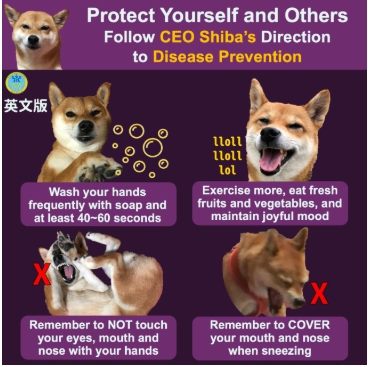
Yeah: Official Doggo content Hygiene+Tips+Avoid+touching+your+face! .

Indeed. That was the advice from the WHO after they had backtracked on their “evidence based” research from the CCP that human to human transmission wasn’t happening, and IIRC before the WHO advised people not to wear masks unless they were symptomatic:

How Tedros sleeps at night is beyond me. Probably dreams about his bank account.

WHO stands ready to provide advice to any country that is considering which measures to take

It was the key moment. Countries that chose not to, either due to advice from the WHO or because they underestimated what could happen, were fooked.

I reckon he dreams of sucking the smallusdickus from Xi.

TAIPEI, Taiwan — As countries around the world grapple with the coronavirus, Taiwan may offer valuable lessons on how to curb its spread.

The island is just 81 miles and a short flight away from mainland China, where COVID-19 is believed to have originated in the city of Wuhan. As the outbreak took hold in January, many Taiwanese business people and their families based in China were returning to celebrate the Lunar New Year, and up to 2,000 Chinese tourists a day visited the island, potentially bringing the virus with them.

And yet, Taiwan has had only 50 cases of COVID-19 and one death as of Friday night — far fewer than China’s 80,824 cases and 3,189 deaths, a stark contrast even when taking into account the enormous population difference: Taiwan’s 23 million to China’s 1.4 billion. Taiwan’s numbers are also much lower than neighboring countries such as South Korea, which has had more than 7,900 cases, and Japan, with 675. It’s also faring better than countries much farther away from China, such as Italy, with more than 17,660 cases, and the United States, which had 2,167 cases as of Friday night.

Of the 100-plus countries and territories affected, Taiwan has the lowest incidence rate per capita — around 1 in every 500,000 people — for a place that is located so close to China and with so much travel to and from.

(. . . . yadda, yadda, yadda, yadda . . . )

To ensure a steady supply of masks, the government quickly banned manufacturers from exporting them, implemented a rationing system and set the price at just 16 cents each.

It also set up new production lines and dispatched soldiers to staff factories, significantly increasing production. – March 10, 2020

It’s the (real, medical grade) masks, stoopid.
One more imported case reported today, this time from Ukraine:

Guy