I think various aboriginal elderly folks might think differently of the Japanese than say the mongols man traders and such. That has been my experience with Taiwanese people when the japanese talk comes up.
Generally people like japan now because they arent nazis anymore and are somewhat supportive of taiwans fight against the 21st century’s nazis. Some just like entertainment and fashion.
China is a country witha long history of hate with Japan. Luckily the country of Taiwan has less of that history (except the native peoples…of course)
Most of the elderly aboriginal people I know are fairly content with the Japanese occupation- people of an older generation, like my wife and her brothers and sisters and their friends, all still use their Japanese use-names, for example. They are Amis, so it could be different amongst other tribes.
They seem to regard the Japanese as “brutal but efficient”, unlike the KMT government which was “brutal but incompetent”.
There was tiny local rich elite of Taiwanese. Industrial, big land landlords, financial and trade families. This is why 228 happened. To scare them off to control island. Taiwan never had strong present of communist movement. Saw in one museum pictures of Japanese factories in Taiwan. Many of them.
It wasn’t rich region, but for this part of world had a lot of potencial. Working government with central authorities in Taipei, peaceful population. Post system build up already, so was banking system too, railway networks. Schools. Fundamentals which China was totally lack off.
Good point. Amis are pretty proud of their stance during Japanese occupation. Paiwan and somewhat rukai have similar opinions because they were used for trading a lot and came out wealthier. the central tribes made into psuedo slaves have different stories. I guess it’s the same everywhere. there were better off black slaves as well as the ones worked to death. I suppose my only point was more that the Huaren were more in line with the free(er) and wealthier aboriginals, and weren’t treated so much like the unlucky aboriginal ones. you are completely right, the last major wave of chinese immigrants, via KMT tail between the legs, fucked up everything! indeed, no denying that. Perhaps the 2 brutal culture’s of the time can be said to have both evolved into more or less peaceful nations that could really stand to be leaders in the world rather than punching bags of the new old style shenanigans.
The push to get camphor in the central mountain range led to harsh conflicts. The Seediq and Atayal tried to fight the Japanese incursions to defend their homelands. The results were grim.
Much of what is now tall apartment buildings along Guangfu road were farm lands, yes. However, research infrastructures were placed in Hsinchu by the Japanese from the start. On the South side of Guangfu road, there are multiple research institutions, such as 4 ITRI facilities, one for food, one for chemistry, one for international trade, and one for electronics, also the national measurements lab, and what has now become the MOEA professional development center, which I recall used to be a CPC facility, were all some type of Japanese research facilities. Most of the flat parts of NTHU was also a Japanese research facility. The Japanese were using Hsinchu to refine naval fuel for their navies, and there were plenty of research facilities built to achieve that purpose.
Hsinchu was chosen to house these facilities because the oil and gas producing Chukuangkeng in present day Miaoli was in Shinchiku shū (新竹州). There are also other natural gas facilities around Hsinchu. The Japanese also attempted to convert the seeds from Tung trees into fuel, and encouraged people to grow these invasive Tung trees. That’s why we get a whole bunch of them in Hsinchu county today.
There are ruins with giant chimneys near what people call Ts’ing-hua night market today, and those used to be the Japanese naval fuel factories that were bomb to the ground by the Americans. There are plenty of fuel and fertilizer facilities along Gongdaowu road, and those probably existed prior to the KMT occupation as well.
Aside from these Japanese military research facilities, Hsinchu was also known for glass making. That was a part of the reason most of Taiwan produced light bulbs were made in Hsinchu in the 60s through early 90s.
Yes, the science park only became a thing in the 80s, however, there is a reason why sites for universities known for their engineering, physics and chemistry departments, such as NTHU and NCTU were chosen in Hsinchu and not somewhere closer to Taipei. These school chose Hsinchu because it was already a research oriented industrial city prior to the KMT occupation.
Then these university made Hsinchu the ideal place to build the science park in the 80s.
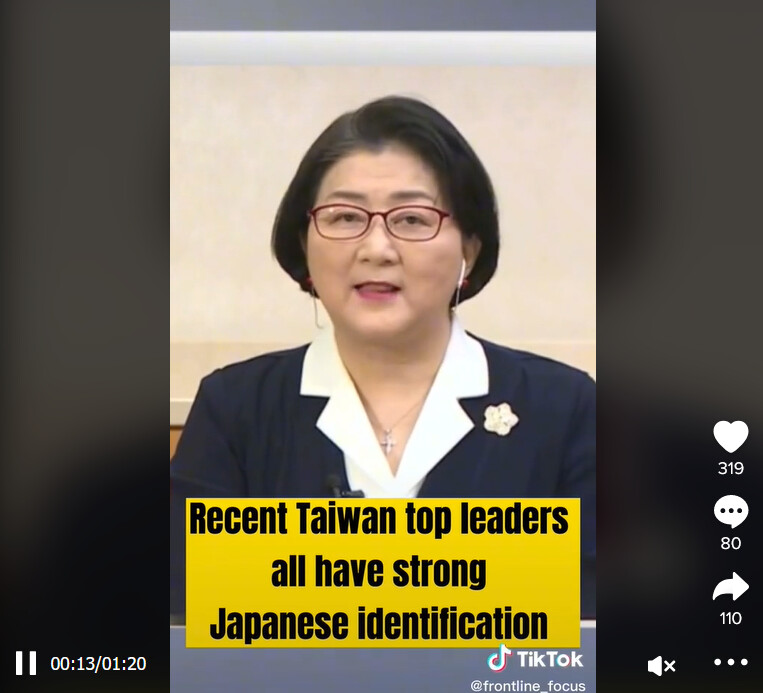
Abian is a rural Tainan Minnan guy who climbed up the ladder, yapping energetically (or annoyingly, depending on your views) all the way. Education all done in Taiwan.
Tsai is by inclination a reserved technocrat, obviously beloved by LDH, mixed Hakka and Paiwan background from Pingtung’s colonial contact zone, with further studies at Cornell (LDH’s alma mater) and LSE.
From this complex mix, you’d have to be pretty ideologically set to label them as “Japanese identified.” The last of those guys was LDH.
Both are Hô-lō-kheh, Holonized Hakka people. There is no Hakka speaking people in Sanzhi by the time LTH was growing up. Same with the Guantian community A-bian came from. I also came from a claimed Hô-lō-kheh family, claiming to be from exactly the same town that LTH’s family supposedly came from.
This recent video discusses why some Taiwanese may not identify as Chinese. The speakers talk about changes in education around the time CSB became president where the history of Mainland China began being taught as distinct from Taiwan’s history.
I thought about this topic on Forumosa when I saw a comment below this video that also repeated the claim that LTH and CSB have Japanese heritage (this isn’t true)